







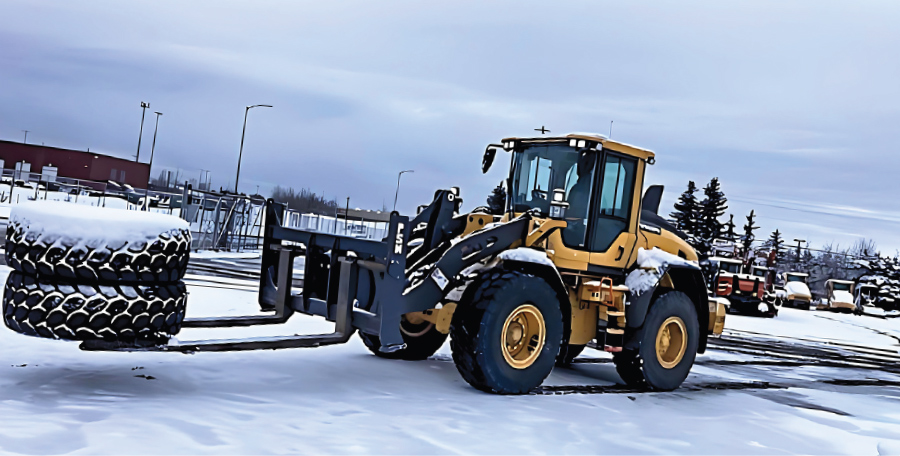
Learn more about what powerful, fuel efficient Volvo haulers can do for your operation.

907.563.3822
Fairbanks
907.931.8808
Juneau
907.802.4242
Ketchikan
907.247.2228

Sales Rep.
Anchorage Branch

Sales Rep.
Anchorage Branch
In Alaska, The best sales and products support lineup.
In your corner, The winning team.

About The Cover
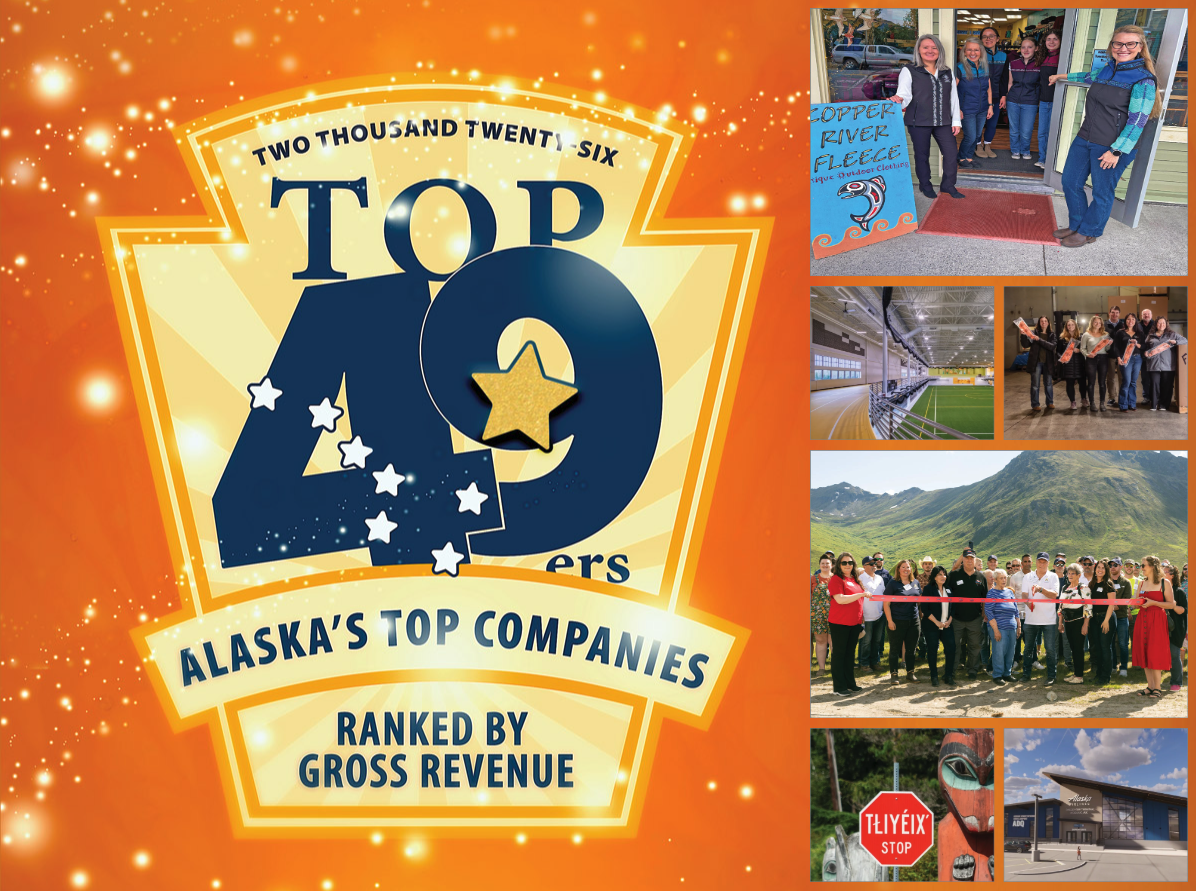
Lots of companies make money, thousands of them in Alaska. But the Top 49ers are an incomparable blend of hometown, Alaska-grown spice and making-the-money seasoning.
It’s not just that they started here; it’s not just that they do good work; it’s not just that they build Alaska communities; it’s not just that they draw Outside money in; it’s not just that they create Alaska jobs—it’s the fusion of all of these elements and more that sets the Top 49ers apart. It’s the special sauce that they bring to every job that’s landed them in the ranks.
ALASKA
together


-
Editorial
Tasha Anderson, Managing Editor
Scott Rhode, Senior Editor
Rindi White, Associate Editor
Emily Olsen, Editorial Assistant -
PRODUCTION
Monica Sterchi-Lowman, Art Director
Fulvia Caldei Lowe, Production Manager
Patricia Morales, Visual Content Designer -
BUSINESS
Billie Martin, President
Jason Martin, VP & General Manager
James Barnhill, Accounting Manager -
Sales
Charles Bell, VP Sales & Marketing
907-257-2909 | cbell@akbizmag.comWeston Giliam, Account Manager
907-257-2911 | weston@akbizmag.comJoshua Wilks, Account Manager
907-257-2917 | jwilks@akbizmag.comTiffany Whited, Marketing & Sales Specialist
907-257-2910 | tiffany@akbizmag.com -
Contact
akbizmag.com | 907-276-4373
Press releases: press@akbizmag.com
Billing: accounts@akbizmag.com
Subscriptions: circulation@akbizmag.com
From the Editor
A few years ago, Costco brought in a version of the clusters that wasn’t the Kirkland brand. I don’t remember what brand it was, but it was the only option and had the same name, so I grabbed one. I got home, manhandled the Costco haul into the house, divided up the food into the fridge, the freezer, and the pantry, and sat down to eat one of my favorite treats.


eopleAK solves the “people” problems behind open positions, retention concerns, and operational pain points that can hinder growth and efficiency. “We’re not an academic consultancy; we’re boutique problem solvers with industry-specific experience,” says President and CEO Paula Bradison.
From its Anchorage hub, PeopleAK’s recent work spans a nationwide executive search, year-round shareholder training, a nonprofit leadership succession plan, and labor-market research for employers entering the Alaska market. “We allow clients to address specific pain points with help from multiple subject-matter experts, often providing broader expertise at a lower cost than hiring one full-time senior employee,” Bradison says.

n a short time, AI has gone from creating freaky-fingered phony photos to a serious business tool. With that rapid change has come equal parts hype, critique, and alarm. To help small businesses leverage AI’s potential while avoiding the perils of security breaches and “slop,” Alaskan experts have been staying abreast of the march of progress to help businesses stay informed.
“Artificial intelligence is a game changer for a lot of small businesses in Alaska,” says Carlos Machuca, director of the AI resource program at the Alaska Small Business Development Center (SBDC).
While Machuca has been leading nonprofit consultations, the private sector is keeping apace with technology too. “We ourselves are small and growing. We’ve found it to be indispensable,” says Kyle Easterly, co-founder and CEO of the “AI deployment service” Delve Group in Anchorage.

nchorage-based Delve Group builds custom AI-powered software for companies that have reached the limits of generic tools or still rely on tedious, time-consuming manual processes. Co-founded by spouses Kyle and Blythe Easterly, Delve Group turns advanced AI capabilities into operational reality. Its cutting-edge AI solutions include AI assistants and conversational tools; data intelligence and reporting; operations and compliance management; planning and decision support; custom workflow applications; and document intelligence.
In the past, custom software often required major budgets, long timelines, and a narrow business case. Now Alaska businesses across industries can leverage solutions that previously seemed out of reach. “We build software that otherwise wouldn’t have been built before AI development techniques became feasible,” says Kyle.
xtra, extra! Newspaper goes to press! That’s the story: a local paper is putting ink on newsprint, for a change. The Anchorage Press, an alternative weekly, has been a web-only shadow of its former self since 2022, but under new ownership, the newspaper is coming back.
“Every single person I talked to mentioned how the Anchorage Press used to be where they got their information around what was happening in town, and it has created a huge gap that folks have tried to step into,” says Veri di Suvero, former executive director of the Alaska Public Interest Research Group. Since departing the consumer advocacy nonprofit last year, di Suvero is entering the journalism business, acquiring the Anchorage Press alongside veteran reporter Nathaniel Herz.
The revival of the Anchorage Press, unfortunately, coincides with the demise of its sister paper, also formerly owned by Arizona-based Wick Communications. The Mat-Su Valley Frontiersman printed its final edition on May 29, and then its archives and trademark changed hands to Amy Bushatz, founder and executive editor of the Mat-Su Sentinel.
entanyl and methamphetamine are dangerous drugs, even for people who never touch the stuff. A synthetic form of morphine, fentanyl is extremely potent, to the extent that casual contact with trace amounts can cause a medical crisis. It’s mostly “cooked” in laboratories in Mexico, according to the US Drug Enforcement Administration, whereas meth could be and has been made in a variety of places, including Alaska.
As use of those drugs has grown in the past few years, it’s increased contamination in homes, apartments, and vehicles. That has contributed to growing demand for the small number of Alaska businesses that provide testing and remediation for drug contamination.
Griffin Forster, the Association of Alaska Housing Authorities’ executive director, says the issue shapes his organization’s work. ‶It’s enough of a problem that we… have a regular training on meth remediation and contamination—generally once a year,ʺ he says. ‶It is a problem that a lot of folks in the housing management space contend with.”
“Testing numbers keep increasing every year,” says Patrick Hartshorn, owner and senior environmental consultant at Advance Look Building Inspections and Environmental Testing. Since 2016, the farthest back he could get data from the lab he uses, Hartshorn has tested 123 buildings and 47 vehicles. As of mid-July, he’d already tested 16 structures and 9 cars in 2026. If that pace continues, he estimates he’ll test about 30 buildings and 18 cars this year—double and triple his average workload.
Native University
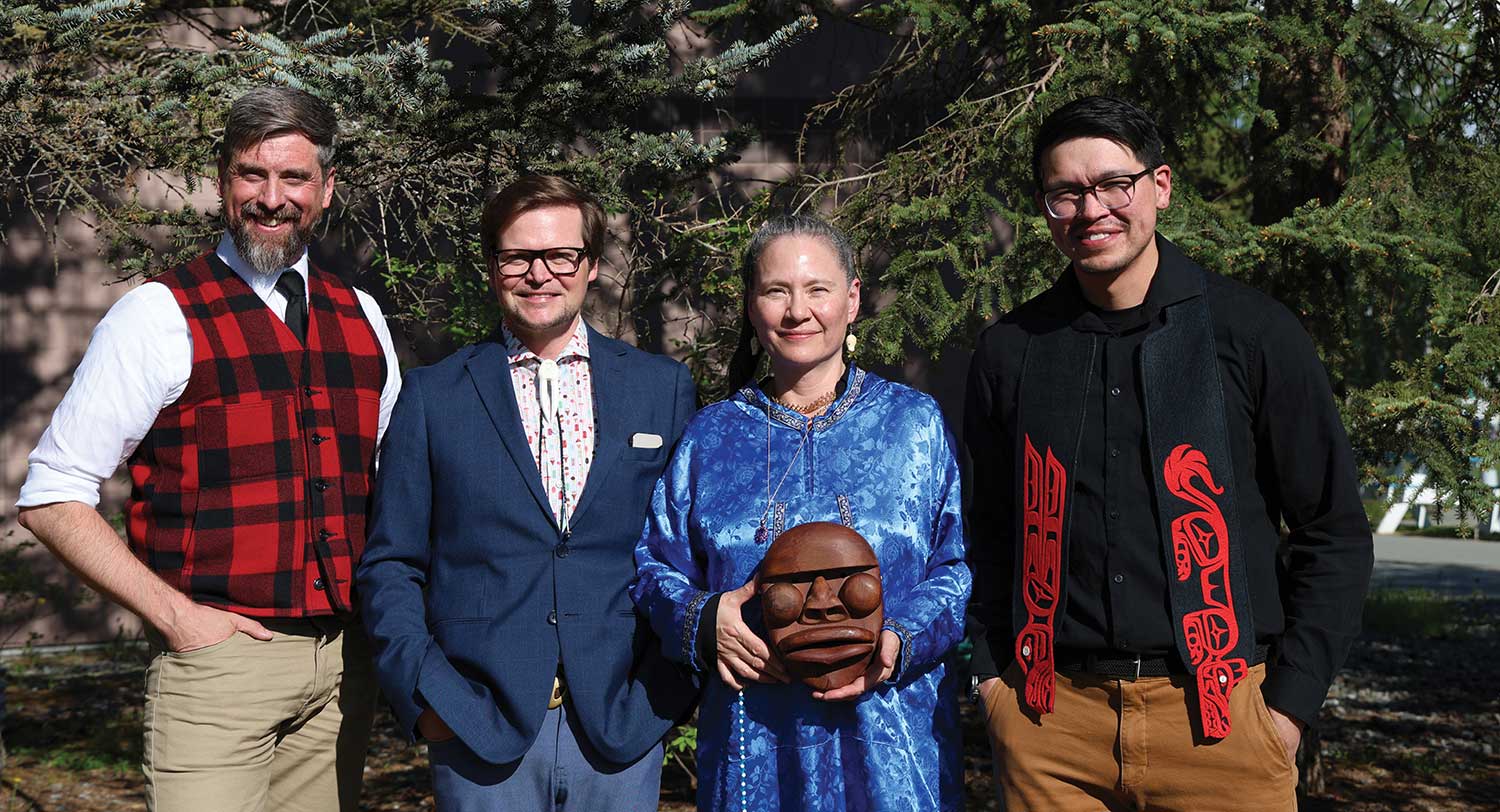
or Alaska Pacific University (APU), being called an Alaska Native university is not a marketing label. It is the organizing principle behind a governance overhaul that is reshaping how the small Anchorage school defines itself, who has a seat at its table, and where its next generation of students will come from.
The founder of Alaska Methodist University, as it was originally called in 1957, was Unangax̂ from the village of Unga in the Aleutian Islands. Peter Gordon Gould envisioned a high-quality university, accessible to all, that would cultivate Indigenous leadership rooted in Alaska. That founding vision resurfaced in 2016, when APU became tribally governed through a partnership with the Alaska Native Tribal Health Consortium. It deepened further in 2017, when the university restructured and renewed its focus on Alaska Native students.
nchorage Memorial Park Cemetery, Saint Patrick’s Catholic Church Columbarium, Fort Richardson National Cemetery, and Angelus Memorial Park: the final resting places for residents of Alaska’s largest city are filling up. Roughly 14,000 people are buried at the city-owned Anchorage Memorial Park Cemetery, which is almost out of space for its traditional burial plots. While the city races to alleviate an above-ground housing shortage, the dearly departed are also in need of alternative abodes for the hereafter.
“Most of the families we serve are looking at what we call simple cremation, immediate cremation. They’re going to do services on their own, celebrations of life on their own. But we have the ability to do viewings and complete funeral services, followed by cremation,” he says.
Investments

laska businesses go above and beyond to make a tangible impact through community support. To strengthen the communities they serve, they contribute via major donations, employee-driven volunteerism, or long-term partnerships.
Alaska has a strong culture of charitable giving and community service, a tradition that’s reflected in both formal and informal volunteerism. For more than a decade, the state has consistently ranked fifth in the nation in volunteerism, according to Laurie Wolf, president and CEO of The Foraker Group, a statewide nonprofit support organization. “I think that really speaks to the generosity of Alaskans—and that’s just the formal volunteerism we have captured,” she says. “When we show up as volunteers, which is a form of giving and community investment, it has a huge impact.”
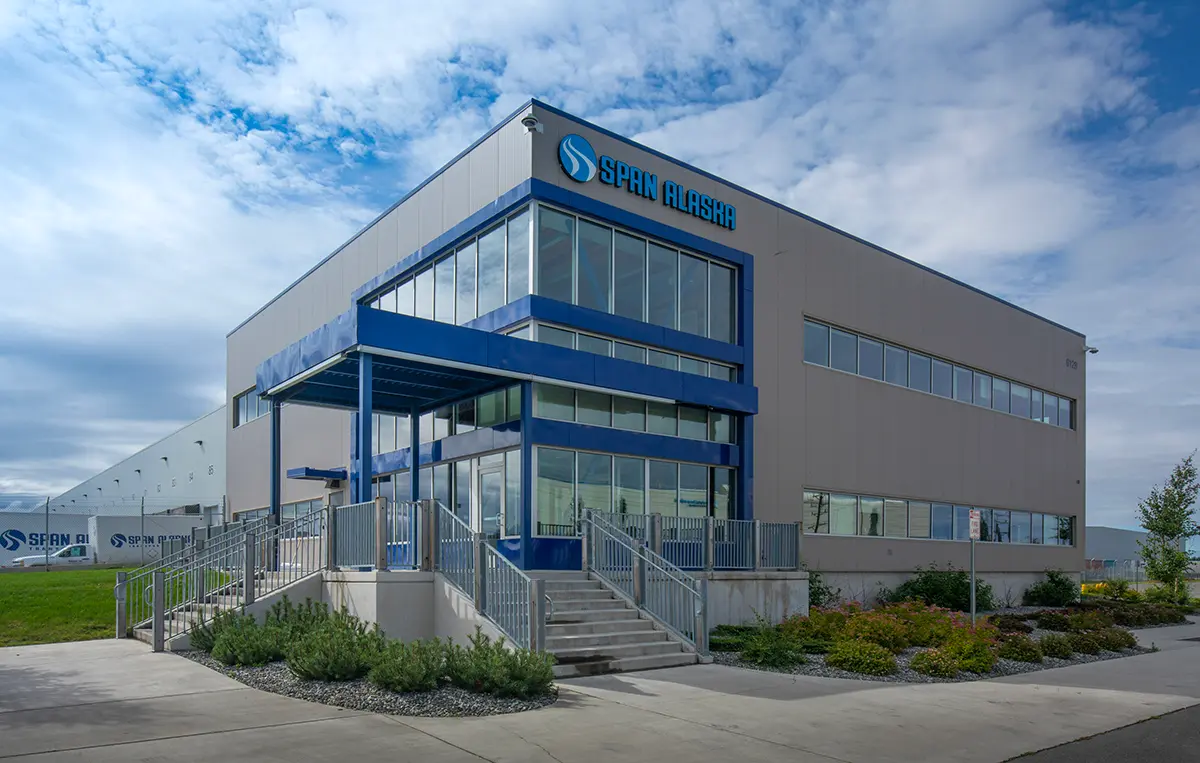
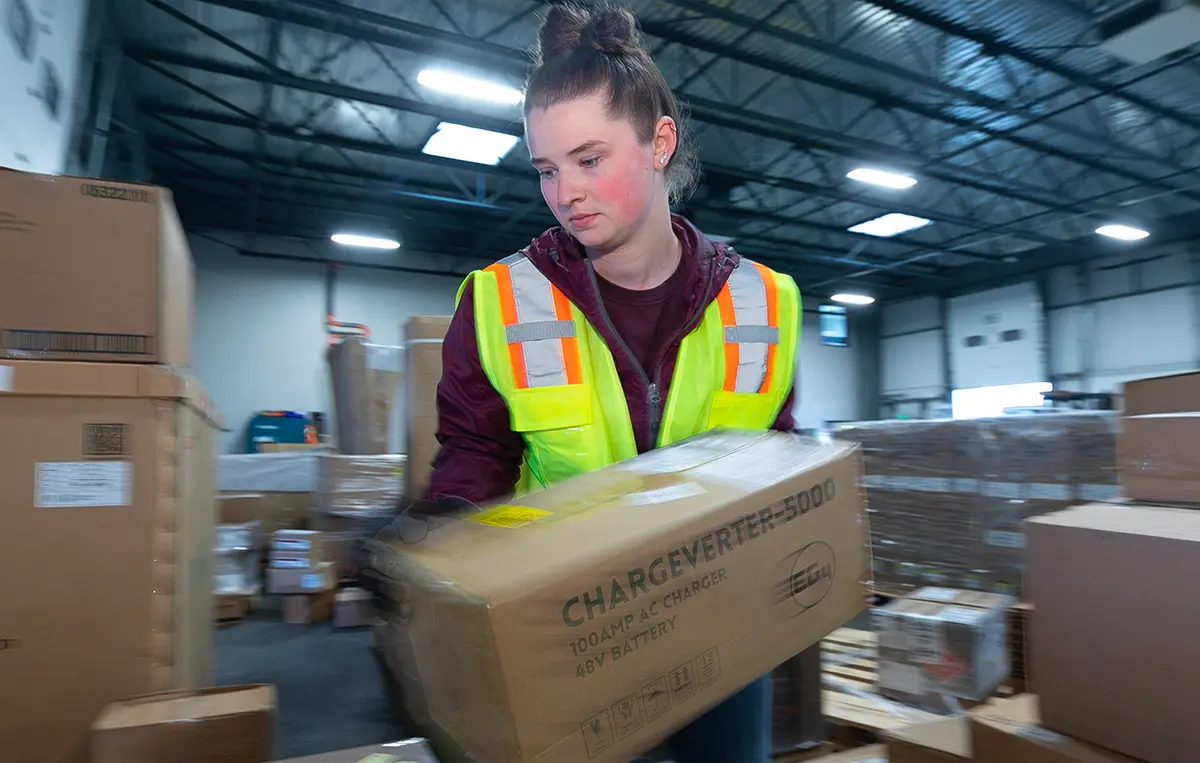



At our West Coast Consolidation Center, we load your products into dedicated containers that transit directly to one of six service centers or air cargo facility for final-mile delivery. This eliminates extra rehandling and costly delays.
- Year-round weekly ocean transit in all conditions
- LTL, FTL, Chill/Freeze, and KFF options
- Specialized equipment for project, oversized, and hazardous material loads
- Delivery throughout Alaska, from metro Anchorage to North Slope to remote villages in the Bush
- Customized solutions for commercial and industrial sectors, including oil and gas, construction, food & beverage, and retail/tourism


he Top 49ers are Alaska’s largest companies, ranked by gross revenue, that were founded in Alaska, are headquartered here, and are not owned by Outside companies. As the name indicates, the ranks include forty-nine companies.
Once that process is complete, the companies are ranked; some are invited to participate in further editorial coverage for the special section; and all are invited to the annual Alaska Business Top 49ers luncheon to celebrate.
The results for 2026 are in, and here are a few highlights:



Performance.
Proud Top 49er.












very company included in this year’s group of Top 49ers excels in their respective sectors. To find a spot on the list, they’d have to. This year, for the first time, eight of those companies make up an elite group, having generated more than $1 billion in gross annual revenue. Arctic Slope Regional Corporation (ASRC), Bristol Bay Native Corporation (BBNC), NANA Regional Corporation, Chenega Corporation, Lynden, Calista Corporation, Bering Straits Native Corporation (BSNC), and Ukpeaġvik Iñupiat Corporation (UIC) all were in the ten-digit club in 2025.
Some companies surpassed $1 billion years ago and, for the most part, never looked back; for others, the milestone is brand new. And while every company in this elite class has its own priorities and business lines, what each has in common is a focus on disciplined expansion, strategic investments, and diversification in the pursuit of sustainable growth.

Cold Bay Airport (PACD) delivers a powerful combination of infrastructure, location, and operational reliability—now featuring the Frosty Fuels Fixed-Base Operator (FBO).


aking the Top 49ers list is a sure sign of success: members are part of an elite class of Alaska businesses, all of which were founded within the state and continue to operate their headquarters here. This year’s list includes three new companies—Contango Silver & Gold, Denali Universal Services, and Shee Atiká, Inc.—that arrive on the list by different routes: not just by earning enough revenue but by becoming more Alaskan.


weet or savory, hot or cold, it’s rare to find a dish that isn’t improved with a special sauce. Alaska’s prominent businesses have all refined their own special sauces: culture developed over decades, tried and tested processes and procedures, bespoke approaches to leadership or recruitment, and individual goals and measures of success.
Many of the 2026 Top 49ers shared with Alaska Business a few of the ingredients found in their special sauces that have led to their accomplishments. Their contributions have been edited for length and house style.


oughly 76 million Americans were born between 1946 and 1964, ushering in an unprecedented population wave which became known as the Baby Boom. As the cohort ages, the United States is undergoing one of the most significant economic transitions in its history: the retirement of one fifth of the country’s population.
Aptly called the “silver tsunami,” this demographic shift directly intersects with business ownership. Baby Boomers own an estimated 2.34 million small businesses in the United States, employing more than 25 million people. Even more striking, nearly half of all small business owners are over 55 years old, placing a substantial portion of the nation’s privately held companies on the brink of transition.

n July 2, 2025, New Jersey resident Shane Svorec and her husband Richard attended the New York Stock Exchange closing bell ceremony that marked the debut of The Frontier Economic Fund (AKAF). The symbolic ceremony, led by the fund’s developers and leaders from Alaska, introduced the first state-based exchange-traded fund (ETF).
As the ticker symbol implies, the fund is a basket of Alaska-related investments. Anyone who owns a share of AKAF will prosper along with the hundred or so companies that do business in, and earn profits in, Alaska.
Svorec, an AKAF investor, remembers feeling excited about the opportunity to invest in a state that has come to mean so much to her family. “It felt victorious,” she says. “You can invest in funds, and you can move funds. But to be part of investing in something that has never been seen before felt like an initiative not just for the state but for the people.”

Brilliantly boring.

international SERVICES | institutional ASSET MANAGEMENT
hen one door closed for Megan Militello, another opened.
After seeing a need for manufacturers in the state to connect and share resources, Militello co-founded the Alaska Manufacturing Association (AKMA) in 2025. The overall mission of AKMA is to link manufacturers across the state to enhance freight, workforce, infrastructure, supply chains, and market access.
“I don’t know how much people realize that manufacturing is everything. Everything is made; even agriculture, is manufacturing, right? We are producing something at scale to serve others,” Militello says. “VanderWeele Farm makes carrots, right? They have a whole system. They have equipment that they need to buy. They have bags that they need to buy. They have the different sales channels that they need to get into to survive as a business… We want to try to have the public support those businesses that are actually making things here in Alaska—because how do we recirculate our dollars within the state instead of just giving them to everybody out of the state?”



he story of moving equipment and supplies is the story of a complex network—where nearly every handoff between barge, truck, and sometimes even sled involves a different company.
There’s competition in Alaska’s construction market, but not when it comes to logistics, according to Jeff Miller of Cruz Construction.
He says, “Your best friends are your competitors. Alaska is a cool place that way because it is so hard and harsh that you need those allies, or else you’ll be left up the creek without a paddle.”
The logistics of getting materials and machinery where they need to go in Alaska starts Outside. Small items, like tools or ladders, may come up via UPS. But pallets of construction material and heavy machinery arrive from the Lower 48 by barge, typically from Seattle or Tacoma, Washington, where they’ve been trucked from manufacturers across the country.






- Mass Excavation
- Underground Utilities
- Paving
- Drill & Shoot
- Rock Scaling
- Aggregates
- Asphalt
- Ready-Mix Concrete
- Emulsions
- Recycled Materials – RAP
- PMA
- Cement
- Highways
- Roads
- Bridges
- Airports
- Ports
- Mining
- Highways
- Roads
- Bridges
- Airports
- Ports
- Mining
- Mass Excavation
- Underground Utilities
- Paving
- Drill & Shoot
- Rock Scaling
- Aggregates
- Asphalt
- Ready-Mix Concrete
- Emulsions
- Recycled Materials – RAP
- PMA
- Cement
- Highways
- Roads
- Bridges
- Airports
- Ports
- Mining
- Highways
- Roads
- Bridges
- Airports
- Ports
- Mining











in Steel
what they’re used for

he August special sessions in Juneau this year involved much talk of volume and contracts, costs and taxes. It’s too soon to say if Alaska LNG will ever break ground. But now is as good a time as any to look at how pipelines get built.
o matter where visitors to the 49th State choose to go, there are always unique activities available to those with an open mind and a sense of adventure.
“It’s probably the most unique Alaska experience you’ll ever get,” says Wesley Bowhay of Glacier Gardens, the attraction in Juneau that he manages. “You can see glaciers and whales in most other ports, but you won’t see upside-down trees like this anywhere else.”
Established in 1998 as an add-on to a plant nursery, the Rainforest Adventure Tour now attracts between 50,000 and 100,000 people a year.
Bowhay recalls the origins of his father’s business. “While working at the nursery, our owner, Steve Bowhay, accidently smashed a tree with a rental excavator and decided to plant it upside down,” he says. “That gave him the crazy idea to create an awesome botanical garden, which took four years to build.”
Visitors first walk through the lower garden area, which includes the upside-down trees (now sourced from windblown trees downed on the property) that Steve Bowhay, now 68, handplants each year. The exposed roots are ornamented with between 50 to 150 different flowering plants.
Come
together



Events | Concerts | Conferences | Conventions | Banquets | Meetings | Trade Shows | Weddings | In-house Catering | Equipment Technology








ver had a boss that hovered? Supervised by always being there? Insisted on rewriting submitted reports, sentence-by-sentence and page-by-page? Then congratulations, you’ve experienced micromanagement. This leadership trap may appear as just overly detailed oversight, but it more significantly signals a lack of trust in employees and makes innovating, scaling, and responding to crisis extremely challenging.
In My Way or the Highway: The Micromanagement Survival Guide, Harry E. Chambers indicates that excessive meddling is more common than not, with nearly eight out of ten employees experiencing micromanagement. Researchers Shona Ryan and Christine Rose perhaps described it best as a leader’s excessive control, relentless scrutiny, and constant interventions, severely undermining individual autonomy by dictating every minute detail of daily work. Chambers found that a staggering 91 percent of micromanagers are completely unaware of their behavior and its effect on turnover.




e’re excited to share excerpts (edited for style and length) from The Fishbowl, a new Alaska Business video series in which we speak with Alaska leaders about the economy: what’s happening and what we should do.
In this first installment, we were privileged to connect with Jon Bittner, president and CEO of the Anchorage Economic Development Corporation (AEDC). The 501(c)(6) nonprofit is where he launched his career in economic development and gained management experience. Bittner left for about nine years to lead the Alaska Small Business Development center, and when AEDC was looking for a CEO—preferably an Anchorage resident with history in management, economic development, and growing programs—Bittner was happy to answer the call, returning to AEDC in March.

Bonnie Paskvan, Michael Mills, Loni Hinton, Alissa Smith,
Michael Grisham, Hannah Benson, and Danika Watson.


 Alaska Communications hired a new top executive. The Anchorage-based telecom selected Courtland Madock as CEO and president. The former Anchorage telephone utility, now an affiliate of Massachusetts-based ATN International, brings Madock to Alaska from Chicago, where she was chief commercial officer for WOW!, a multistate internet provider. She holds a bachelor’s degree in economics from the University of Iowa and an MBA from Northwestern University’s Kellogg School of Management. Madock succeeds Paul Fenaroli, who is stepping down to focus on family.
 A former village corporation president has worked his way back up to top leadership. The Tatitlek Corporation (TTC) promoted Executive Vice President Dick Hobbs to become its new President. Prior to joining TTC, Hobbs was President and CEO of Afognak Native Corporation and its wholly owned subsidiary Alutiiq, LLC from 2006 to 2014. He joined the TTC Executive Management Team in 2018. Hobbs is a graduate of the US Naval Academy and served eight years in the US Navy. In 1996, he joined Chugach Alaska Corporation, and he started working for Afognak in 2000.
Alaska Trends
ill next year’s Top 49ers list fill the top ten slots with billion-dollar companies? The trend is promising. Amy Newman’s article “Billions with a ‘B’” reports that eight companies achieved ten-figure revenues in 2025, up from six the year before. Even adjusting for inflation, eight is the most ever. Adding two more in 2027 is conceivable: Chugach Alaska is within striking distance, and Koniag has been close before.
Three companies are new to this year’s Top 49ers, and eleven have risen in the ranks since 2025. The biggest jump in rank is Cornerstone General Contractors, up thirteen places to #35, beating its previous peak of #38 on the 2014 list. Cornerstone reports the biggest percentage increase in revenue since 2024, but the biggest boost in absolute dollars belongs to NANA Regional Corporation, up by $329 million, or almost an entire Chugach Electric Association’s worth.
Whistler by Ann Patchett and Zingerman’s Guide to Giving Great Service by Ari Weinzweig.
Alaska Public Media… also different organizations for Alaska’s trails.
I snap into family mode, so the work shifts to a different kind of work.
Japan.
I would choose an owl and have it relay messages to all my friends.

Whistler by Ann Patchett and Zingerman’s Guide to Giving Great Service by Ari Weinzweig.
What charity or cause are you passionate about?
Alaska Public Media… also different organizations for Alaska’s trails.
What’s the first thing you do when you get home after a long day at work?
I snap into family mode, so the work shifts to a different kind of work.
What vacation spot is on your bucket list?
Japan.
If you could domesticate a wild animal, what animal would it be?
I would choose an owl and have it relay messages to all my friends.
Off the Cuff
old treats for Alaskans seemed nutty, eleven years ago. Elissa Brown recalls, “It felt like the punchline to a joke, to our friends from Outside.” Since then, her Wild Scoops kitchen has become a keystone in Anchorage’s craft dessert scene. “We’ve helped open the door to other ice cream businesses,” says Brown.
Building community was her goal, after experimenting with recipes as a middle school science teacher and studying experiential learning during a research fellowship in Norway. Brown says, “Ice cream is the perfect vehicle for showcasing different ingredients that also tell the story of the place where you are.”

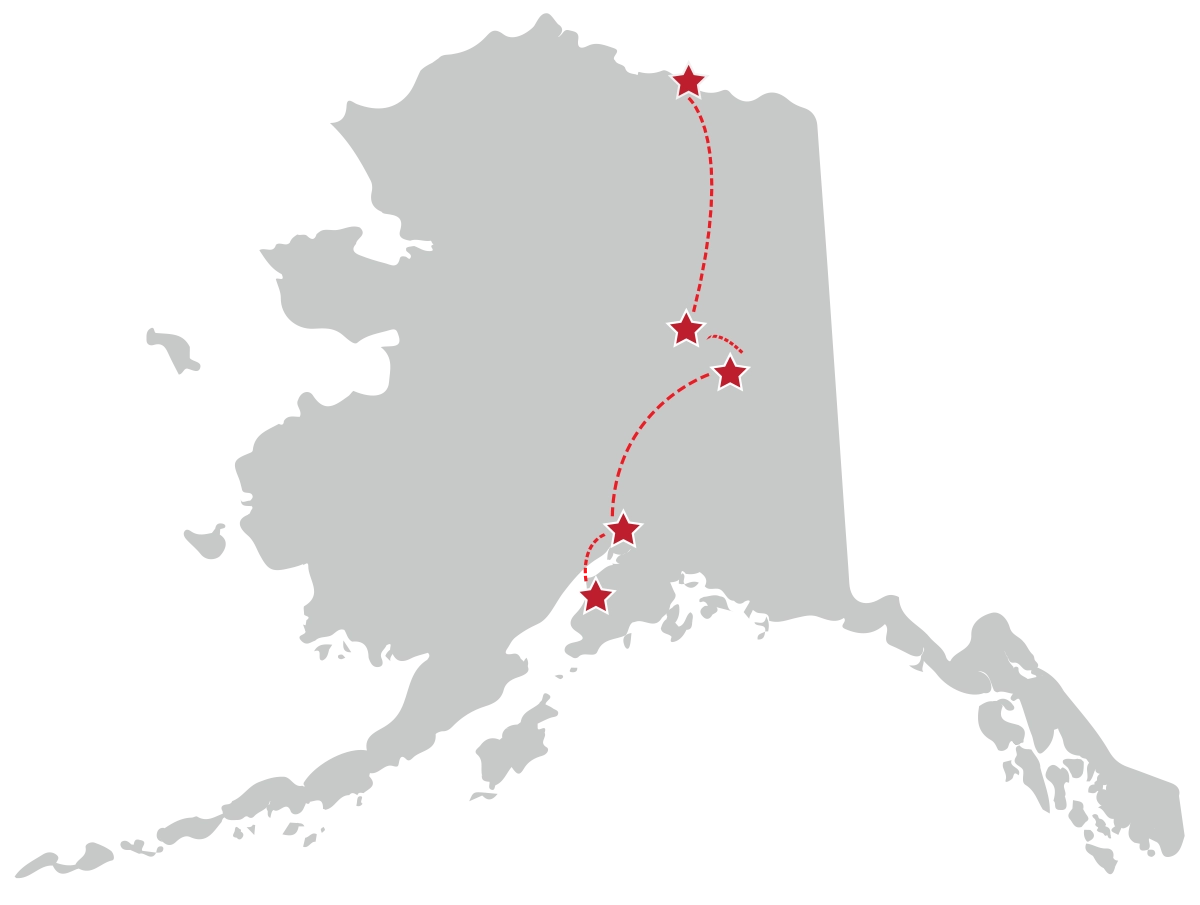
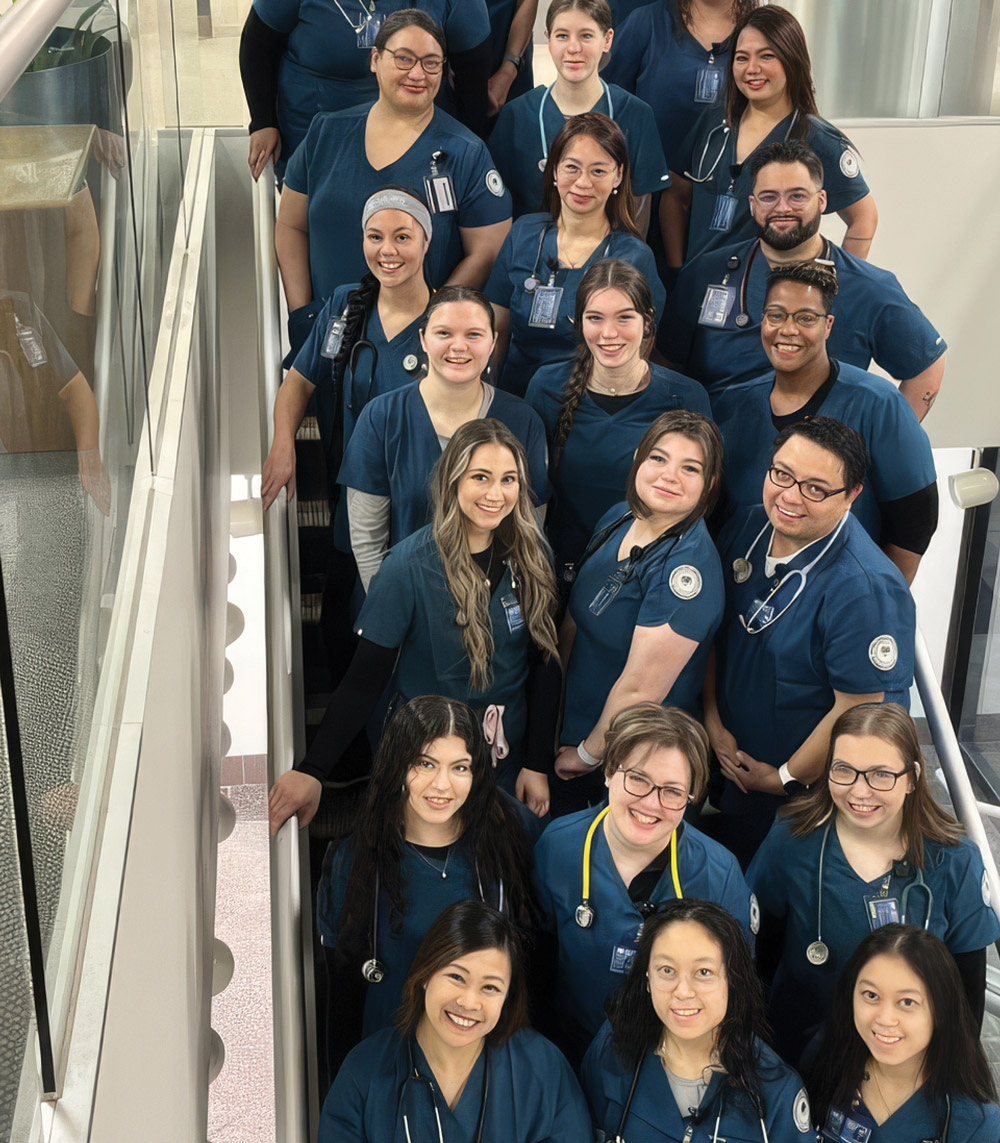
From mechanics and drivers, to customer service and support teams, we are proud of the people who do this hard work every day.