

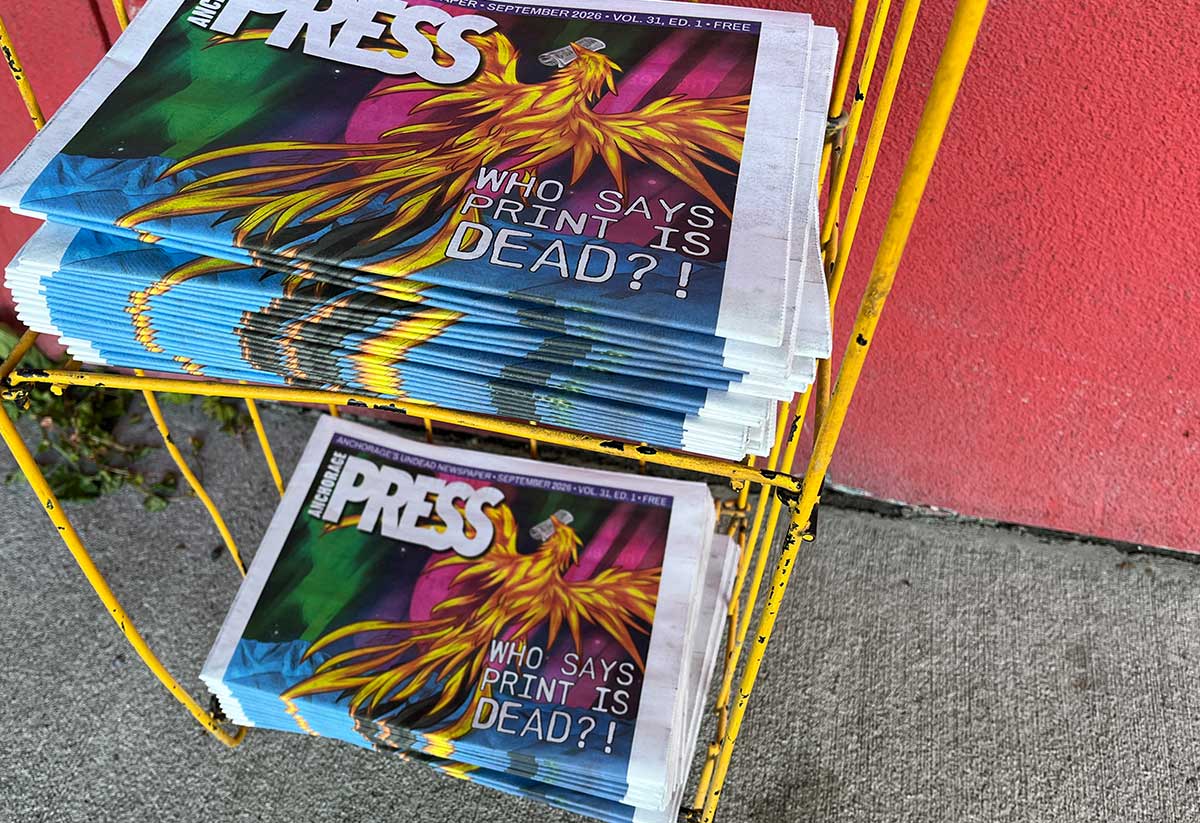
xtra, extra! Newspaper goes to press! That’s the story: a local paper is putting ink on newsprint, for a change. The Anchorage Press, an alternative weekly, has been a web-only shadow of its former self since 2022, but under new ownership, the newspaper is coming back.
“Every single person I talked to mentioned how the Anchorage Press used to be where they got their information around what was happening in town, and it has created a huge gap that folks have tried to step into,” says Veri di Suvero, former executive director of the Alaska Public Interest Research Group. Since departing the consumer advocacy nonprofit last year, di Suvero is entering the journalism business, acquiring the Anchorage Press alongside veteran reporter Nathaniel Herz.
The revival of the Anchorage Press, unfortunately, coincides with the demise of its sister paper, also formerly owned by Arizona-based Wick Communications. The Mat-Su Valley Frontiersman printed its final edition on May 29, and then its archives and trademark changed hands to Amy Bushatz, founder and executive editor of the Mat-Su Sentinel.
Trends had claimed The Cordova Times a month earlier, ending its print run and switching to online only. The Skagway News downsized from ink to pixels in 2022. Even the Anchorage Daily News is daily only on its website, printing twice weekly since 2024. And this year marks the end of Alaska Magazine; Georgia-based Morris Communications announced this summer that December’s issue would be its last.
In this environment, the Anchorage Press rising from web-only hiatus is what editors call a man-bites-dog story.
The internet, obviously. “Craigslist pretty much killed off classified ads in newspapers, which were a source of revenue. And Facebook is free for businesses to post their daily specials or whatever else they want,” notes Larry Persily, publisher of the Wrangell Sentinel. “Long ago, advertisers would cover two-thirds of the cost of newspapers, readers a third.”
In addition to choking off revenue from legacy media, the internet changed news consumption habits. Social media accelerated that trend since 2006, when Facebook became an open channel for anyone with an email address, siphoning audiences away from daily papers and local TV news.
Industry pressures drive consolidation, which brings struggles of its own. Such was the case of the Frontiersman, according to Herz. He speculates, “I think Wick bought the property right before the bottom fell out of the print media business, and then it was not a priority for them as a place for an investment.” Alaska properties were at the periphery of the family-owned media chain’s attention.
Absentee owners led Mark Sabbatini to create the Juneau Independent last year after he departed as managing editor of the Juneau Empire. The capital city’s hometown newspaper, published since 1912, was acquired by Alabama-based Carpenter Media Group in 2024.
“Carpenter was looking at making both cost cuts and editorial policy changes I couldn’t agree with. There was not a high priority necessarily on having local people cover local news,” Sabbatini recalls. “A quote from one of the regional directors that I’ll always cite is, ‘We think people in Alberta and people in Alaska are pretty much interested in the same thing.’ In other words, if you run an interesting story from a small community in Canada, people in Juneau will care as much about that as they do about local news, which I thought was not good.”
Much of the Juneau Empire staff left with Sabbatini to start the Juneau Independent as a free, online newspaper.
Herz, who came to Alaska in 2013 and wrote for the Anchorage Daily News for five years, started the Northern Journal as a newsletter and website to concentrate on environment and government topics that interest him. “This felt like a pretty natural step to sort of create the thing that I really wanted to see and be in the state,” he says.
Now that thing is migrating back to print. Upon the relaunch of the Anchorage Press in September, the homepage for the Northern Journal was redirected to anchoragepress.com, described as the newspaper “acquiring” Herz’s website and merging his reporting into the alt-weekly.
Herz appreciates pursuing projects without four layers of management approval. He does lament the lack of workplace health insurance. And libel insurance. And a recognizable brand name. But the autonomy and flexibility of his online presence has been fun and fulfilling. “I’m not going to say that it’s better; it has worked for me at this phase of life,” says Herz. “I don’t know that it is a setup that would work for everyone.”
Sabbatini, too, is comfortable where he landed. “We have plenty of readers now. Our daily readership is far higher than the Juneau Empire was getting when I was there,” he says, adding: “Some of that is because we don’t have a paywall and they do.”
Ink and paper would be his preference, Sabbatini confesses, but the Juneau Independent would need two things for that to happen. First, money. And second, the Juneau Empire would need to go away completely; with about 1,500 subscribers in town, Sabbatini doesn’t think Juneau could support two newspapers.
The former executive editor of Military.com, Bushatz describes herself as having a “startup mindset.” That said, she admits she’s making it up as she goes along. “I am saying every day, ‘I’m gonna figure it out.’ There’s a whole lot of stuff I don’t know, that I’m figuring out,” says Bushatz. “The nice thing about institutions is they have institutional knowledge; there’s experience and data and history and all that stuff to lean on.”
Now she owns a nearly eighty-year-old institution. “I did not start the Mat-Su Sentinel to compete with the Frontiersman; I started the Mat-Su Sentinel because there’s more than enough news to go around, because they were not covering things that I thought were important, but I could help with that,” Bushatz says.
Still, Bushatz says she made no bones about putting herself in a position to absorb the Frontiersman. That was her plan in 2022 while freelancing for the Anchorage Press as it faded away. “If I could set up a news organization to be in a position to catch them, should they ever be catchable, that would be a good thing for our community,” she says. The paper became catchable in early 2025, when Wick Communications announced it would sell. Bushatz contacted a broker and an out-of-state funder, but the owners took no action on her offer.
A tip last February revived Bushatz’s bid. Attending a lonely borough assembly meeting, she learned that the $100,000 the borough spent annually to print public notices would end when the newspaper shrank from two weekly editions to one. Bushatz sensed a scoop, not just as a reporter but as a buyer. “I had seen their prospectus, and that was a significant amount of their profit margin,” she recalls. By May, Wick Communications was ready to sell.
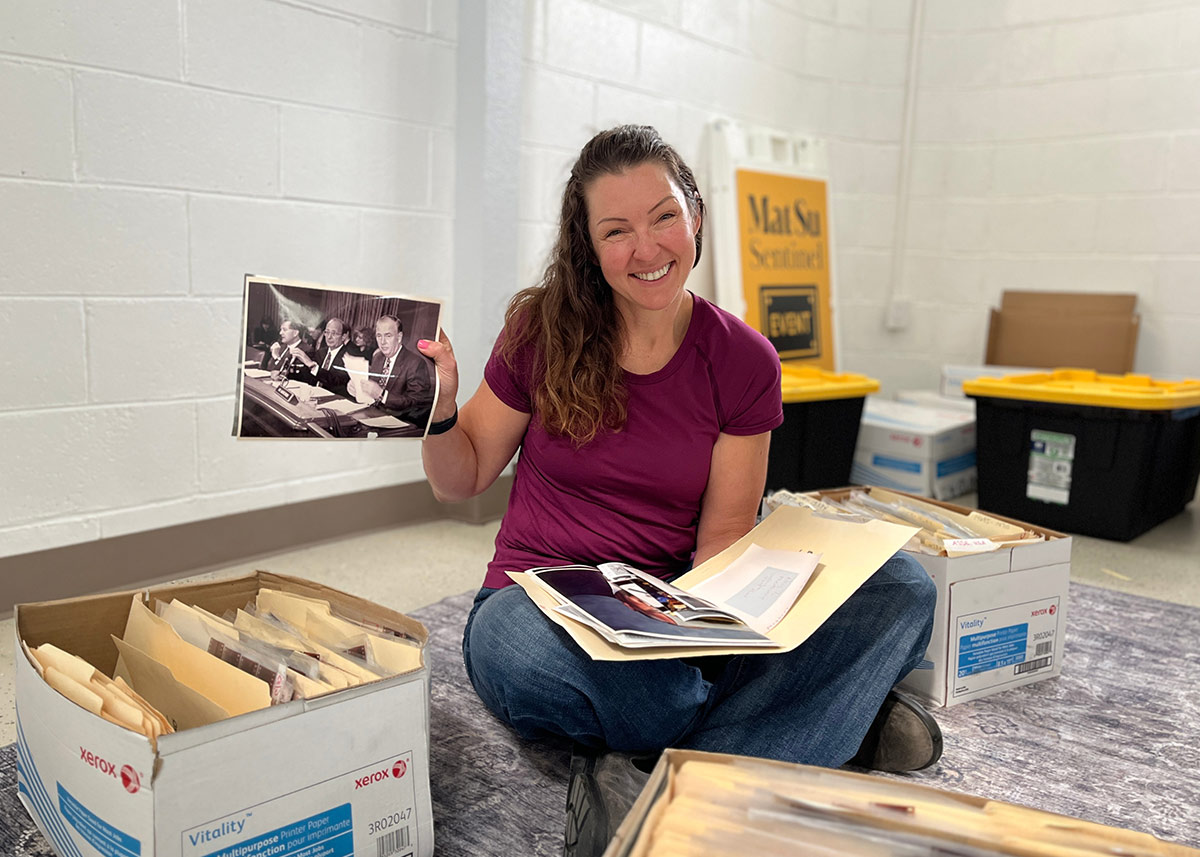
The transaction, for a price Bushatz would not disclose, did not include the printing facility on Palmer-Wasilla Highway, even though Wick Communications was eager to divest everything. Bushatz bought the intellectual property, valued mainly in terms of subscriber loyalty; thus, Mat-Su Valley Frontiersman branding is now on the Mat-Su Sentinel website. And she took custody of its archives: back issues, file photos, and website links, now presented without a paywall, in service of Bushatz’s nonprofit mission.
Alaska Business
Sabbatini established the Juneau Independent as a nonprofit. “The idea of doing this as a nonprofit was important to me. It wasn’t because I thought that was necessarily more sustainable, but it’s a mindset to me,” he says. “After working with the Empire and seeing what’s happened to other for-profit media, I want the overwhelming reality and perception to be that we are doing this strictly as a news organization, as a public service.”
Nonprofit is a tax status, not a business model, as Bushatz points out, but it does diversify the eggs in the proverbial revenue basket. “When that basket fails because the world changes, whether you’re a for-profit or nonprofit, we’re totally screwed,” she explains. “So right now we have revenue from small grants, small local donations, advertising, corporate sponsorships, events, and new (in the last couple of weeks because of the Frontiersman acquisition): obituaries and some public notices. And content syndication; we sell stories to Anchorage Daily News and Alaska Public Media.”
Although di Suvero’s background is in community organizing, not journalism, and they are setting up the Anchorage Press as a worker-governed cooperative and a social venture, it remains a for-profit business. Advertising and subscriptions underwrite the paper’s free distribution.
Still, Herz is taking hints from nonprofit fundraising, and a sponsorship deal with Out North, a 501(c)3 arts organization in Anchorage and operator of KONR noncommercial radio, is part of the revenue mix. “The modern print newspaper revenue stream looks like the old print newspaper revenue stream except with more stuff because there’s less of the traditional revenue coming through those streams,” he says.
Nonprofit status sweetens the deal for donors, who can deduct the charitable contribution from taxes, and that’s a selling point. Bushatz says, “The advantage that being a nonprofit gives you is in communicating, primarily. I can say to people, ‘Think about this as a public service. You support other nonprofits because you think they’re doing good in your community.’”
That message is repeated regularly during public broadcasting pledge drives. However, Persily cautions that fundraising isn’t sustainable everywhere. “Some of these really small towns, I’m not sure there’s enough nonprofit money in town to make it work,” Persily says.
As an example, the Wrangell Sentinel isn’t currently turning a profit as a weekly newspaper, but switching to donor support would be too much to ask. Persily says, “I’m not sure how much I could squeeze the town in donations when they’re also giving money to high school sports teams, senior center, hospice, church programs, and all the rest.”
Persily is now on his third stint owning the Wrangell Sentinel in fifty years, and he has bought and sold other papers; he famously gave away The Skagway News in 2020 for a token $20 payment. He’d do it again in Wrangell. “I’d give it away for a dollar. I’m going to be 75; I’m tired,” Persily says. “But you can’t give away a failing business. I guess you could, yeah, but I can’t imagine anyone being dumb enough to take a failing business.”
Putting the paper into the black will take some creativity. Persily says, “Much like several other newspapers in Alaska, we are all searching for answers. But as of now, the answers have eluded us, and several of us lose money.”
Alaska Business
The coalition also facilitates grants, such as a funding opportunity that became available in 2024: Press Forward Alaska, the first statewide chapter of an initiative backed by the MacArthur Foundation and the John S. and James L. Knight Foundation. Nonprofit and for-profit newsrooms can apply for money to strengthen coverage. The coalition was among the first recipients of a $100,000 grant.
The coalition also promotes collaboration, especially in Southeast, where resources are stretched thin. “There are newspapers in Skagway, Haines, Sitka, Petersburg, Wrangell, Ketchikan; Juneau has two,” Persily observes. “I don’t think Southeast can afford that many papers. I think we need to start looking at collaborating, consolidating. It’s triage.”
In that spirit, Wrangell’s public radio station KSTK teams up with Persily’s newspaper. “We were both sending the one reporter that we can’t afford to the same meeting. That’s crazy,” Persily says. “So we are going to share the cost of a reporter and share stories, so it hopefully will keep the town informed at a financial level that maybe we can afford.”
Persily is also the editor-mentor for an exchange program. Through a grant from the Atwood Foundation, a reporter from a rural newsroom covers the capitol in Juneau during the legislative session. Meanwhile, a student journalist replaces the correspondent at home, learning the basics of the profession. The goals are to improve the quality of reporting and the breadth of coverage statewide, as well as to train the next generation of journalists.
Collaboration is also key at the Alaska Beacon, a website that launched in 2022 to publish free-to-share coverage of state politics, supported by the nonprofit States Newsroom. The Northern Journal had a distribution deal with the Alaska Beacon.
Herz says, “What we’re really trying to do is just figure out what is the model that’s going to be successful and profitable (or at least sustainable) in Alaska in this modern-day media industry landscape.” He credits Anchorage Daily News owner Ryan Binkley and the Helen E. Snedden Foundation with fighting the good fight.
Now she is the custodian of the Frontiersman’s old copies, palletized and shrink wrapped until she can convey them to a library or museum for digitization. She says, “They have a certain odor, and there are a lot of them. As my 14-year-old would say, they are musty, crusty. And so I treasure them very much.”
Paper holds appeal for Wrangell Sentinel readers. Persily says, “They like having the printed paper. So, yeah, I could go online only, stop printing, and save a lot of money. But how much advertising and how many readers would I lose?” So far, the numbers haven’t convinced him.
Physical media entails certain infrastructure, as Herz and di Suvero are learning. To distribute the Anchorage Press at handout sites, the new owners need to scavenge its old wire racks. “They’ve gotten repurposed,” di Suvero says. “Now there’s a bunch of Anchorage Press racks that have been solidly serving other newspapers for years, so we can’t just walk in and reclaim them.”
Herz and di Suvero aim to stock about thirty-five sites. “In its heyday, the Press had over a hundred drop sites just around town,” di Suvero notes. “And then recently we found one wire rack at Wildman’s in Cooper Landing.”
When she bought the Frontiersman from Wick Communications, Bushatz accepted the Anchorage Press as part of the bargain because she knew she could hand it over to Herz and di Suvero. “They’re both very smart people, and they know their audience,” she says. “Anchorage Press belongs in Anchorage hands.”
Whether the revival will become an institution like its previous incarnation remains to be seen, as is true of the press, as a profession, generally. Sabbatini says, “Journalism can be a business, and it can definitely survive as a business, and there’s different schools of thought about what it needs to do to survive and be profitable.”