

he story of moving equipment and supplies is the story of a complex network—where nearly every handoff between barge, truck, and sometimes even sled involves a different company.
There’s competition in Alaska’s construction market, but not when it comes to logistics, according to Jeff Miller of Cruz Construction.
He says, “Your best friends are your competitors. Alaska is a cool place that way because it is so hard and harsh that you need those allies, or else you’ll be left up the creek without a paddle.”
The logistics of getting materials and machinery where they need to go in Alaska starts Outside. Small items, like tools or ladders, may come up via UPS. But pallets of construction material and heavy machinery arrive from the Lower 48 by barge, typically from Seattle or Tacoma, Washington, where they’ve been trucked from manufacturers across the country.
“We have a multitude of trucking companies within the Lower 48 that will go to the factories, pick up the equipment, get it to the port in Tacoma,” says Jerry Sadler, the company’s president. “From there, it’ll go either to TOTE for their roll-on, roll-off service, or maybe Span [Alaska, a subsidiary of Matson Logistics], or Alaska Marine Lines if we have customers in the Southeast.”
Once shipments arrive in Anchorage, Sadler adds, “From there, we’ll figure it out.”
With six locations on Alaska’s road system, AER can use its own truck and trailer for items going to the Interior or the North Slope. Delivery to other locations, though, may mean coordinating another barge, subcontracting with a trucking company, or driving a piece of equipment straight off a barge and onto a train car, to be hauled to its destination via railroad.
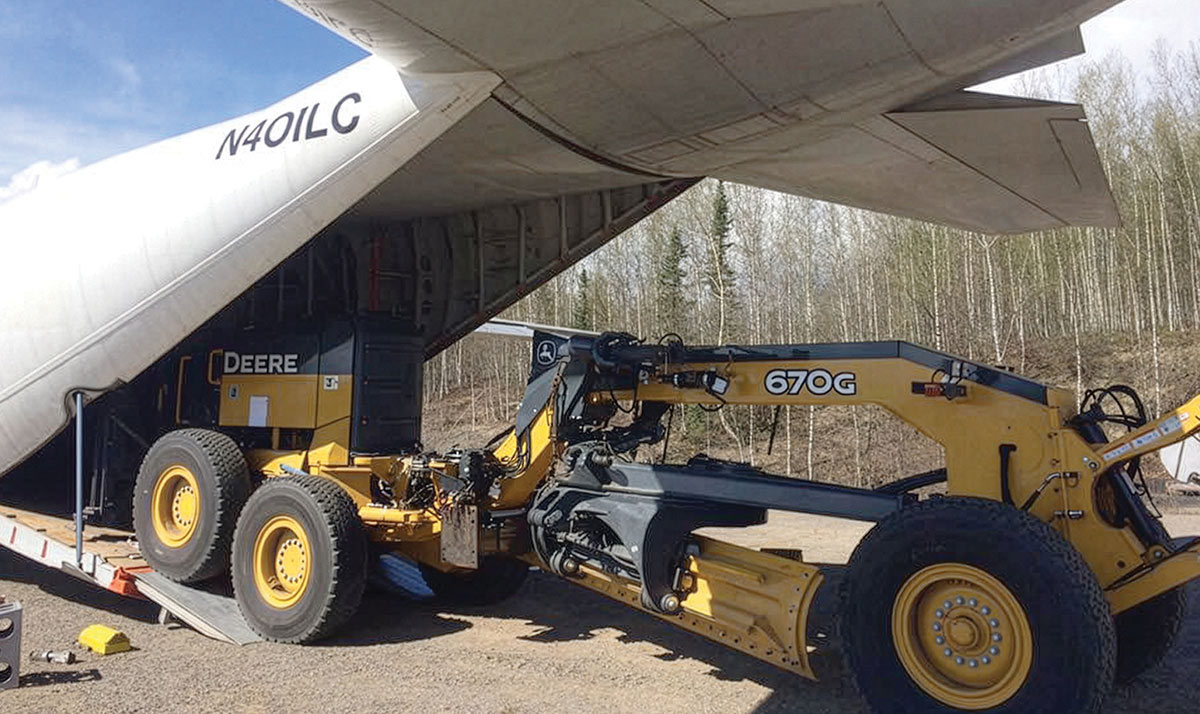
When ground and water won’t cut it, AER improvises. It has flown replacement machine parts like transmissions, cutting edges, and a disassembled road grader to remote sites using a Pilatus PC-12 turboprop, pulling the seats out and sliding pallets through the rear cargo door. AER has even used helicopters to get machinery where it needs to go.
“We shipped a grader in Lynden’s [C-130] Herc before,” Sadler recalls. “We disassembled the grader into parts, and then they put it into the Herc and flew it out to the remote site.”
ASCI’s own research—the Alaska Logistics Cost Index—found that moving goods to Alaska typically runs two and a half to three and a half times what the same shipment would cost in the Lower 48, and that’s before factoring in the cost of moving material around within the state.
Timing can be everything. Ken Gerondale, president of Construction Machinery Industrial, recalls missing a barge by just one week when trying to deliver a truck the company had sold to a customer in Kaktovik. The truck ended up in Anchorage instead.
“We had to have it trucked up to Deadhorse, and then it had to be put on a Herc and flown from Deadhorse to Kaktovik,” he says. “The cost differential in that freight was over $60,000.”
The consequences of a mistake like that go beyond the financial cost, he adds. “This truck was critical for Kaktovik. It was a water delivery truck, and their old one had been down. If somebody gets a date wrong or gets a shipping location wrong, and then you miss that barge cutoff,” Gerondale says, pondering the implications. “It’s easy to see the financial part because you see those numbers right away, but the downstream of that is the [truck] not showing up when it’s needed.”
Airport Equipment Rentals
Barges run on seasonal schedules, typically from May through September. Remote airports and coastal communities have limited capacity. Some villages receive barge service only once per year.
“That’s one of the bigger pain points and one of the reasons our construction season is so short,” Johnson points out. “The housing authorities, for example, they’ll order their construction materials during the fall so they can get those materials by the following spring. Imagine trying to deliver those materials to Barrow—you can’t just do it every day.”
The state’s seasonal construction calendar means that jobs are planned around barge schedules. A delay in May can mean failure to complete a project before freeze-up in September or October.
Planning against delays is part of ASCI’s services. The company runs its own warehouses and uses software to keep tabs on exactly where every shipment sits. But warehouse space in Anchorage is tight and expensive, so ASCI avoids simply stockpiling everything just-in-case.
“We try not to have too much excess inventory,” Johnson says, describing calculated reorder points based on historical demand—enough of a cushion to avoid a stock-out, not so much that space sits full for a job that’s still months away.
ARG Industrial takes a similar approach but leans on its network of branches in Anchorage, Wasilla, Fairbanks, and Kenai to move its inventory of cables, ropes, belts, hoses, and fittings to wherever demand is building, so stock shifts as customers’ needs shift with the season.
The company takes warehousing a step further for some customers, placing inventory and equipment directly at customer job sites through what Regional Operations Manager Tyler Mitchell calls a vendor-managed inventory program, with ARG staff flying to service sites like Prudhoe Bay every other week.
Accuracy matters as much as quantity. “If your system says you have five, but you go and check the bin and you have zero, well, you just lost a lot of time,” says Jaylon Winborg, director of warehousing and logistics for ARG. Both ASCI and ARG Industrial describe daily cycle counts and dedicated staff tracking every shipment—not glamorous work, but the alternative is a construction crew standing idle while a part that’s supposedly in stock turns out not to be.
There’s also a piece of the puzzle that’s easy to overlook: what happens to leftover material? Johnson calls figuring out what to do with the excess materials “reverse logistics.” Companies have options: redeploying material to other projects, donating it for a tax write-off, scrapping it, working with a third-party auction house to sell it. Whatever a company chooses, it comes down to, once again, data visibility.
“You don’t want that material to just sit there collecting dust,” Johnson says, “but you need to know where it’s at.”
Cruz Construction builds more ice roads and ice infrastructure than any other contractor in Alaska, consistently creating hundreds of miles of ice road and snow trail annually.
“If you want to do remote construction and do it well, you better know how to [build ice roads]. Or we get hired by people to do it for them,” Miller explains. “We had one trail last year that was longer than the [proposed state-spanning] gas line—over 700 miles of trail for laying down fiber. We’ve built all the way out to Point Thomson, about 50 miles of road, and we do hundreds of miles a year of ice roads mixed in with snow trail.”
Ice roads are temporary by nature, designed to be used for a season and disappear without a trace when spring arrives. This makes permitting more straightforward than permanent road construction.
But ice roads also introduce unpredictability. They depend on consistent cold temperatures and snow conditions. A warm spell can make them soft and treacherous. Sparse snow years limit where roads can be built. Optimal ice road conditions occur when temperatures hover around -20 to -30°F; anything warmer makes conditions deteriorate rapidly.
Late-season temperatures proved challenging in 2025 when UIC Oil & Gas Support took on the task of hauling 1.2 million pounds of construction materials over tundra to repair one of the Point Lay’s two water storage tanks. About 400 miles north of Anchorage, Point Lay is accessible only by air, water, or winter ice road. Waiting for a summer barge would bring materials to the village too late for construction season; the only option was a late winter tundra haul.
“It was the very bitter end [of the season],” recalls Joe Barron, UIC Oil & Gas Support general manager. “So these guys have been going, they’ve been working nonstop since January 15. And then we’re closing out on April 29. So it’s the very last run of the winter.”
Barron had roughly three weeks to plan the operation. His team assembled fourteen machines and twenty-two trailers and began moving material from Deadhorse, carrying an average load of 60,000 pounds per trailer. The journey covered about 520 miles each way; the caravan of trailers traveled an average of eight miles per hour through conditions that varied from deep cold to thawing slush.
“Late season tundra work can always be hit or miss,” Barron says. “Trail conditions can deteriorate, and it makes it softer snow.”
The team’s operators worked 18-hour days, fighting fatigue and often dealing with flat light that visually blended the ground with the sky. They had five to six hours of sleep each night, no showers for twelve days, no access to running water, and minimal hygiene facilities. Some days they moved only 10 miles; other days, when conditions were favorable, they managed 40 to 50 miles. The convoy had to balance speed against the risk of equipment failure and the challenge of breaking trail where no established route existed.
Yet Barron’s crew completed the 1,000-mile round trip in nineteen days—eight days faster than planned. The key to the haul’s success was its team of operators, Barron says. “I can bid and win work like you wouldn’t believe, but if I don’t have the crew to do it, then nothing gets completed.”
The Point Lay water storage repair project was a testament to the logistical complexity that can go into any Alaska construction effort and the way planning can make the difference.
“We may take the equipment to a customer’s job site two months before they need it or before the rental period starts,” says Sadler. “Having the forethought to get equipment to the site before weight restrictions hit is definitely always a challenge.”
The limited availability of certain transportation services creates bottlenecks. Barge options have consolidated, there are fewer specialized heavy-haul contractors, and some remote air service providers have ceased operations. This means contractors increasingly need to own their own assets to reliably control their project timelines. Small companies without such assets face increasing disadvantage.
“More than ever, it’s important to be able to control your own destiny as much as economically feasible,” Miller observes. When he started out in the industry, on his first barge project for Wilder Construction in the early 2000s, he remembers using “other people’s resources to do the job. We didn’t own anything that we used on that job.”
Still, even though Cruz Construction has developed its own assets, partnership is key to getting things done in Alaska. Miller points to a job in Russian Mission where Cruz barged some of its own freight but relied on another operator, Ruby Marine, to help move material back to Nenana, with Lynden pitching in on top of that.
During recovery efforts after Typhoon Halong, Miller also recalls companies that might otherwise bid against each other were working side by side; one even loaned its man camp to another that didn’t have housing set up.
“It’s just a really small world up here,” he says. “If you don’t have a good attitude of sharing your expertise or sharing your resources to help somebody out, it’s going to come back to bite you.”
Airport Equipment Rentals
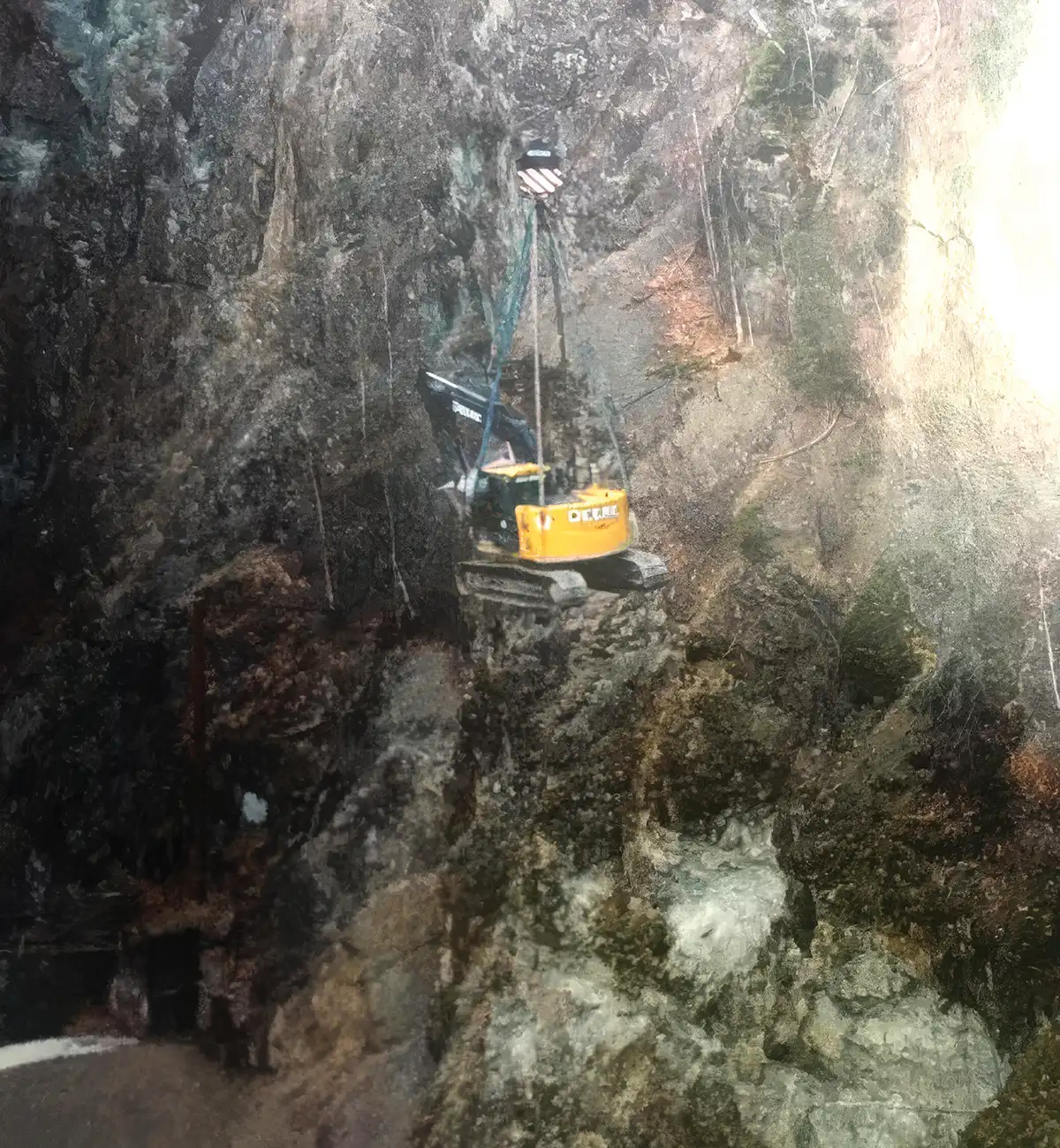
The Point Lay project succeeded because multiple subsidiaries of Ukpeaġvik Iñupiat Corporation—from UIC Oil & Gas Support and UIC Sanatu Construction to UMIAQ Design—could coordinate seamlessly and because contractors, suppliers, and transporters have developed systems to work together despite competition and distance.
But without continued investment in these capabilities, the system becomes fragile. A loss of expertise, a consolidation of services, or a shift in priorities could leave Alaska’s remote communities without the logistics support they depend on. “There’s a lot of institutional knowledge in this state with local contractors that is very impressive,” Miller says. “It’s from what we messed up to do wrong. Luckily, [we] made it out with our shirt on, and we’re able to live to fight another day.”
That knowledge is what keeps Alaska’s construction industry moving. It’s the invisible infrastructure that matters most in a state where getting anything delivered requires not only knowing where you’re going but how to get there.