

ousing is in short supply in Alaska, and it’s holding back the broader economy. According to a study by Agnew::Beck Consulting in 2023, the state will need more than 27,000 new housing units in the next ten years to meet rising demand. Construction, however, has yet to match this need. In 2022, just 578 new units were authorized statewide.
The problem has many roots. At the forefront, houses are prohibitively expensive in Alaska. While a new house in the Lower 48 might incur an average hard cost (materials and labor) of $120 per square foot, Anchorage homes see hard costs of $300 per square foot. Outside of urban areas the cost jumps even more: in Bethel, the figure is an astounding $800 per square foot.

In a feedback loop, the housing hang-up discourages workers from living in Alaska, thus shrinking the workforce and making homes even harder to build and maintain.
Yet there are innovators trying to escape that loop.
Alaska Adaptable Housing

“The goal is to make home ownership equitable for all Alaskans,” says Stacey Fritz, an applied anthropologist of arctic infrastructure and part of the Alaska Adaptable Housing team in Fairbanks. She co-owns the LLC with her husband, Ryan Tinsley, a building systems designer. Their colleague at the Cold Climate Housing Research Center, construction project manager Jessica McKay, is on the team too. And Dan Fritz, Stacey’s brother, supplies the organization with his know-how as a technical consultant specializing in engineering and business.
The team plans to make home ownership equitable by designing and building adaptable home systems specifically for the Great Land—houses that can be locally sourced, affordably built, and more easily maintained, even in remote parts of the state.
In 2020, while partnering with the National Renewable Energy Lab, the Cold Climate Housing Research Center received a grant from the US Department of Energy to address the energy efficiency of Alaska homes, as well as the amount of waste generated by conventional construction.
Alaska Adaptable Housing
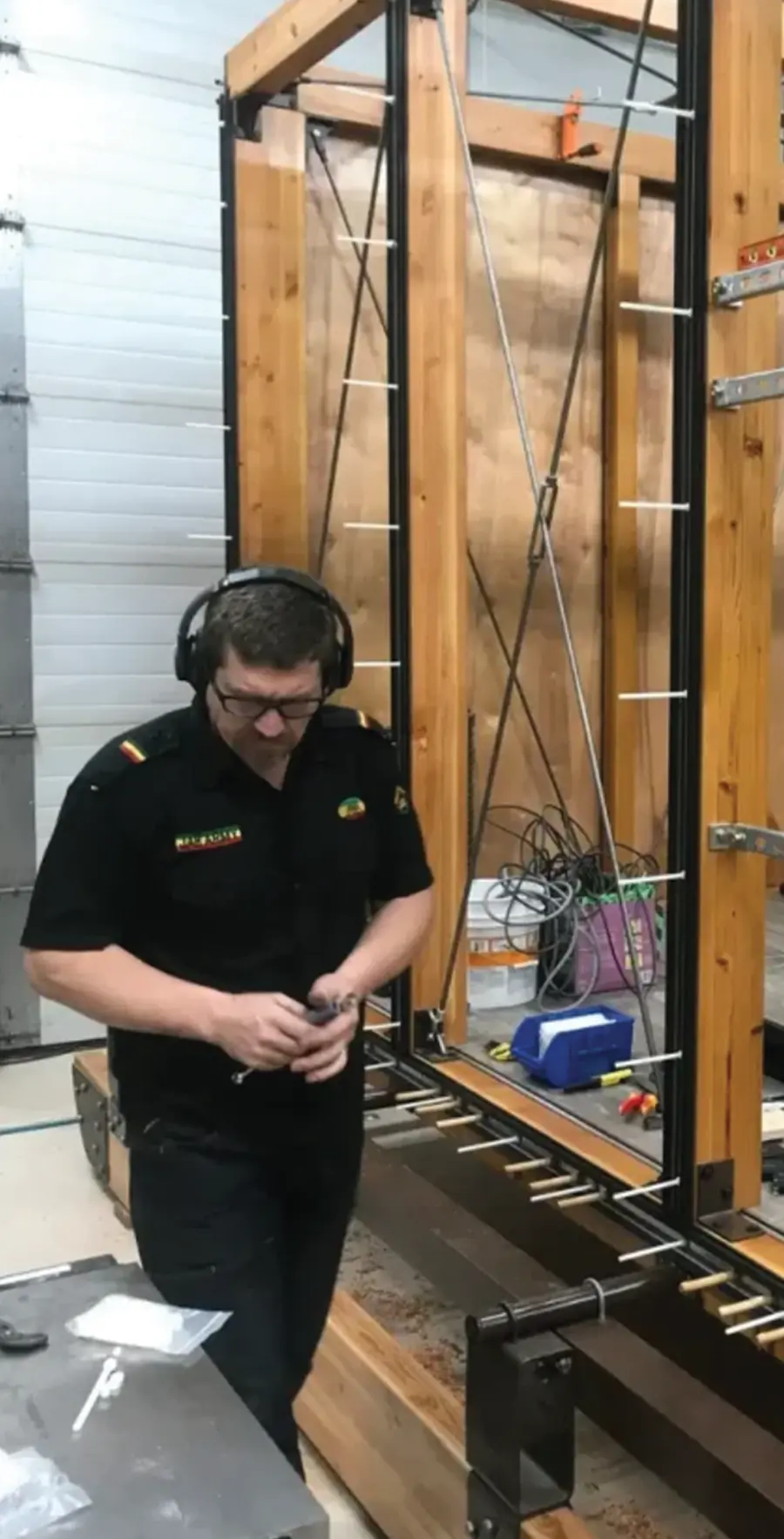
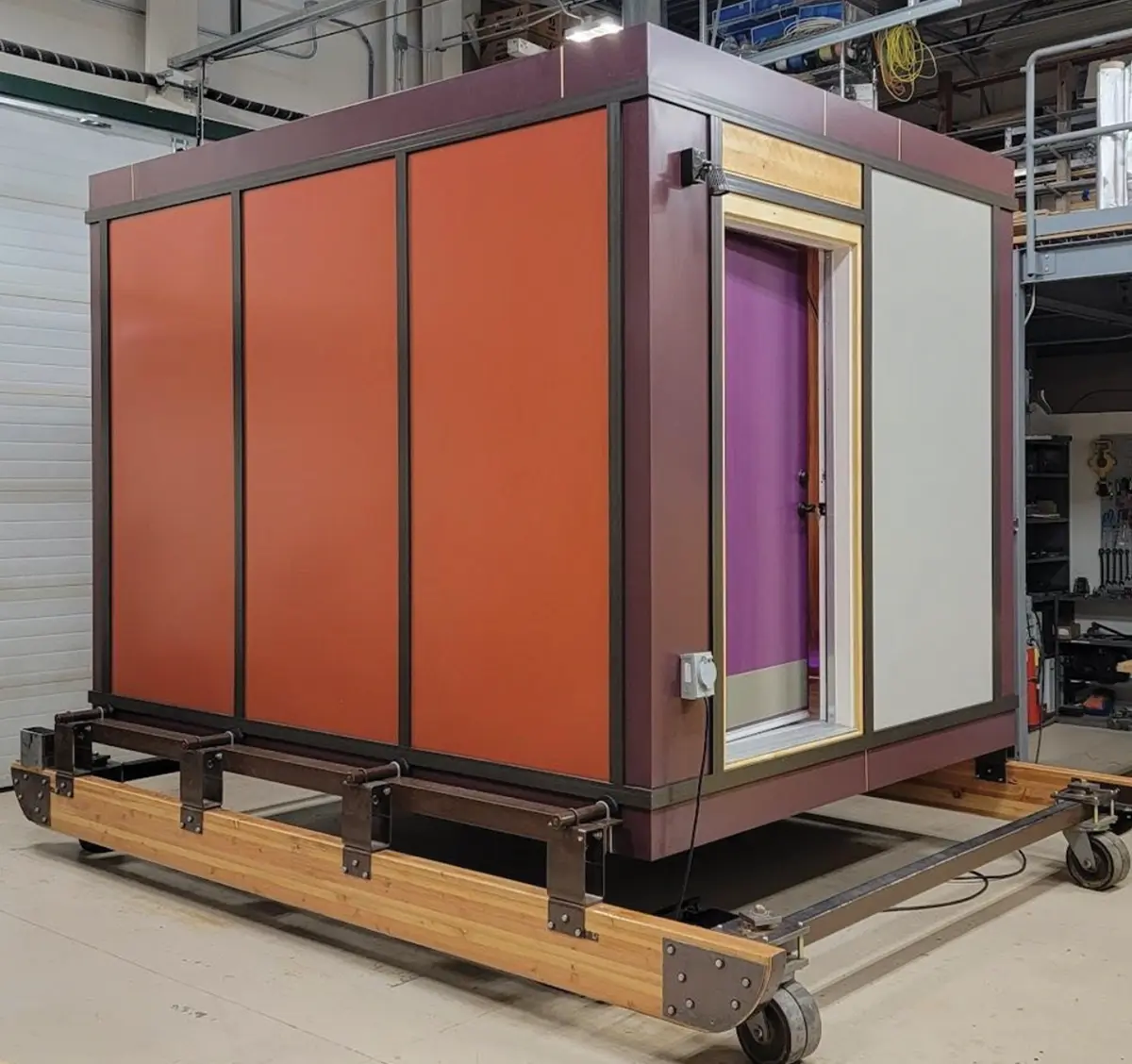
Tinsley, the company’s “chief visionary officer,” compares it to a giant LEGO set. The houses aren’t made of giant, primary-colored bricks, but a collection of interchangeable and replaceable home parts.
Alaska Adaptable Housing
Alaska Adaptable Housing

While Tinsley and the team ultimately decided they’d rather use wood fiber or other locally-sourced insulation in their home design, VIPs proved that reversible building systems—that is, home materials that can be removed and replaced without damage or loss—were possible.
Alaska Adaptable Housing didn’t stop there, of course. The next step in the kit-of-parts system is arguably the most important: the foundation. In Alaska, home foundations take a beating; they’re bent, broken, and tossed around by relentless freezing and thawing, erosion, and seismic activity—sometimes all in the same season. Eighty percent of Alaska is affected by permafrost, adding more complications for the ground-to-building interface. Making foundations that are shippable, maintainable, and replaceable in remote Alaska adds to the difficulty.
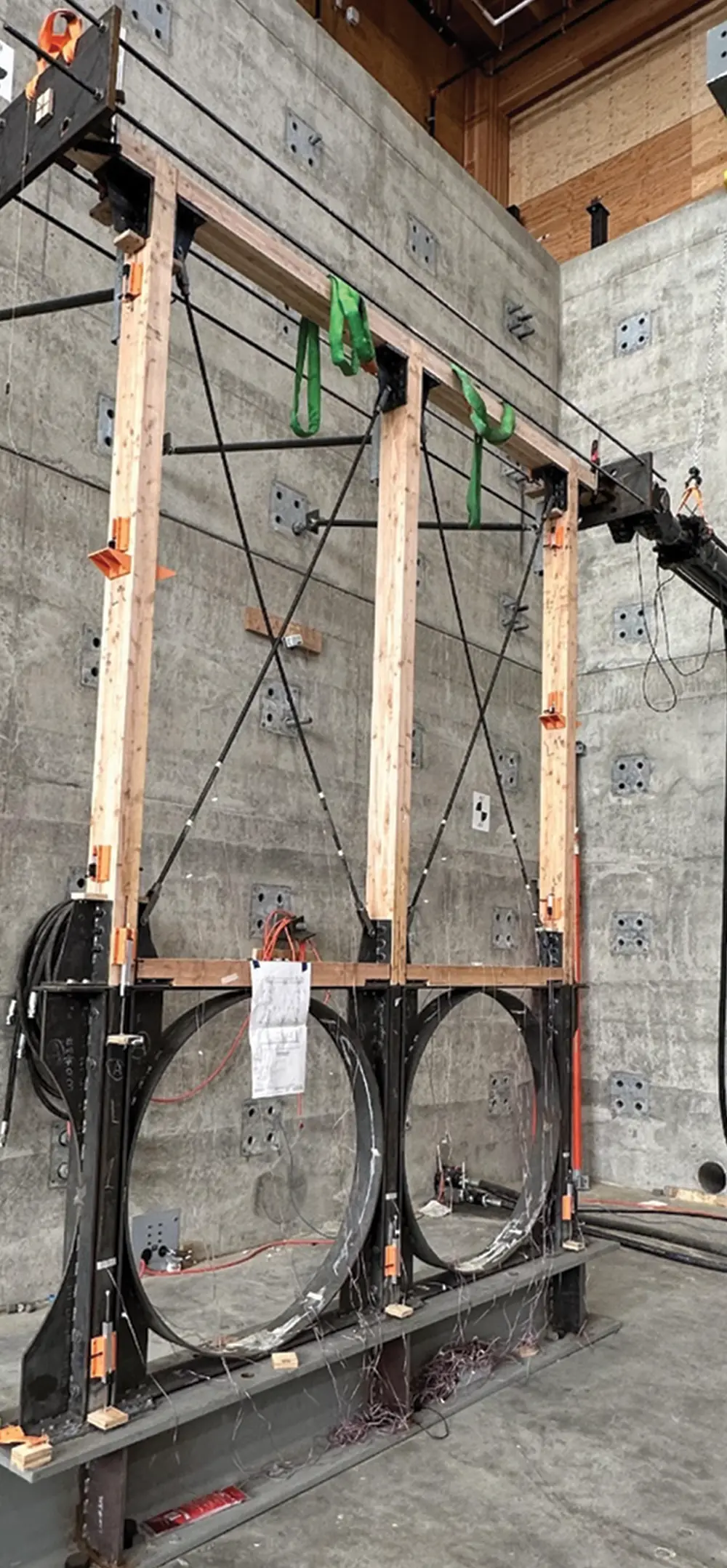
Alaska Adaptable Housing is rising to the occasion with a unique foundation system. The foundation, patent pending, can stack flat to ship, requires no heavy equipment or specialized tools to install, and is self-squaring. The system also received special recognition as winner of the UAF 2025 Arctic Innovation Competition in April, earning the $15,000 top prize plus two $2,000 kicker prizes in the Arctic and Climate Adaptation categories.
The Arctic Innovation Competition collected submissions from more than 150 entities and, according to Stacey Fritz, was an invaluable opportunity for Alaska Adaptable Housing to pitch ideas to fellow Alaskans and streamline its thinking.
Alaska Adaptable Housing
“We’re not reinventing the wheel,” says Tinsley. “We’re simply relearning what has been lost.”
A bonus feature of Alaska Adaptable Housing’s kits is the workforce development aspect. Assembly and maintenance of the kits are the most obvious jobs, and those alone could employ a significant number of residents in many communities. Alaska Adaptable Housing also hopes to create fabrication jobs (manufacturing kit parts) for year-round employment.
“Kit” structures such as teepees, wigwams, and even log cabins bear another critical distinction beyond their adaptability: historically, they could be sourced entirely from local materials. When shipping and handling fees often amount to 50 percent of a home build’s material cost in Alaska, this could be a gamechanger.

Alaska Adaptable Housing
In 2023, the Alaska Legislature made moves to shift that. House Bill 93, also called the Local Lumber Exemption, opened the door for local lumber resources to be used in home construction. Under HB 93, small-scale sawmills can produce dimensional lumber and receive free training in visual lumber inspection. It also provides an exemption from the typical building code requiring grade-stamped lumber to be used, while requiring an equivalent system of Alaska grades.
Alaska Adaptable Housing cites this legislation as a huge opportunity for rural communities. Tinsley has already explored some of the bill’s potential by harvesting driftwood on the Yukon River to be milled by a collaborator in Galena.
Lumber is not the only resource that can be sourced locally. McKay is leading Alaska Adaptable Housing’s initiative to use other local materials to make Alaska communities more self-sustaining.
First on the list is seaweed. Certain seaweeds can be used in wall insulation, as they’re naturally fire-resistant and antimicrobial. Kelp can also be used as a cement alternative, drastically reducing carbon emissions normally associated with concrete production. Alaska Adaptable Housing is also looking into using local mineral resources for similar purposes.
Alaska Adaptable Housing set a goal of sourcing 85 percent of its home materials locally in the next five years. A prefab home package developed in cooperation with Alaska Building Arts and Sciences, a training nonprofit in Delta Junction, incorporates as many adaptable building principles as possible. Within the next year, Alaska Adaptable Housing anticipates evaluating a full-scale prototype of its foundation. The system itself is currently at a Technology Readiness Level (TRL) of five to six; a TRL of one indicates basic technology research, while a TRL of nine signifies that a technology is ready for launch.
Alaska Adaptable Housing’s goals are lofty. But the goals are backed by a team with vision, experience, and grit to buckle down and get a job done. Kit homes could be what Alaska needs to break out of the housing spiral. Adaptable homes aren’t mere figments of the past. They could very well shape the future.