

That Wasn’t
There
alternatives to
absent
billboards

isitors to Alaska immediately notice the stunning scenery. Noticing what isn’t there, however, takes longer: the absence creeps in slowly before Outside tourists look around and observe, “There are no billboards here!”
Alaska is one of four states that ban off-site commercial signs. Hawai’i, Maine, and Vermont have also chosen to protect their viewsheds at the expense of outdoor advertising. Anywhere else, roadside rectangles are part of the landscape.
Billboards are a business Alaska has elected to do without, so alternatives have sprung up in their place.
The windmill has stood in the Chilkoot Charlie’s parking lot for more than forty years, but its origins date nearly to statehood. Circa 1960, Byron Gillam erected the windmill at Fireweed Lane and Gambell Street to attract attention to his Kut Rate Kid liquor store.
His grandson, McKinley Management CEO Rob Gillam, recalls, “My grandfather fancied himself, I’m told, a marketer. At that time, there were restrictions: you can’t have a billboard. So he built a really large windmill backlit with neon lights and put it in the parking lot of the liquor store as his version of ‘social media.’”
At the time, the city government targeted the windmill as a prohibited sign, but the elder Gillam reportedly argued that the windmill was just a fancy lamp.
After Byron Gillam’s death, the liquor chain went bankrupt, and the windmill was up for grabs. According to Chilkoot Charlie’s (Koot’s) general manager Doran Powell, “Mike Gordon, our founder, saw that they were going to dismantle it, tear it down. He pulled into the parking lot and said, ‘I want that!’”
A sign did adorn the windmill for a time, advertising Mafia Mike’s pizza restaurant across the street. “There was some erroneous history that he paid for or contributed to putting the windmill up,” notes Powell. “He didn’t have anything to do with it; Mike [Gordon] just let him put a sign up, and everybody assumed Mafia Mike owned or had the windmill installed in Spenard.”
Outdoor advertising for a business not on its own property is a violation of Alaska Statute 19.25.105. The law that bans billboards within 660 feet of a roadway has been in place since 1949. Voters closed some loopholes with a 1998 ballot measure, such as banning billboards that are even visible from a state highway.
Unlike broadcasting or print, these ads are typically fixed in place, connoting a certain solidity. “When you see something in the real world, outside your home, psychologically you view it as a real product,” says Jonathon WolfeBarron, founder and CEO of Rolling Adz. “So when you do get targeted online, out of the 5,000 ads you see a day, you’ll resonate more with the one you’ve seen in the real world.”
Billboards have been around for almost 150 years, since shortly before the Outdoor Advertising Association of America formed. Today, clients now have more OOH options than ever. “We’re seeing a huge surge of more brands doing out-of-home,” says WolfeBarron. “The big brand awareness comes from something out of home, in the real world, where they can psychologically make it a real product.”
Alaska, sans billboards, relies on other OOH modes more than elsewhere, notes Yael Kaufman, owner and general manager of Alaska Channel. “Places that have billboard advertising also have advertising at airports and on buses,” she says. “In Alaska, since we don’t have billboard advertising—which is great because we all would rather see the views over a big, tacky billboard—it makes airport and bus more relied upon.”
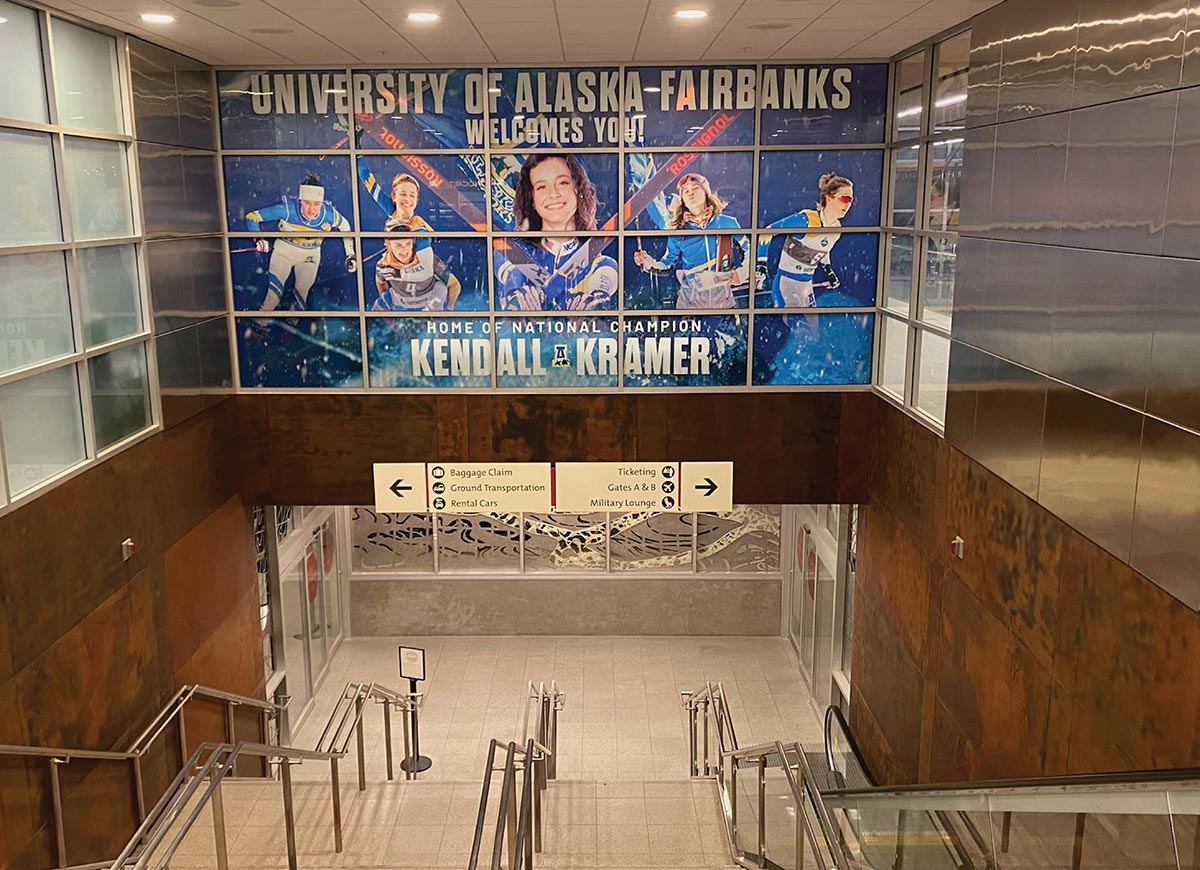
Placement of ads in airports and on buses are among Alaska Channel’s services. Kaufman observes that, given the importance of aviation in Alaska, airport advertising takes the place of billboards along interstate highways in the Lower 48.
“We were not looking to get into out-of-home,” says Kaufman, but Ted Stevens Anchorage International Airport was making its own app and contacted Alaska App for help. That led to a contract for Alaska Channel to take over the airport’s indoor ad contract, replacing an out-of-state vendor. Contracts for other state airports followed.
Travelers may have noticed that airports are rich with ads. “You’ve got a captive audience situation. You’re engaging passengers during long dwell times,” Kaufman says. “You’re connecting with them in a unique environment when they’ve got time, perhaps a more receptive mindset.” Kaufman adds that ads are an important ancillary revenue source for airports. Even so, Alaska Channel will turn down proposals to avoid cluttering the indoor environment.
Airport ads are, of course, a first impression for arriving visitors, but Kaufman says it’s a misconception that they are the prime audience for advertisers. “That’s a very small percentage of the people they’re trying to reach. They are largely trying to reach locals,” she says. “The Anchorage airport is the biggest venue in the state, so it tends to be a very desirable way to reach the masses. A lot of airport advertisers are specifically trying to reach business decision-makers.”
Thus, clients that Alaska Channel places in airports tend to be financial institutions, consumer products, Alaska Native corporations, state agencies, and the like.
The goal of bus ads, says Kaufman, is “truly to reach the masses, to reach anyone who is on the streets in Anchorage—preferably (and hopefully) not looking at their phones, but looking up. So you’re reaching everyone, everyone, in the greater Anchorage area.”
WolfeBarron appreciates the appeal of rolling ads; that’s his business, after all. “Things in motion capture your attention,” he says. “Now you have something that is driving every day, doing deliveries, and it happens that your brand could be on the side of them.”
WolfeBarron recounts another admittedly aggressive use case: “If our clients are trying to target a hospital because they’re trying to hire nurses from another hospital, say, I can take that truck right outside their front door (well, usually on a public road).”
For these clients, WolfeBarron developed his niche in the OOH sector. “We’ve created this subcategory called ‘moving out-of-home,’ which has been a disruptor in that whole space,” he says. “The billboard companies don’t like us; they’re, like, ‘You’re getting two-and-a-half times the impressions of a regular billboard!’ Because people don’t subconsciously block it out as they’re driving, that tunnel vision. Whereas if you have a truck in front of you with an ad on it, it’s unavoidable.”
Alaska Channel

The company contracts with local drivers to carry clients’ ads. Among thousands of trucks in every state, WolfeBarron says he has eleven in Alaska, mainly Anchorage, with clients including political campaigns, lawyers, and Starlink internet service. “We do this all across the country. A lot of people don’t want to be on a billboard,” he says.
Mobile OOH can supplement billboards, but it can’t replace them. Rolling Adz must be careful not to run afoul of rules in stricter states, like Alaska, that ban ersatz billboards pasted on stationary vehicles. “We don’t fall under the billboard category because we’re not fixed, stuck to the side of the road,” he says. “The vehicles that we’re advertising on aren’t solely advertising vehicles; they’re actually delivery vehicles.”
In contrast to buses, WolfeBarron says Rolling Adz offers clients more control. “Buses, there could be twenty to a hundred-some routes in a city, so you don’t always know where that bus is. Additionally, there’s a lot of extra inventory when it comes to buses, so it could be one of the buses that’s parked in the garage,” he says. “Buses usually go for the ‘tonnage’ effect, where they wrap a ton of buses just so there’s an opportunity that some of those buses are on-market. Whereas ours, we know these trucks, we know where they’re at, we know what their delivery routes are, so it’s much more of a higher frequency than you’d see with other types of messages.”
Moreover, the drivers can serve as “brand ambassadors,” supplied with samples of products to demonstrate for curious onlookers. “They could be hauling beverages, paper, commodities, any type of products. And we wrap ‘em, like a big vinyl sticker,” WolfeBarron explains. “Normally we use the box trucks. Those are the ones that are already in-market; there’s already a driver doing it. We’re creating more economy in the market because we’re paying those drivers to have an ad on the vehicles as well.”
Alaska Channel
“We’ve done enough studies to show measurement and effectiveness, the actual conversion rate when someone sees an ad, gets retargeted, and clicks online, is insanely high compared to just a digital ad, for example,” he says.
How does Rolling Adz know who sees an ad out in the world? “We’re able to capture the cellphone signals of people who come in contact with them. If they fit our client’s profile, then we can send ads back to their phone,” WolfeBarron explains. “A little Big Brotherish, but it works very well. It’s very effective.”
Cellphone capture is not unique to Rolling Adz; it’s widespread in market research. When mobile devices ask users to share “location information,” that’s one thing that happens to it.
“When I started this company, we spearheaded this whole thing. There was no measurability,” WolfeBarron says. “We had beacon technology put in these vehicles early on, and then we amplified that into a viewshed of how far you can see these vehicles. Then anybody that came inside that viewshed for eight seconds or longer, we counted that as an impression.”
Measuring the effectiveness of airport ads is trickier. “It’s harder than digital, of course,” according to Kaufman. However, based on a straightforward count of passenger traffic, “At the Anchorage airport, some displays have upwards of 10 million annual impressions.” That covers multiple displays seen by the 5 million to 6 million travelers passing through the airport.
Thus, advertisers tend to renew year after year. “People want to be there. Some parts of the Anchorage airport are consistently sold out,” says Kaufman, citing the well-traveled C Concourse in particular. “Some bus signs are consistently sold out.”
The ultimate measurement, then, is client satisfaction. “Advertisers feel like they get results from airport advertising. Bus advertising, as well.” Kaufman says, “They also appreciate the feeling that they’re elevating their long-term brand awareness.”
Alaska Channel

Powell thanks the municipal Planning and Zoning Commission for accommodating the renewal of the landmark. Now he must find money to pay for it. Koot’s is trying to raise $50,000 throughout the winter. “We will be doing very specific, targeted fundraisers,” says Powell, warning donors to beware of fakes. The genuine drive, he says, will be “very irreverent and keeping with the Spenard lifestyle: keep Spenard weird.”
He calls the windmill a “community icon” and notes that it doesn’t even say “Koot’s” on it. Powell says, “Everybody in the neighborhood loves the windmill. It’s not going away. It’s not going away.”
And traditional billboards are not coming to Alaska. “I don’t see that happening. It’s been disallowed for many, many years, and I’d be surprised if that ever changed,” Kaufman says.
Coming from a place rife with billboards, WolfeBarron experiences relief in Alaska when visiting his wife’s relatives. “I do like it. When I travel in the South, it’s just littered with billboards,” he says. “There’s definitely a need for billboards in certain spots. To be every 100 feet is an overstretch, but there is certain messaging on billboards that can be really effective and helpful for markets.”
OOH alternatives will do the job while billboards are forbidden. “Alaskans love the beauty here, so it’s really nice to not have that obscured,” Kaufman says. “At the airport, we shy away from doing things on windows that would obscure the view.”
Powell notices the difference when traveling Outside, not being used to billboards at home. “I guess it can keep you entertained while you’re on a long, straight highway,” he says. “Does it detract from the natural landscape? Absolutely. Does it keep you from falling asleep? Probably.”
And then Powell returns home. “When I come back to Alaska, and I don’t see them, I think I like it better,” he says. “I would prefer that we didn’t have big billboards here.”