

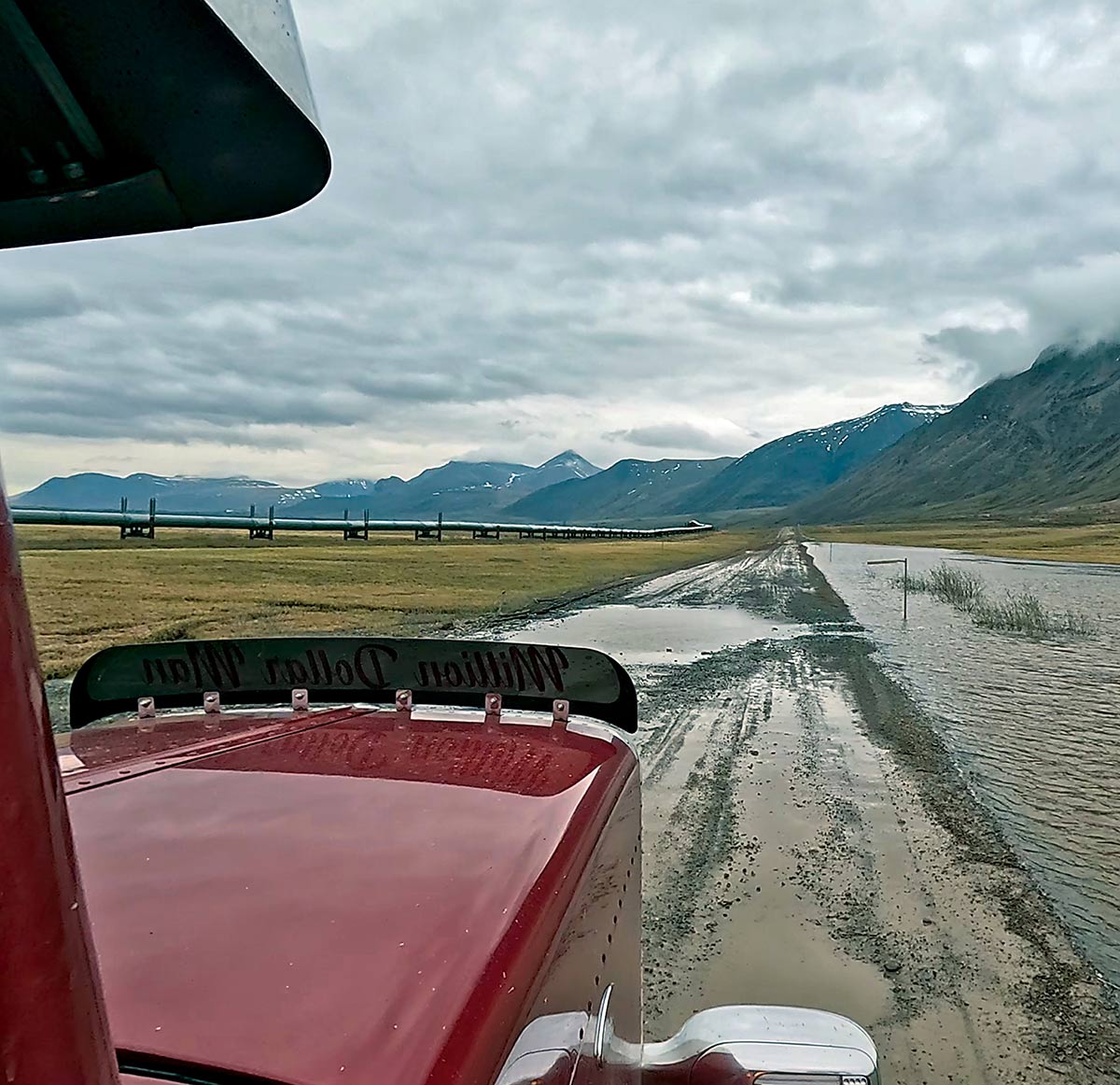
rom the Community Winter Access Trail to the Pan-American Highway, from the Willow and Pikka projects to the proposed Ambler Access Road, the Dalton Highway is a lifeline to the top of North America. But despite fifty years of improvements, unevenly thawing permafrost and an uncertain financial foundation have frayed the North Slope’s road to the rest of the world.
The Dalton’s increasing fragility comes at a time of growing demand. The Alaska LNG project could significantly expand industrial use of the road. At the same time, increasing numbers of Arctic tourists, whether bicyclists or exploratory electric vehicle drivers, seek to taste the road’s dust and slap its mosquitos for themselves.
“The Dalton is one of these things, we can’t just Band-Aid it,” says JR Wilcox, founder and CEO of Alyeschem, which is building a chemical plant near Deadhorse. “There’s a stewardship mindset we have to take.”
Providing that continuity will require solutions to a larger budgetary challenge that has bedeviled the state’s elected leaders for more than a decade. After years of budget surpluses, Alaska has had a deficit every year since 2013, except for 2022. Without a sustained increase in oil prices or a new source of revenue, balancing the budget will take further cuts to spending, even with no changes to the Alaska Department of Transportation and Public Facilities’ (DOT&PF) maintenance budget.
DOT&PF currently spends $20 million a year to maintain the Dalton, according to a January 28 presentation by commissioner Ryan Anderson to the Senate Resources Committee. Compared to the 2019 spending estimate of $16.5 million posted on the DOT&PF’s maintenance web page, funds have only been adjusted for inflation, as Kawasaki says, not greater need.
Of that earlier $16.5 million, $6 million came from federal funding the state could spend on certain types of projects. “We would also welcome greater flexibility to use federal funds for maintenance on strategic infrastructure corridors such as the Dalton Highway,” Anderson says, noting the road “supports national energy production and security.”
Anderson and DOT&PF’s acting Northern Region director Lauren Little say federal funding can only be used for “reconstruction” projects and things like resurfacing and improvements. Federally funded projects along the highway have a roughly 90/10 cost-sharing split (with the state picking up 10 percent of the cost), although that ratio varies slightly by project. The state could enact a toll on the road, but pursuing tolls or other funding mechanisms limits the state’s ability to obtain federal project funding. “State funding provides substantial flexibility,” Anderson says, but has “no automatic mechanism that increases a highway’s funding in direct proportion to its traffic.”
Despite widespread desire to see more investment in the road’s maintenance, the bill stalled amid opposition from various groups. Jamie Benson, president and CEO of the Alaska Trucking Association (ATA), says its greatest concern is that toll funds “would go into the general fund [and] wouldn’t be earmarked” for the Dalton Highway. Article IX, section 7, of the Alaska Constitution prohibits “dedication” of tax proceeds “to any special purpose, except as provided in section 15 [related to the Permanent Fund dividend] or when required by the federal government for state participation in federal programs.”
While funds cannot be dedicated, Alaska does frequently use accounting designations for different funds: fuel tax revenue is traditionally used for road maintenance, for example, and marijuana taxes are divided, with half going toward reducing recidivism and the other half split between the state general fund and public health campaigns combating the effects of marijuana. However, those designations could be lifted if legislators chose to do so.
Benson’s organization travels yearly to Juneau to advocate for more road maintenance funding for the Dalton. ATA and its members are “always highlighting the safety concerns, the backlogs that occur, the operational impacts,” she says. “They are wonderful folks to work with,” she says of DOT&PF, but “they can’t do the job that they need to do without the appropriate funding.”
Inadequate maintenance carries a high cost. “It can be so impactful to a vehicle that you’re talking about thousands of dollars of repair costs, just to travel that road,” Benson says.
Road conditions also contribute to a rising cost of freight, says Senator Robert Myers of North Pole, who also works as a Dalton Highway trucker. In the same January 28 meeting as Anderson’s presentation, Myers told colleagues that the company he drives for has doubled its freight rates over a few years. “A large portion of that [increase] can be traced back to insurance and maintenance costs because of the condition of the road up there,” he said.
Dewberry Engineers
Dewberry Engineers
Dewberry Engineers
According to slides from Richards’ 2008 presentation, titled “Infrastructure Improvements Needed to Support Gas Pipeline Construction,” that $1 billion covered twenty-four highway projects, three airports, two bridges, and seven facilities—thirty-six projects in all—slated for completion by 2014. Richards, in his presentation, calls the laundry list of projects “Too Much Work to be Compressed into a 2 to 3 Year Construction Window” and notes “Bad Roads = Slower Gasline Construction and Increased Costs.”
The legislature provided the initial $100 million Richards requested in 2008, which covered the construction phase for three projects on the Dalton Highway. These reconstructed the road between mileposts 9–11; 175–197 (along with a bridge replacement); and repaired and replaced culverts between mileposts 260–321.
During the January hearing, no one in the room could say how many of the original thirty-six projects had been completed. Neither DOT&PF nor Richards, now president of the Alaska Gasline Development Corporation, responded to a follow-up request for clarification of the projects and their status. Anderson’s January presentation and testimony show $465.6 million in capital investments in the highway between 2015 and 2025. DOT&PF plans another $454 million through 2031.
Beyond the questions of what has been, should, and can be funded, the state also faces increased labor costs and demands. Anderson, in his January presentation notes, “Alaska’s LNG construction boom will create intense competition for equipment operators, mechanics, laborers, engineers, and other skilled workers.”
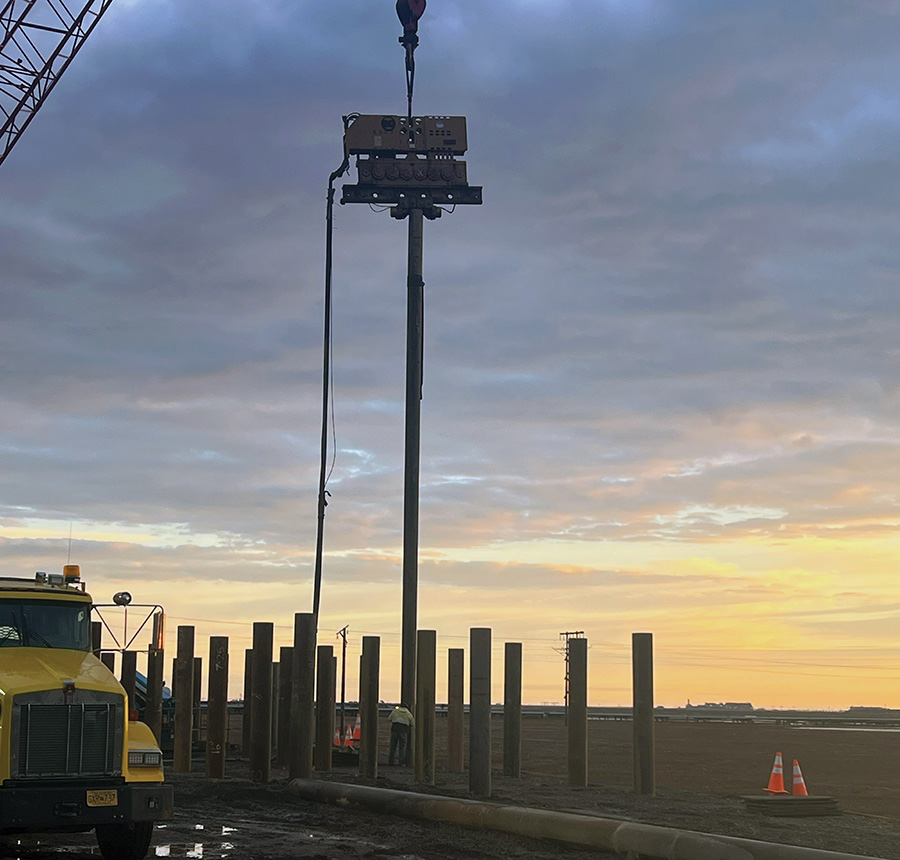
Alyeschem
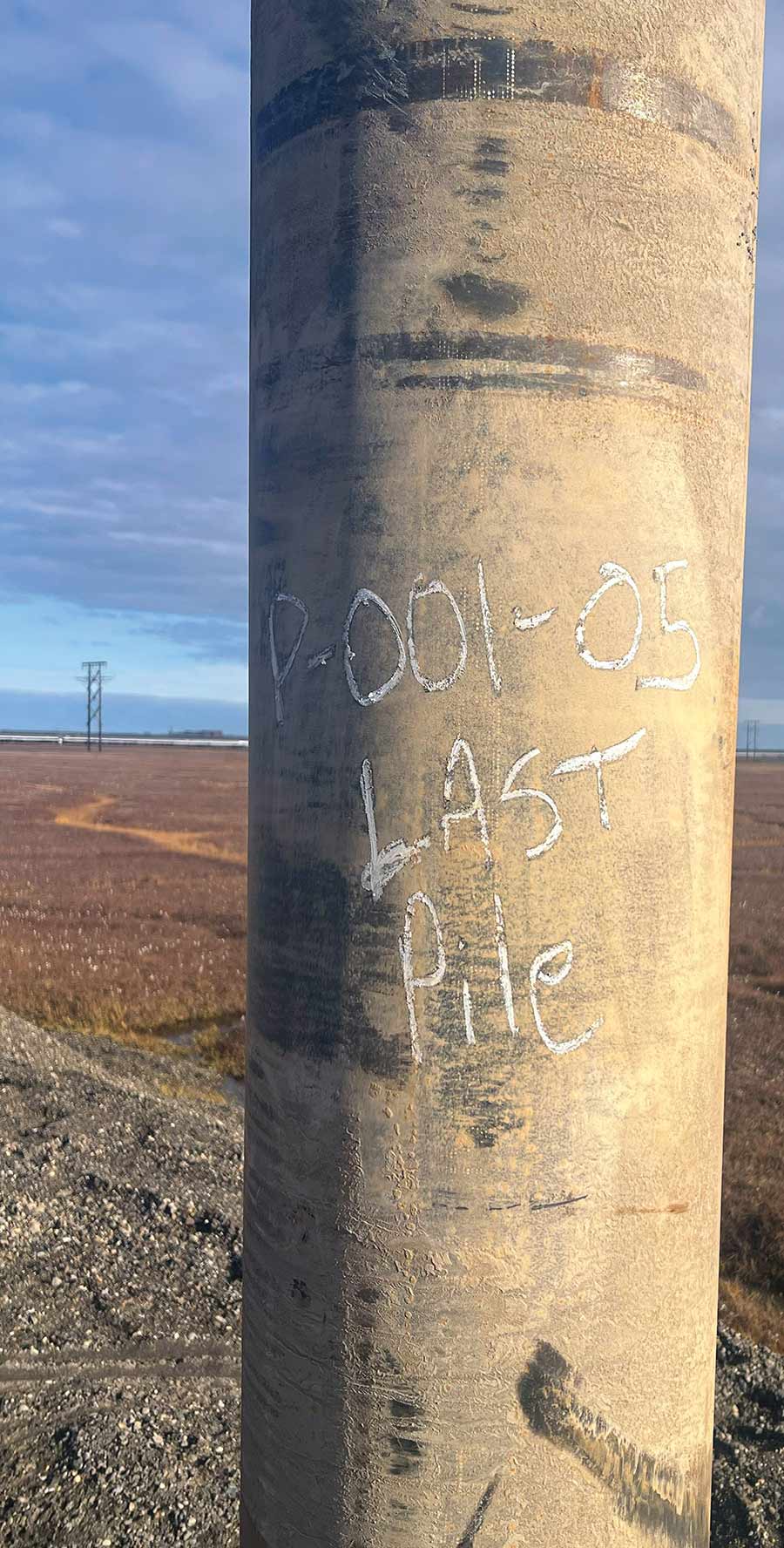
Over the past decade or so, Alaska has declared three disasters along the highway related to flooding. In 2015, two events related to ice jams and spring breakup led to the road’s closure for nearly a month —a week in April and again for a longer stretch from May to June. Emergency repairs to fix the 24 miles of affected road cost $17 million—more than the combined 2019 state and federal spending on the road. It happened again last year, when flooding damaged the road from mileposts 315 to 404 and caused a five-day closure.
Permafrost thawing creates another issue. Since the early ‘80s, the UAF Geophysical Institute has monitored temperatures at several different sites along the Dalton. “The permafrost [has] turned much, much warmer, especially in the northern part,” says Vladimir Romanovsky, an emeritus geophysics professor at the institute. Three sites near Prudhoe Bay, which used to be -8 or -9℃, are now “halfway to zero,” he says: -4 or -5℃. Above 0°C, frozen soil turns to soggy mud.
Summer depth measurements of the ground layer above permafrost show that it’s deepening. Romanovsky says that’s because permafrost, by definition, has been frozen for two or more years. In some areas that, in the ‘80s, had permafrost up to the ground layer, Romanovsky says permanent freezing might now start only five to six meters down. This has significant consequences for the road.
Permafrost includes unevenly distributed layers of ice, called wedges, Romanovsky says. When permafrost thaws, the surface above an ice wedge drops much further than soil above ground with less water content. The state has engineered some roads, such as the roughly half-mile Thompson Drive access road to UAF, to use special engineering features that reduce or prevent permafrost thawing. But that project cost $16 million, and not all the features would work along the Dalton.
FDL-A continues to move. If the lobe maintains its current path and speed, it will hit the road’s present path in a little less than nine years—around 2034 or 2035. After the earlier set of calculations, the lobe’s speed increased, but DOT&PF was able to complete relocation before the collision. A UAF researcher studied what happened when the lobe collided with the abandoned section of highway and found it caused cracks, shearing, buckling, rotational failure and soil slumping. Netardus says the state doesn’t “have a formal plan yet” to address a possible future collision, but would probably start one around 2030, “if needed.”
In the January hearing, Anderson told senators the relocated road is now so close to the Trans Alaska Pipeline System that a possible second encroachment by the lobe would likely threaten both structures.
The Dalton Highway corridor includes nine other lobes, Netardus says, but “FDL-A is the only lobe currently projected to affect infrastructure.”
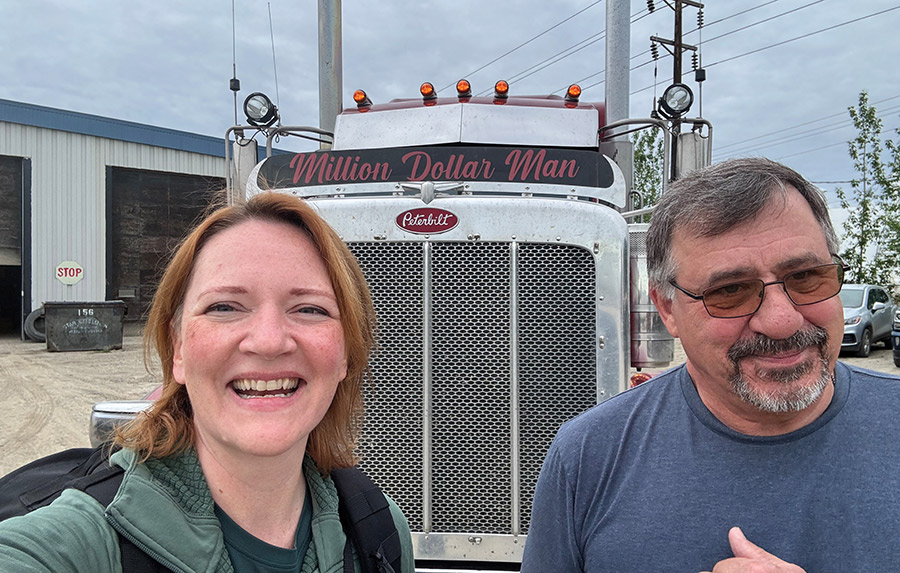
Dewberry Engineers
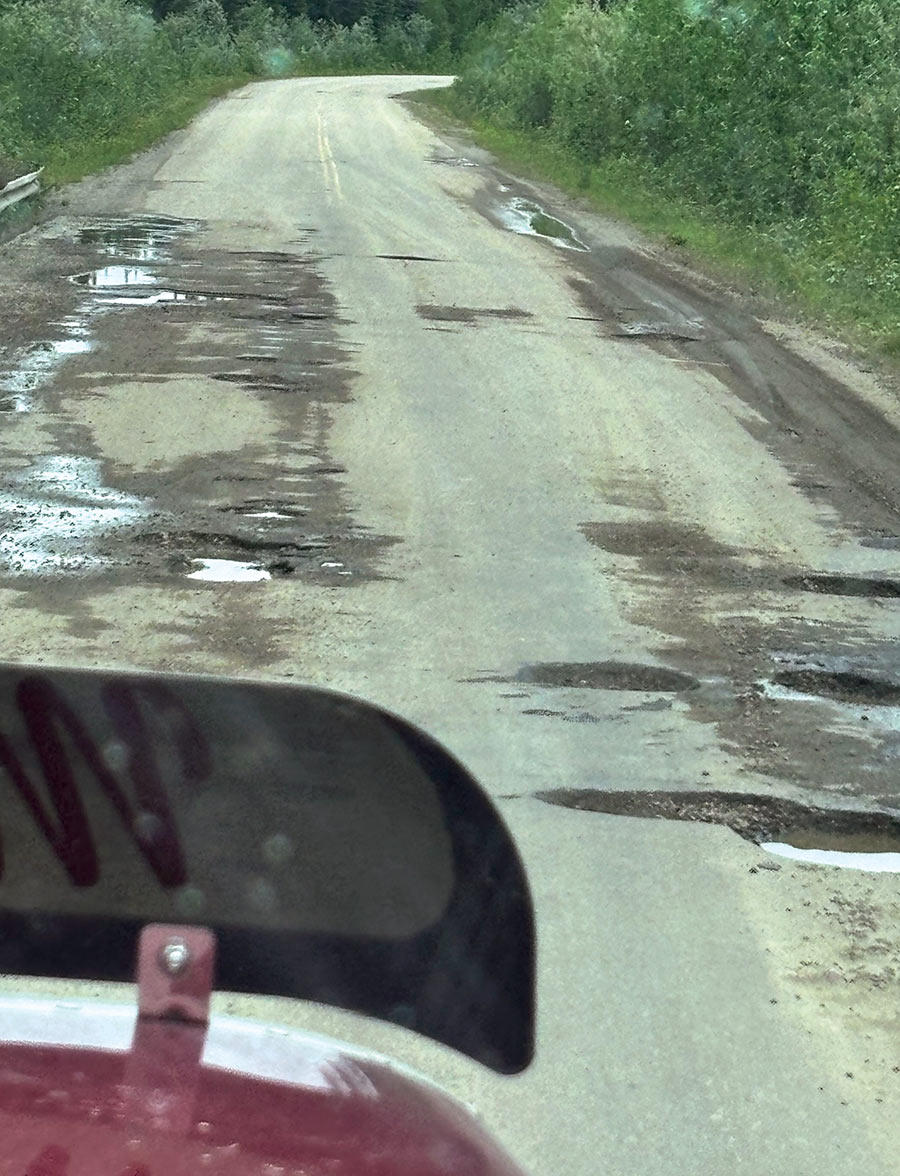
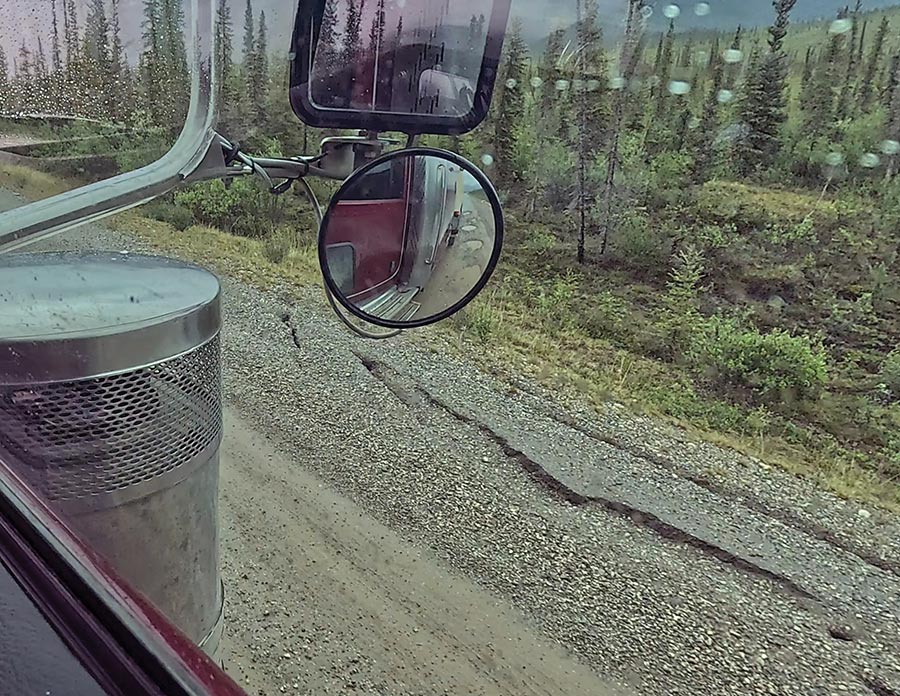
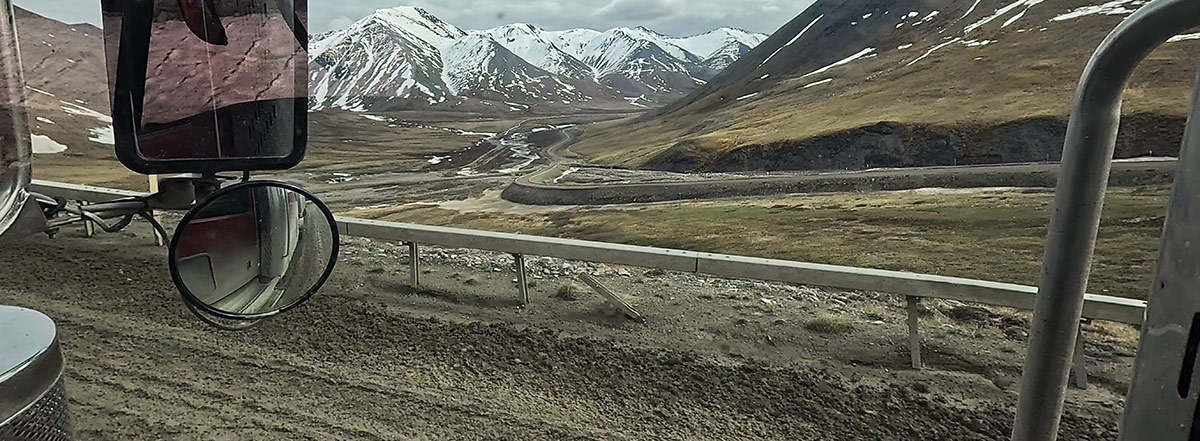
Pavement costs the most, but theoretically has the most longevity, says Josh Fischer, DOT&PF’s maintenance and operations superintendent for the Dalton Highway. Under ideal circumstances, “Pavement might last twenty years. But as any Alaska driver knows, roads here don’t traverse ideal conditions, least of all the Dalton. Pavement ten years or older takes more maintenance,” Fischer says, “and the farther you get away from a metropolitan area, the harder that is.”
Chipseal, sometimes called “high float,” can last three to seven years, Fischer says. Longevity depends on “where it’s applied and how much the road moves.” Gravel costs the least and is less prone to frost heaves. Crews can also maintain gravel throughout the year, but they can only fix pavement certain times of the year. However, Fischer says gravel loses one inch per year. It’s also especially bad in rain, and gravel is prone to dust that Romanovsky says kills vegetation covering permafrost, which harms the permafrost itself in turn.
Regardless of a given mile’s surface, Fischer says weather poses the greatest challenge to road maintenance. “You can leave Fairbanks and it’ll be 20°F above here and you get up to Yukon River and it can be 60°F below there, and then you get up by Atigun Pass and it’s 20°F above again, the wind’s blowing 60 miles an hour and you can’t see 10 feet in front of you.”
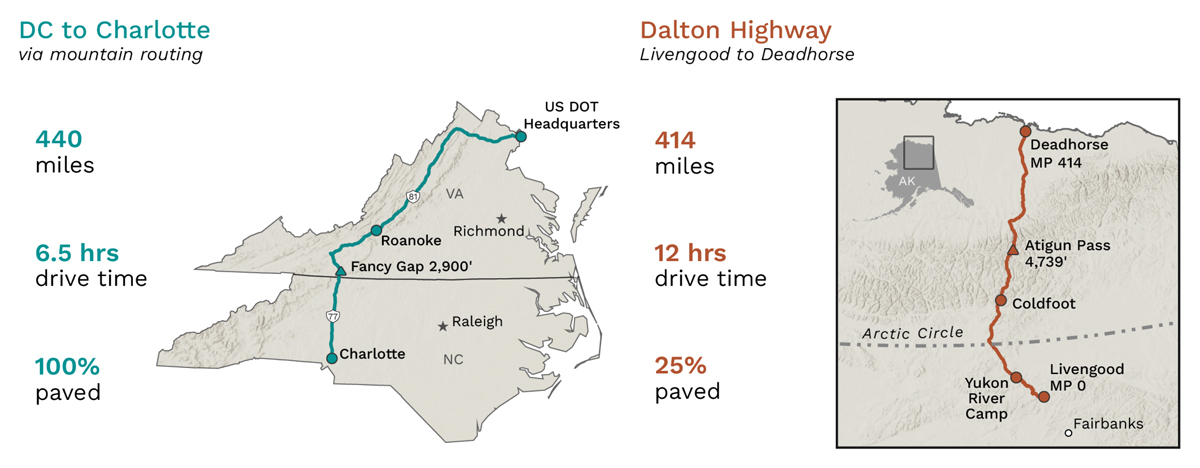
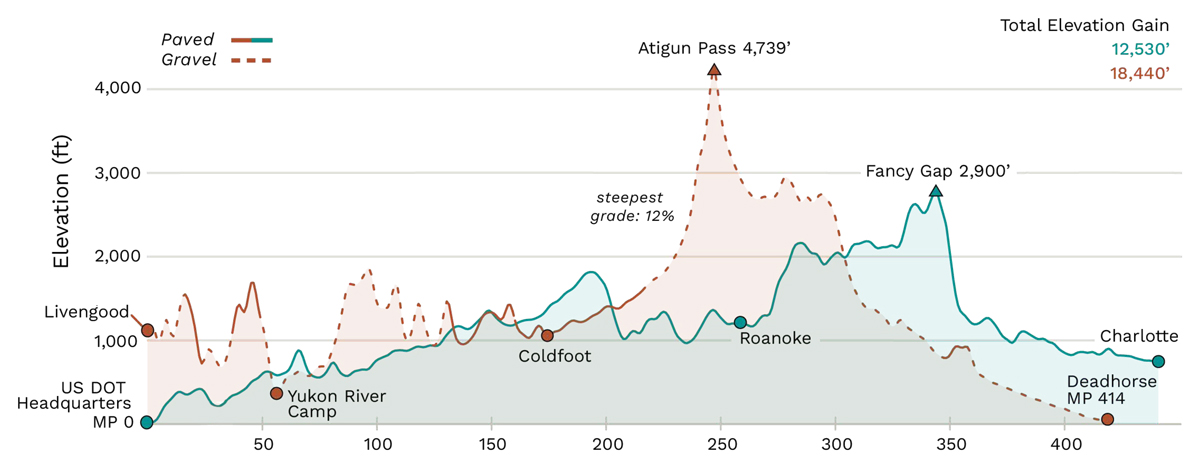
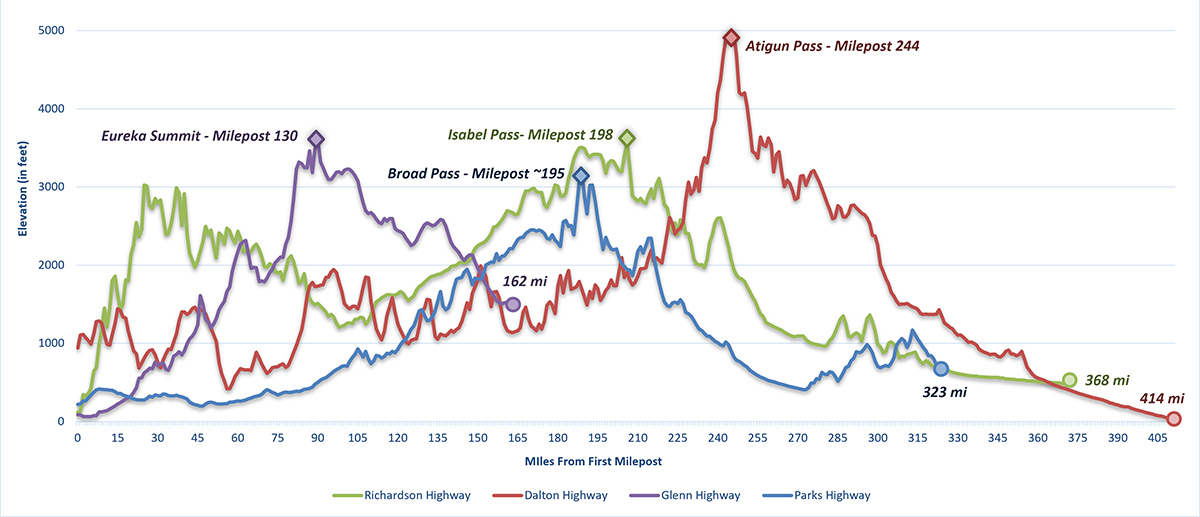
Geography creates additional challenges, Fischer says. Between how fast Alyeska Pipeline Service Company first built the road—in five months—and its original raison d’être, the Dalton has several sections that don’t conform to federal highway standards. The 12 percent grade through Atigun Pass? Twice the recommended maximum steepness of 6 percent. The road also has some tight corners. Fischer says “facilitating truck traffic… on steep grades… takes more repair than more conforming hills.”
The small crew size can also complicate things, especially if workers quit or can’t make their two-week shift. Hauling material from a site can sometimes require three people to move vehicles, Fischer says, but he might have only two people on shift. “It’s just the constraints of our resources,” he says.
Until recently, DOT&PF also sometimes faced US Department of the Interior Bureau of Land Management (BLM) limits on where materials for reconstruction and maintenance could be sourced. In his January remarks, Anderson called the revocation of Public Land Order 5150 earlier this year, opening BLM land to resource use, “a big deal… The sooner we can have access to those gravel resources, the better we can do our jobs,” he said. “Otherwise, we… can be hauling gravel for 50, 60 miles. You can only do so much when that’s the case.”
And then there’s maintaining the maintenance vehicles themselves, after the beating the road gives them. “It takes pretty considerable effort to manage a fleet that’s stretched along a 500-mile corridor, and some of it is 250 miles away from the nearest parts store,” Fischer says. “It can take a number of days or sometimes even weeks to get the part you need” out to where it’s needed.
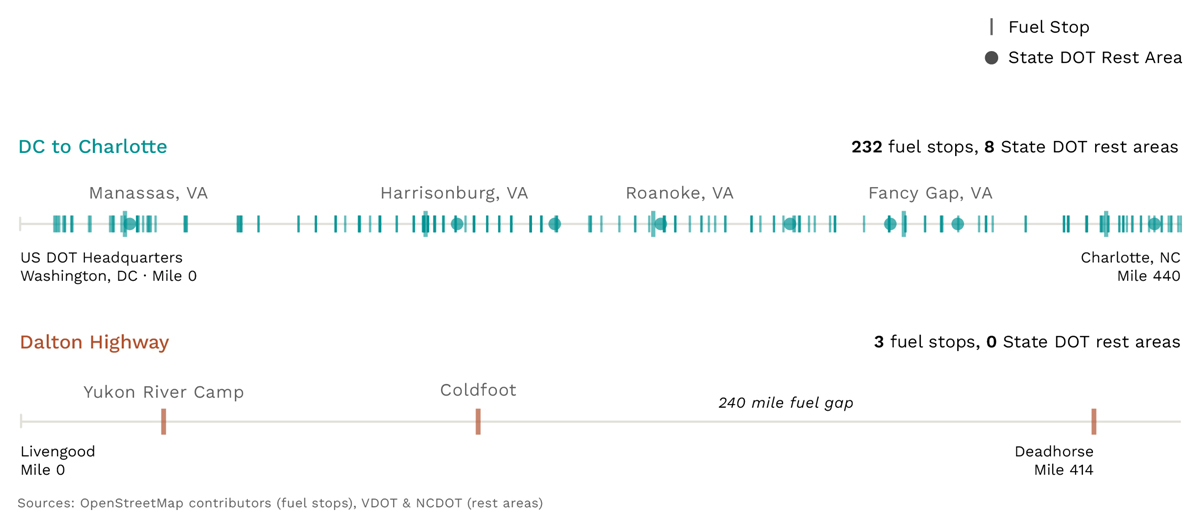
From Livengood (mile 0) to Prudhoe Bay, the highway has three fuel stops: Yukon River (mile 56), Coldfoot (mile 175) and Deadhorse, at the road’s north end. BLM maintains a handful of rest stops and campgrounds, most concentrated south of Atigun Pass (mile 244). According to the visitor’s guide, Galbraith Lake (mile 275) offers the last bathroom until Deadhorse.
Access to law enforcement and medical care is similarly limited. Austin McDaniel, a spokesperson for the Alaska State Troopers, says accident response times depend on location and severity. At the south end, troopers could respond from Fairbanks. If closer to the north end, North Slope Borough Police might respond.
Under flawless conditions, truck driver Robert Christianson says the trip from Prudhoe Bay to Fairbanks theoretically takes twelve hours. But a recent trip took him about two-and-a-half days, due to the weather. Conditions like those make other drivers more likely to be first responders to an accident than law enforcement or EMTs.
Given the limited services along the highway, both DOT&PF and Alyeska Pipeline workers sometimes respond to requests for help simply because they’re in the area. While Alyeska Pipeline staffs its pump stations with security medics, their primary focus is employee safety, says the company’s chief communications officer, Michelle Egan. “We don’t have the resources to be the responder,” she says, but they try to help when they can. “When we’re able to respond, we will… but there’s limits to what we can do.”
Fischer says DOT&PF faces a similar challenge with its seven maintenance camps, which exist to house employees and equipment. “State policy is [that the camps are] for workers only,” he says. But “obviously we’re not gonna leave somebody in a broke-down truck with no heat in 50°F below,” he says. “We’re all part of a large community up here, right?… We always try to help each other out.”
Unprepared drivers are “the number one problem” on the Dalton, Christianson says. In the highway’s early days, he says truck drivers had to go through something like an apprenticeship to drive the road. “You used to have to run that road with a seasoned driver for at least three months before you would be allowed to travel that road by yourself,” Christianson recalls. Nowadays, he and Benson say drivers might run ten to twelve trips before hauling solo.
By contrast, recreational drivers or even truck drivers from companies outside Alaska might reach the highway’s south end with little more than their driver’s license and tire chains. “It’s a different kind of trucking from what it is in Canada and the Lower 48,” says Canadian truck driver Julie McCarthy. Before she met Christianson and other drivers, she didn’t know the spots on the road where she needed to call out her position on the CB radio channel 19 that drivers use. Alaskan drivers also taught her to put Trygg snow chains on her trucks, which have much better grip than chains she’d used before.
A “Dalton Highway Etiquette” brochure developed by ATA members and distributed by ATA recommends drivers use “three-rail, V-Bar, or Studded Trygg” chains and carry items including 2.5 gallons engine oil, “full body winter gear,” and three pairs of gloves. Benson says it covers “every kind of scenario, any kind of safety need you would have” on the Dalton. ATA has worked to have the brochure handed out at the border and other places where a Dalton-bound driver might pass through.
“Drivers who are going up there for the first time should learn more about it,” McCarthy says. “You’d better be prepared for it. Because on certain days, it will chew you up and spit you out.”
Christianson and his fellow drivers sometimes use nicknames for the tourists who drive the Dalton—“we have nicknames for everything up here,” he says. But none of truckers’ frustration with ignorant or unprepared travelers matters when someone has a need. Christianson recalls a young bicyclist who set out on the Dalton, thinking he’d packed enough food and supplies for the entire round trip, but ran out 100 miles south of Prudhoe. “Who’s gonna help him? Us. Who’s gonna make sure he stays alive? Us,” Christianson says. “At the end of the day, we’re all human, and we need to help each other… We need to make sure everybody gets off that road alive.”
Dewberry Engineers
Running a continuous counter requires both reliable power and some kind of phone connection, Vockeroth says. Much of the Dalton doesn’t have cell service, but sources say that’s slowly improving. That has left power as “the biggest hiccup,” Vockeroth says. DOT&PF has tried solar-powered counters, such as at the Yukon River bridge, but these only collected data for part of a year.
“On top of that, there is the roadway. Our sensors, depending on what kind of setup we have, if they’re embedded in the roadway, they can get torn up,” Vockeroth says. “There’s always the heaving and the potholes… so having something in the roadway is hard” in terms of longevity. Newer sensor technologies use roadside installations, but these take more power.
Instead, DOT&PF aims to collect a week’s worth of data from different points along the Dalton every summer.
It’s even harder to come by accident data, which Fischer attributes to the limited law enforcement presence. As of early September, his statistics showed 677 total accidents since 1977, of which 22 were fatal, for an average of 14.5 crashes a year. “A person could infer that a lot of things go unreported up there,” he says.
Word has gotten out anyway. The Dalton’s role as “the end of the Pan-American highway is a big deal,” says Matt Atkinson, one of three owners of the Northern Alaska Tour Company. Along with tour operations, the company also runs various businesses along the Dalton. Atkinson describes discussions with Tesla about adding electric vehicle charging stations at points like Deadhorse and Coldfoot.
“There’s so many projects that are… adding demands on the Dalton,” Wilcox says. “Alyeschem’s really the only one I know of that’s removing pressure from the Dalton.”
The need for trucked-in diesel stems from US Environmental Protection Agency (EPA) changes since 2006. Prior to that, Wilcox says Prudhoe Bay and Kuparuk could largely make their own diesel through what are known as topping stations. But the EPA’s new requirements involved more sophisticated refining than the topping stations could do. Despite an initial agreement with the state to upgrade facilities to make the ultra-low-sulfur diesel, oil producers decided to import the fuel instead.
Once operational, Alyeschem will provide a much closer source of ultra-low-sulfur diesel than Prudhoe Bay has had. Wilcox hopes to convert 1,500 barrels per day, producing 63,000 gallons of EPA-compliant diesel. According to Benson, an average tanker can haul 9,600 gallons of diesel. By reducing how much diesel must be trucked up the Dalton, Wilcox hopes the freed-up supply can help reduce some of the cost pressures in other parts of the state.
For the Dalton to thrive in its next fifty years, its stewards must find more ways to balance the needs of all who live, work, depend on, and wish to explore its 414 miles.