

ate Mitchell had a sewing machine and a dream she clung to like a barnacle on a boat.
In 1965, because there were no jobs, she enlisted in the US Coast Guard Women’s Reserve, also known as the SPARs. The abbreviation was derived from the Coast Guard motto, “Semper Paratus”—Latin for “Always Ready.”
By going outside of her comfort zone, Mitchell was following the example set by her mother, Ruby Reeder Kent, after the family moved to Washington during World War II.
“So many guys had been drafted that many businesses were in danger of having to close,” Mitchell writes in her memoir The Bag Lady at the End of the Road. “Christianson Upholstery, on South Tacoma Way, advertised for an upholsters’ apprentice. Ruby applied. It paid more than the sewing jobs that women were usually hired for. Christy didn’t want to hire a woman, so he said, ‘Okay, lady, if you can get that couch up on those sawhorses without help, I’ll give you the job.’ She eventually earned her journeyman’s card in the upholsterer’s union. The first woman ever to do so.”
It was the second time in Ketchikan, with two little children, that Mitchell started her sewing business, borrowing $1,500 to buy a machine. Ketchikan Marine steered jobs her way, initially repairs like zippers, patching, and stitching—and, for the first time, boat covers.
Mitchell’s Boat Tops was open for business in her home, charging $25 per hour.
In 1978, Ben was transferred to USCGC Sedge in Homer, and the family settled there at a time when the population was 2,050. The surge of people after the construction started for the Trans Alaska Pipeline System made Homer grow quickly; it doubled in population between 1977 and 1978.
But with the population boom, there were few properties to rent to start the business, so Kate ended up in a gutted-out bus. A sign painted on the sign read “Mitchell’s Marine Canvas and Upholstery.”
In the fall of 1979, she moved the shop into a Quonset hut in a storage yard. There was space to bring in a boat to fit with a cover, a warm coal stove, an outhouse, and a dirt floor covered with plywood for the sewing machine.
NOMAR
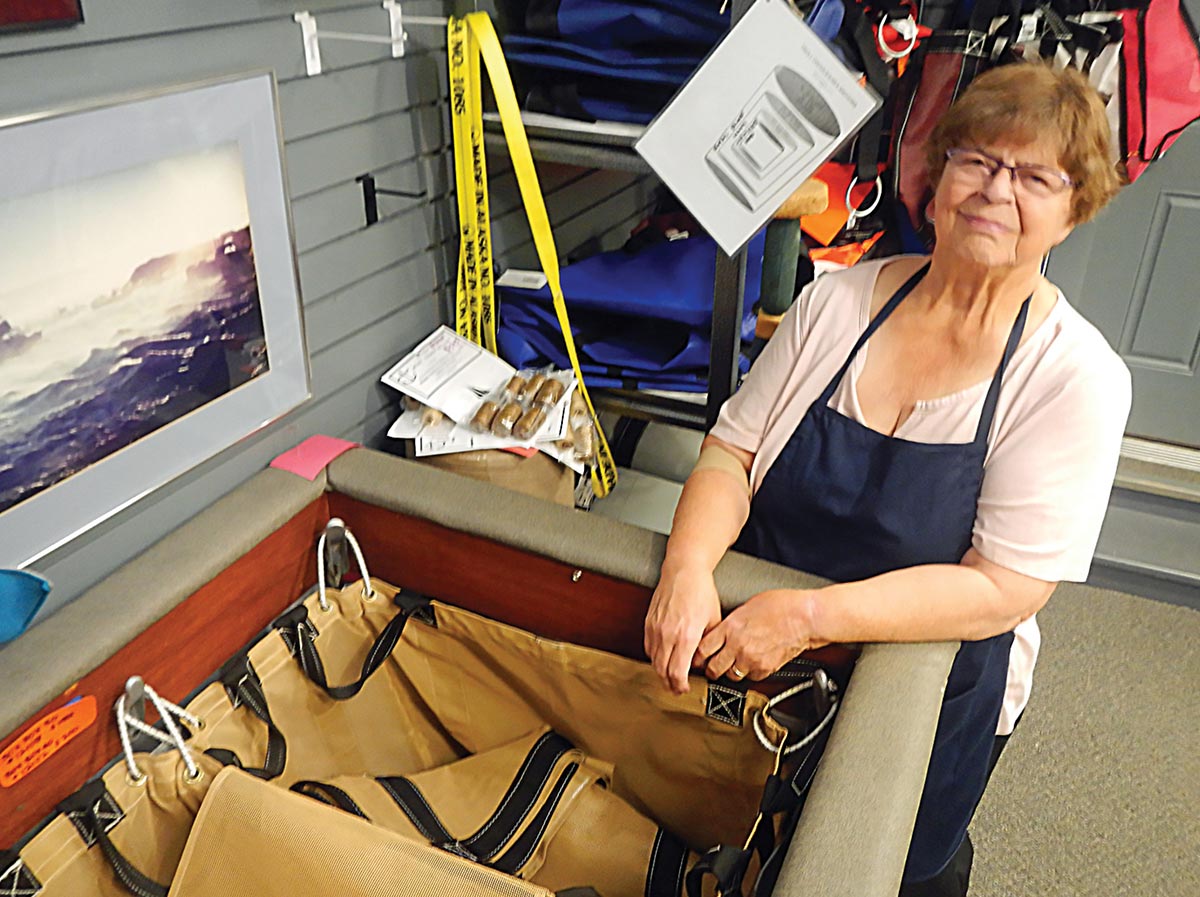
NOMAR

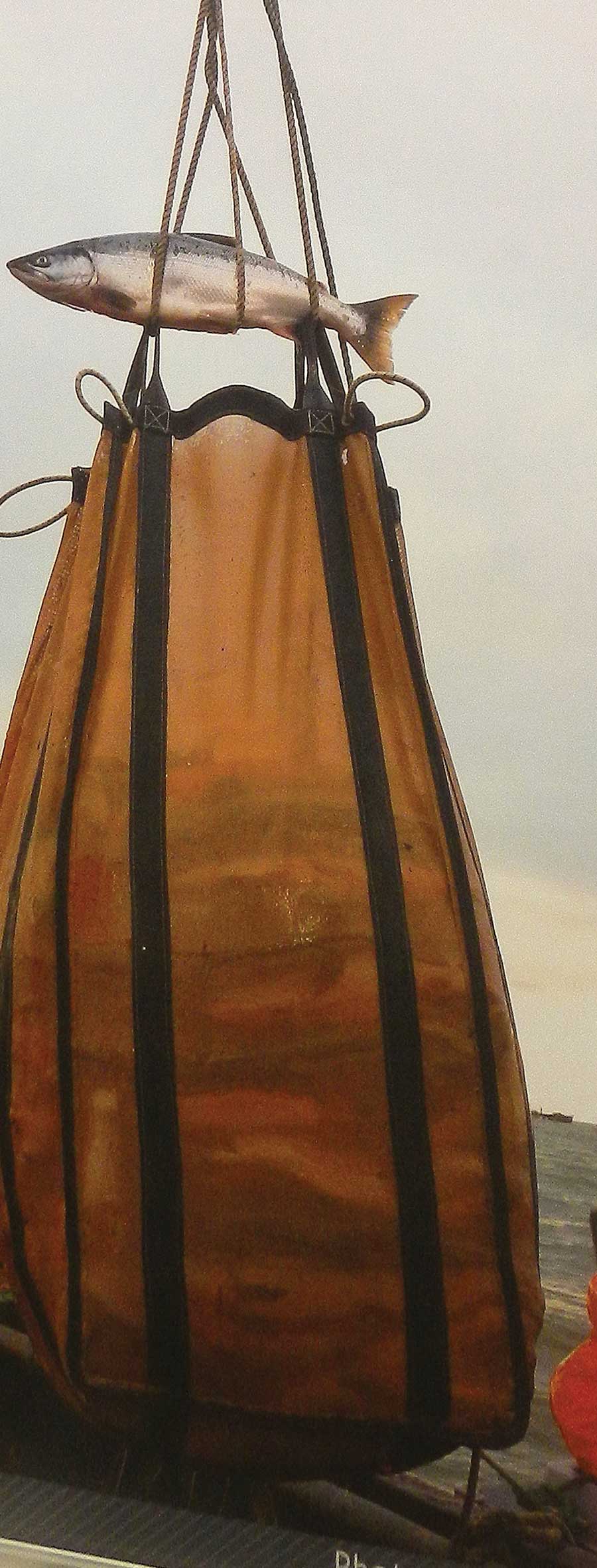
In the winter of 1982, a fisherman came to Mitchell with a problem he thought she could solve. The net brailers used in Bristol Bay and False Pass crushed the fish when hauled in, making marks on the fish that lowered their value. So, instead of netting, she tried out tarp material, but it turned out the grommets on the bottom that drained the slurry formed a suction that could not be broken.
“We needed a fabric that would drain faster and hold fish,” she says. “With no internet, no other canvas businesses to talk to, I was on the hunt for a material that would work.”
She found a net-like fabric, but it took a while to learn production techniques.
This was the beginning of the long road to the perfect brailer bag and the trademarked NOMAR “no marka the fish” label.
That’s not the official derivation of the new business name. Formally, it’s a contraction of Northern Marine Canvas products.
The standard bag size was 30x30x40 inches and held 1,000 pounds, but they didn’t fit on the small bow pickers, so the Mitchells added custom sizes.
Another local gear supplier sent a prototype to an overseas manufacturer to be copied, but those cheap bags broke and lost the fish.
Three more companies tried to copy the NOMAR brailer design and failed. NOMAR bags built a solid reputation with fishermen, and that has not changed.
To better market the NOMAR brand, the Mitchells traveled to the Pacific Marine Expo in Seattle. There they had a booth across from the beer garden and offered bags of peanuts, ran a video, and talked up their products to anyone walking by.
In March 1992, they bought a vacant grocery store on Pioneer Avenue in Homer and cleaned it up.
Mitchell’s children Richard Mitchell and Jennifer Hakala now own the company, with Jennifer in charge of the store and Richard running the sewing side and boat side. NOMAR remains one of the few sewing shops in Alaska capable of manufacturing apparel and accessories at scale.
Richard is still developing new products, such as inventing a waterproof cover for a $1,000 electric reel. Innovations continue to be a source of pride for the company. NASA even contacted the company to design a custom bag for the Artemis lunar program.
NOMAR
NOMAR

Another consideration was finding trained workers. Now a nonprofit, Homer Marine Trades Association, in cooperation with the North Pacific Fisheries Association, pushed for a deckhand training class at the Kachemak Bay campus of UAA’s Kenai Peninsula College that would eventually lead to a marine tech course of study. And Homer High School offered one-hour sessions with local business owners about pursuing work in the marine trades.
These days, Homer teems with tourists during the warm months, but fishing vessels go out year-round. It is now a town with many parts working together, and NOMAR’s homegrown textile manufacturing stands firmly at the center of a boat support industry.
At the presentation of the August award, Kenai Peninsula Borough Mayor Peter Micciche stated, “We’re recognizing these folks because they literally provide an economy for the Kenai Peninsula Borough that would look nothing like it looks without these industries.”