


laska mining companies are combining proven engineering with real-time data, advanced recovery systems, aerial drones, and digital compliance tools to extract more value from natural resources while shrinking long-term environmental risk. This represents a broader shift in Alaska mining where technology is no longer confined to increasing production. Tech is being used to recover more metal from ore already mined, reduce the volume or risk profile of tailings or leftover material, improve water management, lower energy demand, protect workers, and produce the data needed to satisfy increasingly detailed permit requirements.
At the same time, state regulators are using real-time data, satellite connectivity, digital models, and aerial imagery to monitor sites spread across a vast and logistically demanding landscape.
This shift matters in Alaska, where mining is a major economic driver but faces constant environmental scrutiny. Technology is especially valuable at remote sites, where sampling, communications, and field inspections tend to be more costly and complex.
Owner and operator Hecla Mining Company is evaluating the potential of a pyrite concentrate circuit that would add a flotation step to separate pyrite-rich material into a dedicated concentrate stream. Pyrite—commonly called fool’s gold—is an iron sulfide mineral that can contain or occur alongside silver and gold. Instead of suppressing it and sending it to waste, the proposed circuit would turn it into a marketable product.
“We’ve always tried to be innovative in our approaches in minimizing our impact,” says Mike Satre, director of governmental affairs for Hecla. He describes the project as transformative because it could “separate pyrite materials that currently go into our waste stream and turn that into a marketable, sellable product.”
Preliminary metallurgical and engineering studies suggest that the pyrite circuit could produce around 1 million ounces of silver annually. Along with aligning revenue growth with waste reduction, the pyrite concentrate circuit would also address a significant environmental issue. “We’d be able to take all of that material, maximize the extraction of metals, and remove our biggest long-term environmental liability from the Admiralty Island National Monument,” Satre says.
Hecla is completing the final engineering and feasibility work now, with production being targeted for the first quarter of 2027. Since the underlying flotation technology is something the company is already applying, the immediate questions relate to capital investment, integration, and commercial feasibility. Satre describes the project as a “great internal growth opportunity” built upon material already moving through the mill. “It’s a great way of using tech that didn’t pan out years ago—but it does work now—so that we maximize and minimize waste,” he says.
Greens Creek’s tailings inventory is substantial. Hecla estimates that about thirty-six years of dry-stack tailings contain roughly $6.1 billion worth of precious and critical metals, including approximately 51 million ounces of silver, 600,000 ounces of gold, 310 million pounds of zinc, 205 million pounds of lead, 27 million pounds of copper, and 1.3 million pounds of nickel. Smaller quantities of other critical minerals are also present.
“Hecla has always focused on innovative technologies and solutions to address challenges in the mining industry, and recovery of critical minerals from tailings is just the latest example of this,” Satre says.
If successful, the tailings reprocessing project could extract value from material that has already been mined while also reducing sulfides in the tailings pile by an expected 96 percent, reducing chances of acid mine drainage, arsenic leaching, and groundwater contamination in the long term. It could also support demand for critical minerals without relying exclusively on new extraction. “What it comes down to is: we reduce our environmental impact when we are the most proficient with what we do,” Satre says.
That impact-reduction principle extends to standard operations. Greens Creek currently uses GPS proximity systems and fatigue-monitoring cameras in surface haulage, which can protect drivers and prevent environmental incidents such as spills. The mine also tracks water-treatment demands, diesel use, dust, and biological indicators. “It’s being incredibly efficient in what we do to reduce environmental impact,” Satre explains. “It’s continuous improvement; everybody works together to make that happen.”
Usibelli Coal Mine

Usibelli Coal Mine
The results are measurable. “Usibelli has fully reclaimed more than 5,500 acres, with hundreds of additional acres currently in active reclamation,” Seavey says. “Because reclamation is a long-term process, we also have several thousand acres in various stages of reclamation and monitoring at any given time.”
Beyond the mining process itself, Usibelli has upgraded electronics and control systems in its processing facilities to improve energy efficiency, modernized its environmental compliance program with digital tracking and reporting tools, and invested in advanced laboratory technology to analyze and manage water quality. It also uses drones extensively for surveying, environmental monitoring, and other operational applications. “They allow us to survey and inspect areas that may be difficult or unsafe for an employee to access while also providing high-quality data more efficiently,” Seavey says. The same information can support earthwork calculations, reclamation planning, and environmental documentation—compressing jobs that once required more field time.
Usibelli is also meticulous about water management. At the Jumbo Dome mining area, for example, it uses a customized passive system to treat collected stormwater and groundwater before discharge.
Instead of relying solely on energy-intensive mechanical or chemical treatment, the system uses natural processes adapted to local conditions. Seavey says the system has been highly effective. Water discharged from the treatment system can be cleaner than the naturally occurring water in the receiving stream. “For us, the goal is not simply to meet a regulatory standard. It is to design systems that work effectively in Alaska’s environment and protect water quality over the long term,” he says.
The company’s energy strategy also demonstrates how industrial assets can foster efficiency. For example, Usibelli has been using electric mining equipment for decades. “Our Bucyrus-Erie 1300W dragline, known as the ‘Ace in the Hole,’ is the largest piece of mobile equipment in Alaska and is 100 percent electric,” Seavey explains. “It has been central to our mining operation since the late 1970s.”
Usibelli also uses a custom-designed electrical peak-shaving system in conjunction with the dragline. The system captures energy generated during portions of the dragline’s operating cycle and uses that recovered energy to help reduce the machine’s peak electrical demand. “It is a good example of how technologies that improve efficiency and reduce energy demand can be incorporated into large-scale mining operations, and we have been doing this for many years,” Seavey says.

Alaska Department of Environmental Conservation
Division of Water
That long-term dataset helps Usibelli identify trends, evaluate whether mining activities are having an impact, measure the effectiveness of environmental controls, and continuously improve practices. It also provides an objective way to evaluate whether a new technology, treatment system, or operational approach is producing the intended results.
Data is also integral to environmental management at Greens Creek, as long-term monitoring helps distinguish normal environmental variations from mine-related impacts. Greens Creek, whose record reaches back nearly fifty years in some areas, uses monitoring to evaluate metal levels, dust from tailings, and fish biology, and then adapts plans when controls do not perform as expected.
The mine also continually collaborates with stakeholders and regulators. If data indicate impacts from its operations, Hecla explores changing its operational strategies to minimize and mitigate those impacts. Such datasets can help distinguish operational effects from natural variability—which is a crucial task in a large, relatively young state where long-term environmental records can be limited.
“That is the key to building up this comprehensive ecological understanding of the environment we’re operating in,” Satre says.
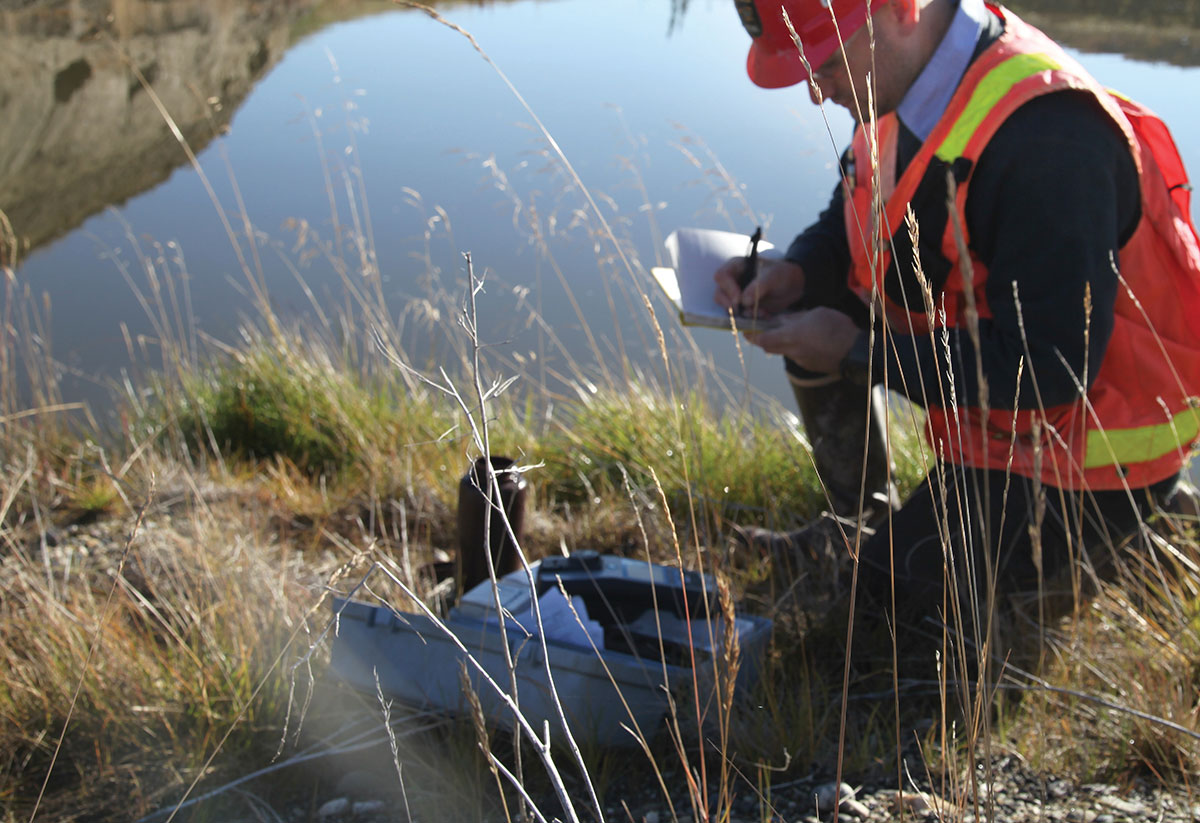
State regulators are seeing the same shift. Nick Waldo, mining section manager within the Alaska Department of Environmental Conservation (DEC) Wastewater Discharge Authorization Program, says multiple mines now use real-time monitoring within treatment processes to identify problems early. “For example, turbidity monitoring is increasingly done in real time,” Waldo says. “Because suspended particles can carry heavy metals and other pollutants, turbidity is an important parameter to keep an eye on and test further if needed.”
Meanwhile, remote connectivity is solving a distinct Alaska problem: samples, reports, and consultations must move across long distances, often from sites without road access. “This can make it difficult to ship water quality samples to analytical labs within the window where the sample is valid, as well as impacting communications between miners and DEC,” Waldo says.
But modern telecommunications are alleviating the problem. “Satellite internet connections can allow permittees to file forms, data reports, and more from onsite instead of relying on slow and sometimes unreliable physical mail to Juneau or Anchorage from the mine sites,” Waldo says. DEC has also transitioned to an online portal for submissions—an environmental data management system.
Better targeting can make inspections more effective, while remote monitoring and just-in-time telemetry can signal where closer attention is needed. Waldo views drones, high-end statistical models, and remotely monitored sampling sites as technologies with particularly strong potential to reduce water-related environmental risk in mining during the next decade.
These tools could help organize a fragmented permitting journey. Authorizing a large mine involves obtaining many different water permits. And multiple programs need to be coordinated across not only DEC but also the Alaska Department of Natural Resources (DNR), Alaska Department of Fish and Game, and other agencies. “The technical questions of a specific water quality permit are complicated on their own, but then they need to be put in the context of the holistic permitting and public policy process,” Waldo says. “DNR has an office dedicated to this coordination; we were ahead of the federal government on that one. The new FAST-41 program, which many mines are signing up for, has a lot of similarities to what the state has been doing for a while.”
One of the key features of that program is a public data dashboard that tracks multiple concurrent permitting processes online in real time. This can give agencies, applicants, and the public a clearer view of status and dependencies.
For Usibelli, regulatory compliance is a fundamental responsibility. “Usibelli began reclaiming mined land before federal law required it, and that commitment has continued across generations of the company,” Seavey says. “At the same time, we do not view our past accomplishments as a reason to become complacent. Mining technology, environmental science, and monitoring capabilities continue to evolve, and we are constantly evaluating opportunities to operate more efficiently, improve environmental performance, and further reduce our impact on the land.”