

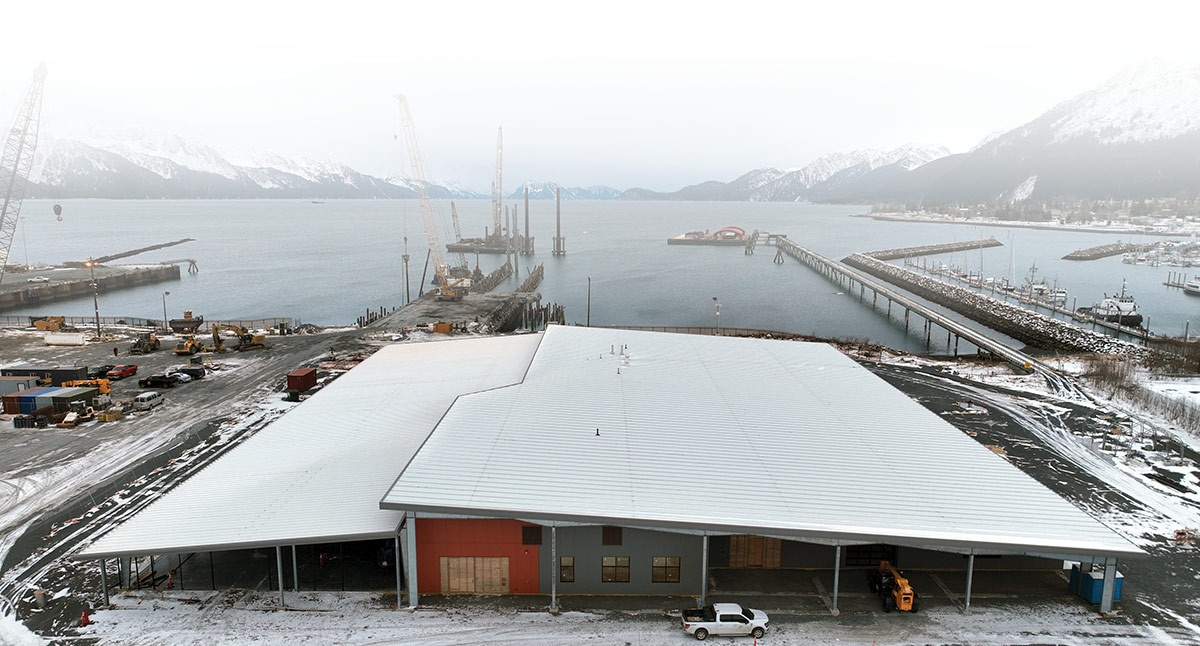
he Port of Seward has long been an important multimodal gateway, connecting marine cargo, cruise ship passengers, and rail passengers to Alaska. Now, a major infrastructure investment has transformed the aging facilities, expanding and modernizing the port to position it for increased economic opportunity.
The revitalized Seward Cruise Ship Terminal is designed as Alaska’s largest turn port, where passengers begin or end a voyage and ships are fully reprovisioned. It features a state-of-the-art floating double-berth pier, a 200-foot-long split transfer span, a 41,500-square-foot passenger terminal, and 27,500 square feet of covered outdoor space for luggage and passenger vehicles. The $137 million project is the culmination of a multi-year joint effort by the Alaska Railroad Corporation (ARRC), Royal Caribbean Group, and The Seward Company, headed by real estate developer Mickey Richardson.
The project’s partners stress the collaborative nature of the process.
“Operations logistics are different [in Seward] than a lot of the other places we operate. We worked hand in hand with Mickey and Jason [Davis] from Turnagain Marine, and the Alaska Railroad, who had operated the existing terminal there for many years,” says Josh Carroll, Royal Caribbean’s senior vice president of destination development. “All of our thinking came together to [determine] what would create the best structure for what we all need.”
“The project that rose to the top of that master planning process was the critical need for a new passenger dock,” says Terry, who was the railroad’s port manager in Seward at the time, before a term as city mayor. “Once we had done a really deep-dive assessment, we realized that the dock was at the end of its useful life and required some major replacement.”
Despite the urgent need for replacement facilities, several attempts to get a project on track were unsuccessful—until Richardson formed The Seward Company as lead developer under his parent company Port of Tomorrow. He brought in Royal Caribbean as a major collaborator and designed a proposal that satisfied the cruise line’s needs, securing a thirty-year pier use agreement with Royal Caribbean as the anchor tenant that guaranteed a 140,000 passenger minimum annually. Richardson approached the ARRC with his proposal in January 2024; by July, the three organizations had agreed to terms.
“We started by vetting this process through all of the different divisions that Royal Caribbean would be operating—hotel operations, procurement, security, marine operations—so that when we took the final proposal to the railroad, it had essentially been approved with all the elements to make this a world-class port,” Richardson explains. “It’s a facility that’s a purpose-built design for cruise passengers, but also we know what the conditions are in Seward, and also the needs of the railroad outside of the cruise season, so we tried to accommodate all of those things in the design.”
Richardson’s understanding of the unique needs of all project partners was a key reason why Carroll believes this iteration of the project was not derailed. “I think it was their understanding of us as a large, publicly traded organization; their understanding of the Alaska Railroad and their capabilities and processes; and then lastly, timing for sure played a role in it,” he says, noting that COVID-19 was no longer sidelining projects. “They were able to bring together various groups that had their own unique operating structures and bring us all together.”
Carroll says Royal Caribbean requested a few “very, very simple things” to change, such as relocating the terminal from the dock to solid ground, opening up the dock’s layout to improve logistics and make for a more seamless embarkation and disembarkation process, and creating a terminal designed for passenger and grounds crew ease. The changes, he says, were the result of the dock and terminal having a different purpose today than when it was built more than sixty years ago.
“I don’t even think the idea of a cruise ship visiting was even a faint glimmer in anyone’s eye” in the ‘60s, he says, “so it was not built for cruise ships in any way, shape, or form.”
The Seward Company
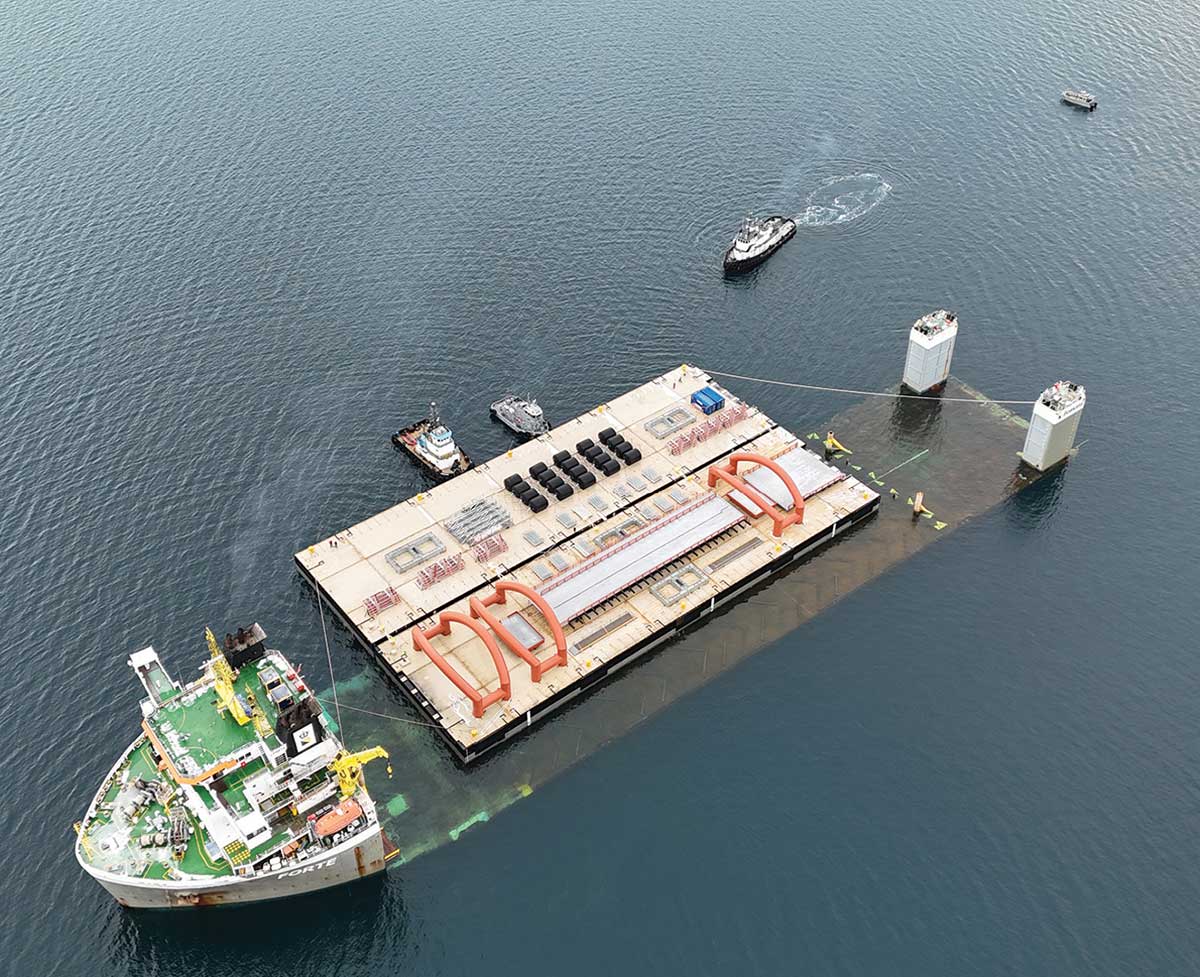
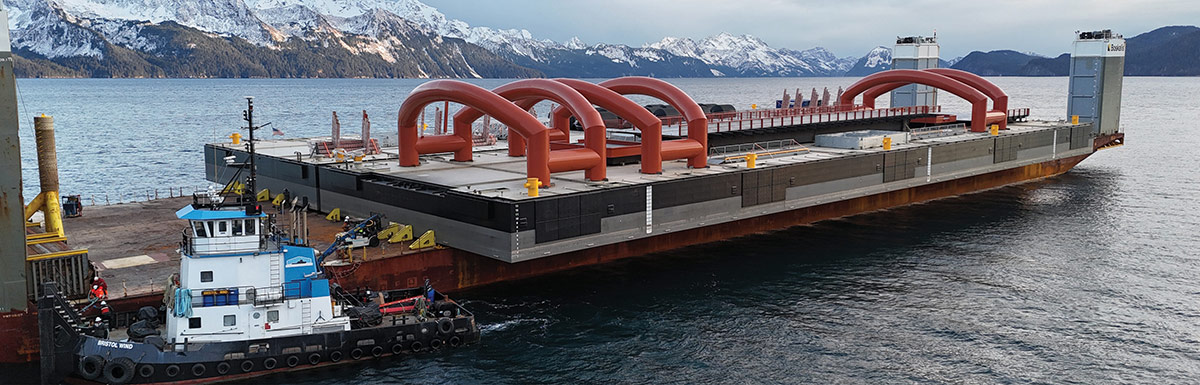
“The benefit is that the dock will be set to the actual height of the provision doors,” Richardson says. “The pier itself moves up and down with the ship, and there’s never any change with the mooring lines and the gangways, so it always stays level without needing stairs or moving walkways. That’s a huge difference in the way that it will function.”
A 200-foot-long split transfer span facilitates safe and efficient embarkation and disembarkation of cruise ship passengers and provisioning vehicles. Additional mooring dolphins, a load capacity that exceeds current requirements, and caissons with a thirty-year design life were included to accommodate future changes in vessel size, Richardson adds.
The passenger terminal, which is 75 percent larger than the original, was designed to meet the cruise industry’s needs. It includes covered awnings in the outdoor waiting space and an open-air component to protect vehicles and luggage from the weather.
“The new facility really does help with passenger protection from the weather and the safety aspect of separating vehicular and equipment traffic,” Terry says. “The new design helps with passenger flow, and we have covered walkways and larger awnings protecting passengers from the inclement weather, augmenting the customer experience.”
Separate from, but tangential to, the cruise terminal, the City of Seward is advancing a project to provide shore power to vessels. Funded primarily through a US Environmental Protection Agency grant, the project aligns port operations with the community’s environmental stewardship values.
“This project will allow up to two cruise ships to plug into shore power while docked, rather than running their engines,” Seward City Manager Kat Sorensen says. “It includes the installation of the necessary electrical infrastructure as well as a battery energy storage system to support reliable power delivery. The goal is to significantly reduce air pollutants and greenhouse gas emissions associated with vessels at berth.”
“That in and of itself becomes a challenge, knowing that your cost to develop is higher,” he says. “Trying to figure out how to pay for it trickles down across all parties. That is a challenge.”
The project is funded by a mix of pier usage fees collected between 2022 and 2025 and ARRC-issued revenue bonds; the bonds are secured by Royal Caribbean’s thirty-year pier use agreement and guaranteed passenger minimums. The commitment is “a tool we use from time to time in places that are very critical to us,” Carroll says. The Alaska Legislature had to approve raising the state-owned railroad’s bonding authority from $60 million to $135 million to advance the project.
The unique arrangement to finance the $137 million terminal netted it an award for 2025 Deal of the Year in the Far West by The Bond Buyer, notes ARRC Director of External Affairs Meghan Clemens.
The project’s biggest obstacle was the clock, which posed dual challenges.
“We have a failing piece of infrastructure that creates pressure,” Richardson explains. “When you have a state-run entity, it has its own limits as far as time goes. And you also have the reality that you only have a limited amount of time to construct the terminal because of the seasonal effects of winter and the effect of the cruise season.”
Getting Royal Caribbean on board with the design before presenting the proposal to the ARRC helped with the time crunch. So did having design-build firm Turnagain, which has marine construction experience throughout Alaska and in Resurrection Bay, serve as general contractor, Richardson says.
Structuring the project to avoid interrupting the cruise ship season was the other big clock-related challenge. Construction began in spring 2025, and demolition of the original dock began the day after the 2025 cruise ship season ended. Working in conjunction with ARRC and Royal Caribbean, Richardson designed a transport plan that enabled passengers to move alongside construction, with no interruptions to cruise or rail operations.
“We were able to have a continuous cruise ship season last year, so it didn’t interfere with any of our docked ships,” Terry says. “The developer simultaneously began the construction phase of the project while we continued to run an uninterrupted cruise ship season.”
“That was a really great thing, that we were able to continue our operations, while also making progress on the project in parallel,” Carroll adds. “That was very important and a really strong attribute of the project.”
Construction is not anticipated to hamper the 2026 cruise season either; the new facility is scheduled to be open to passengers this summer.
Alaska Railroad Corporation
The revitalized cruise ship dock and terminal offers more than a good first impression—it brings expanded economic opportunities for Seward and Alaska’s entire visitor industry as well.
“For the City, it means increased economic activity and greater year-over-year stability by reinforcing Seward’s role in the cruise industry,” Sorensen explains. “While we are a year-round community, we rely on seasonal tourism, and the terminal will be a key driver in supporting our local economy and the residents who live here full-time.”
Those benefits aren’t limited to the cruise ship season, either. The terminal was “designed with flexibility in mind,” Clemens says, and the ability to reconfigure the interior’s layout provides increased opportunity to be used as a community space during the off-season.
“The community had often used the previous terminal for winter events, such as the Seward Music and Arts Festival,” Sorensen says. “I know we are all looking forward to finding ways to engage with the new facilities in a similar way and expanding the options for meeting and rental spaces.”
Construction also brought jobs to Seward. Richardson prioritized hiring local contractors, laborers, and construction companies, and he says there were consistently between thirty-five and fifty local workers on site. Ensuring the terminal’s longevity guarantees the continued availability of marine industry jobs in Seward.
“Cruise ships employ union longshore workers, and these are really good, living wage jobs, and this ensures that these will continue in the City of Seward,” Terry says. “Local jobs in check-in, security, [and] delivery during the cruise ship season, and in the off-season—the dock is going to be used to support the marine service industry.”
Last but far from least, cruise ships also come with passengers who have time to spare and money to spend while waiting to set sail or catch a train or other land-based tour, a boon to local businesses.
“When you look at that wave that moves off the ships, it helps local businesses—excursions, restaurants, staying in hotels, shopping in small shops,” Terry says.
And those waves of dollars are not exclusive to Seward.
“This facility is really important infrastructure with statewide economic impact,” Clemens says. “We know that cruise ships are traveling across a number of destinations. Having this new dock is going to have commercial impact across Southeast Alaska, as those cruises are traveling up the Panhandle en route to a cross-Gulf port in Southcentral. So many of those guests are going to step off the cruise ship and add on a land tour, whether it’s exploring the Kenai Peninsula or moving up Southcentral into Denali or the Interior, spending their money along the way.”
The city’s official motto is “Alaska Starts Here,” and the new cruise ship terminal is positioning Seward as the state’s front stoop.