


aula Hill grew up in Hooper Bay, a small Yup’ik community on the Bering Sea coast. Her mother pushed all of her kids to pursue education beyond high school and enrolled them in Alaska’s college savings program to help make that happen.
Hill went on to attend UAF—and now she’s pushing her own daughters, ages 3 and 14, and saving for them too.
“It feels like an honor,” Hill says of being part of the program for a second generation. “Being able to contribute to them after they leave my home and start their journeys. I know it doesn’t really feel like a difference each year, but everything adds up, and by the time they’re done with high school it will really make a huge impact.”
Hill is one of thousands of Alaska families who have turned Alaska 529 into something of a family tradition. This year, the program marks twenty-five years, a milestone that Lael Oldmixon, executive director of the Education Trust of Alaska, says speaks to something bigger than the dollars in the accounts. “We’ve seen graduates, we’ve seen second-generation families using the 529 as a tool and a lever to be able to access and attain education and training after high school,” Oldmixon says. “For us, it’s really actualizing the goal. It’s seeing the goal come to life.”
Through the ‘90s, a coalition of states lobbied the US Congress to formally protect these accounts from federal income tax. Alaska was a founding member of what became the College Savings Plan Network, and Jim Lynch—the creator of Alaska’s program and a University of Alaska finance official—was widely credited at a recent national industry conference as a key player in getting Section 529 of the Internal Revenue Code passed in 1996. That legislation put the tax-advantaged structure these plans depend on into law.
After Section 529 passed, Kelly and then-State Representative Lisa Murkowski led the effort to convert Alaska’s prepaid plan into the UA College Savings Plan, which Governor Tony Knowles signed into law in 2001. Alaska partnered with investment management firm T. Rowe Price to build it out, creating what would eventually become one of the top-ranked college savings plans in the country by performance, cost, and governance.
“To have Alaska be such an important part of this industry that has now served millions of individuals is incredible,” Oldmixon says. “We’re a large state, we’re a small population, we have a big impact.”
Today, account holders can use their funds at virtually any eligible institution in the country, including four-year universities, community colleges, vocational and trade schools, apprenticeship programs, and even K–12 private school tuition. More recently, the plan expanded to cover professional credentialing and, under certain conditions, Roth IRA rollovers. Families can also use up to $10,000 to help pay down a beneficiary’s student loan debt.

Alaska 529
“We love the flexibility of how the kids can use their funds however their future may look—college, trade school, et cetera,” Rhein says. “It’s an extremely easy program, and it’s certainly nice not to have to deal with a national organization.”
For Hill, the flexibility resonates as well. She told her 14-year-old that whatever path she chooses after high school, the money will be there. “I encourage her to find something that she really loves to do and work for that,” Hill says. “Whether it’s a trade school or something else, because we’re literally going to have to be working for the rest of our lives.”
Right now, the trust is running an incentive program called Dash to Save: Open a new account and fund it with at least $25, and Alaska 529 will add a $250 contribution. Set up recurring contributions and the plan kicks in another $100 per year. New account growth was up 38 percent year-over-year in the most recent year, a number Oldmixon calls huge.
“Normally we would see low numbers or negative numbers,” she says. “We think we’re starting to stick, and that people are becoming more aware of the savings options and the many uses that folks can use the funds for.”
Families planning on the University of Alaska have an additional option: the University of Alaska Portfolio, which allows account holders to essentially pre-purchase tuition credits at today’s prices. Current UA System tuition runs roughly $230–$310 per credit; buying in now hedges against future increases. And any enrolled beneficiary can attend the University of Alaska at in-state tuition rates and apply for free admission, regardless of where they live at the time.
Accounts can be opened by anyone: parents, grandparents, other relatives, or even the eventual student. The maximum balance per beneficiary across all Education Trust of Alaska plans is $550,000.
Alaska 529 itself—the flagship direct-sold plan—has about 46,000 beneficiaries and is closing in on $886 million in assets, with the $1 billion mark within reach. Each year, approximately 3,800 students enrolled at University of Alaska campuses take withdrawals from their accounts, representing about $23 million flowing back into the university annually.
The average account balance across all three plans sits at around $40,000. That won’t cover every educational path from start to finish, but it’s a meaningful head start, and Oldmixon is quick to point out that even modest contributions add up in ways that matter beyond the balance.
“When we put small amounts of money aside for kids and say, ‘This is for college,’ the kid goes, ‘Oh, I believe I can do this. My parents believe in me,’” she says. “Even a little bit can help families make the cost of education a little less expensive.”
Rhein puts it more plainly: “What seems like a minimal amount of money now can grow to a substantial amount of money for the future. It’s preparing for the future. Even if you just click the box on your PFD every year, that adds up.”
The trust sponsors statewide competitions and programs: the Alaska Native Youth Olympics, the Alaska Academic Decathlon, robotics competitions, and the UAF Arctic Innovation Competition, among others. The trust also supports Denali Arts Council, a Talkeetna program that brings artists and musicians into rural schools.
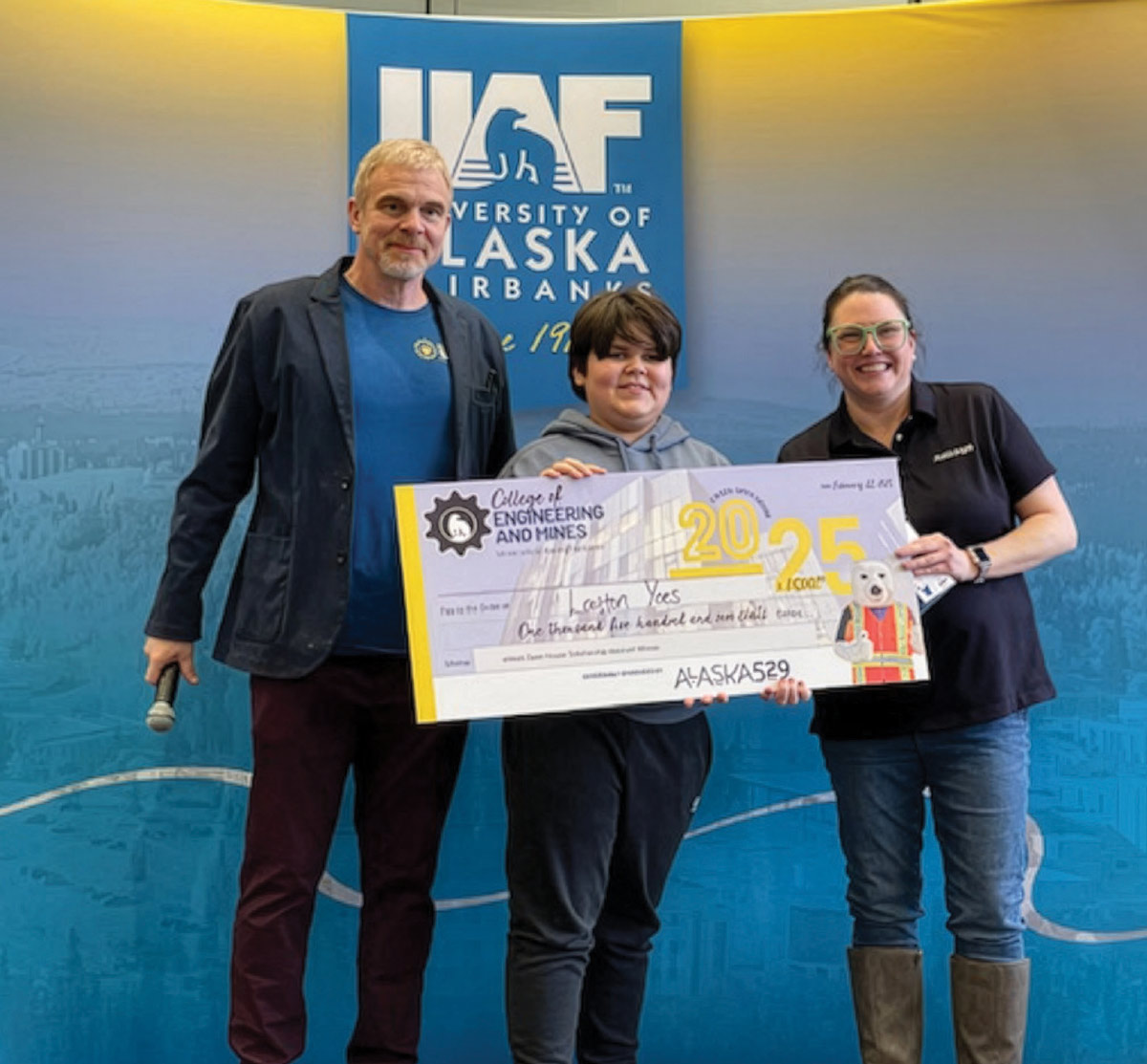
The annual $25,000 scholarship account giveaway, a raffle tied to the PFD check-off, has had some especially visible community ripple effects. When a young woman from Kasigluk won a few years ago, it gave her the push she needed to pursue her goal of becoming an illustrator after a period of feeling uncertain about her direction in life. After a boy from Sitka won in 2025, new account openings in that community jumped 128 percent.
“The story of this family inspired so many people in that community to save,” says Bonnie Carroll, the trust’s director of marketing.
Alaska 529
The second misconception is that 529 plans are only for the wealthy. In all actuality, these plans were designed to serve the middle-class and lower-income families. For families worried about financial aid, recent federal changes have softened that concern: Grandparent-owned accounts no longer factor into federal student aid calculations, and parent-owned accounts count only as a parental asset, typically around 4 percent.
There’s also the question of what happens if a child never uses the funds. Families can change the beneficiary to any qualifying family member, out to a first cousin. Unused funds can also now be rolled into a Roth IRA without penalty, up to certain limits. The flexibility built into these plans, Oldmixon notes, is one of their most underappreciated features.
It’s not an entirely abstract aspiration. The Dash to Save incentive program, the employer payroll deposit partnerships, and the community outreach investments are all steps toward that goal. So is advocating at the federal level to protect the tax-advantaged status that makes 529 plans so valuable in the first place.
For the families already enrolled, the next twenty-five years look a lot like the last twenty-five: steady, purposeful saving, PFD deposit by PFD deposit.
“Should they remain in state, which we clearly hope they do, I can’t imagine why they wouldn’t continue with the plan,” Rhein says of her boys. “Hopefully they would want to, after seeing the results of it, once they’re entering their next chapter.”
In Hooper Bay, Hill is already working on that next generation. “I’m slowly teaching her the concept of money and responsibility,” she says of her 14-year-old. “I’m getting confident she will also encourage her children to enroll, too.”
That cycle of one generation saving for the next is exactly what the people who built this program had in mind.