

ero winning bids for the first federal oil and gas lease sale in Alaska mandated by the One Big Beautiful Bill Act of 2025 (OBBBA) was nothing to worry about. Instead of investing in offshore tracts in Cook Inlet, interested parties were keeping their powder dry for the main event later in March: leasing in the National Petroleum Reserve-Alaska (NPRA).
The sale, the first in the reserve since 2019, saw the second most acreage leased in a single sale, and the revenue is the most ever, in nominal dollars, at $163,696,722 in total receipts for 187 tracts.
While setting the stage for a major realignment of federal policy on oil and gas development, the Trump administration’s push for new oil and gas lease sales has renewed debate between those touting production as an economic necessity and those seeking the protection of the state’s environment, wildlife, and Indigenous traditions.
As a result, a total of eleven additional, separate offshore oil and gas lease sales will be held in Lower Cook Inlet over the next seven years. Five of these are proposed in the Trump administration’s new offshore drilling plan. Congress mandated six more sales when it passed its budget reconciliation bill.
The first federal oil and gas lease sale in 2026 for the lower Cook Inlet, held March 4, received no bids. It wasn’t exactly surprising. The most recent sale in state waters of Cook Inlet, held the same day, attracted only one bid: a $600 offer from Three Mountain Oil for 20 acres, out of 2.9 million acres available for lease.
Other parties assert that ongoing sales in Cook Inlet aren’t in anyone’s interest. “Today’s lease sale once again revealed the lack of industry interest in Lower Cook Inlet drilling and the continued political theater surrounding offshore drilling in Alaska,” said Bridget Maryott, co-executive director at Cook Inletkeeper on March 4. “Continuing to hold lease sales with zero interest and strong local opposition to drilling is a blatant waste of taxpayers’ money.”
Regardless, federal managers say lease sales will continue in Cook Inlet so that the industry has a regular, predictable schedule.
Judging by the receipts when bids were unsealed March 18, the first sale tapped into pent-up demand.
“Today’s lease sale underscores the National Petroleum Reserve in Alaska’s vital role in strengthening America’s energy security while fueling economic growth across Alaska,” said US Secretary of the Interior Doug Burgum. “The reserve was created to support our nation’s energy needs, and this successful sale demonstrates what’s possible when we align responsible development with that original purpose.”
NPRA spans roughly 23 million acres in northwest Alaska. According to BLM, the sale was “exceptionally competitive,” drawing 430 bids across 1.3 million acres.
“We knew that industry’s interest in this area is remarkably strong,” says Senator Lisa Murkowski. “Our efforts to restore access, return to the rule of law, and get this program back on track have now been fully validated by these historic results. The best part is, the best is yet to come.”
Representative Nick Begich adds, “When we remove federal barriers, investments in Alaska’s future follow. Removing those federal barriers and unlocking millions of acres in the NPRA is a direct result of hard-fought efforts and strategic policymaking.”
Senator Dan Sullivan notes, “This lease sale wasn’t just historic in the amount of bids but also in terms of the companies bidding, from some of the biggest energy companies in the world to smaller, aggressive wildcatters.”
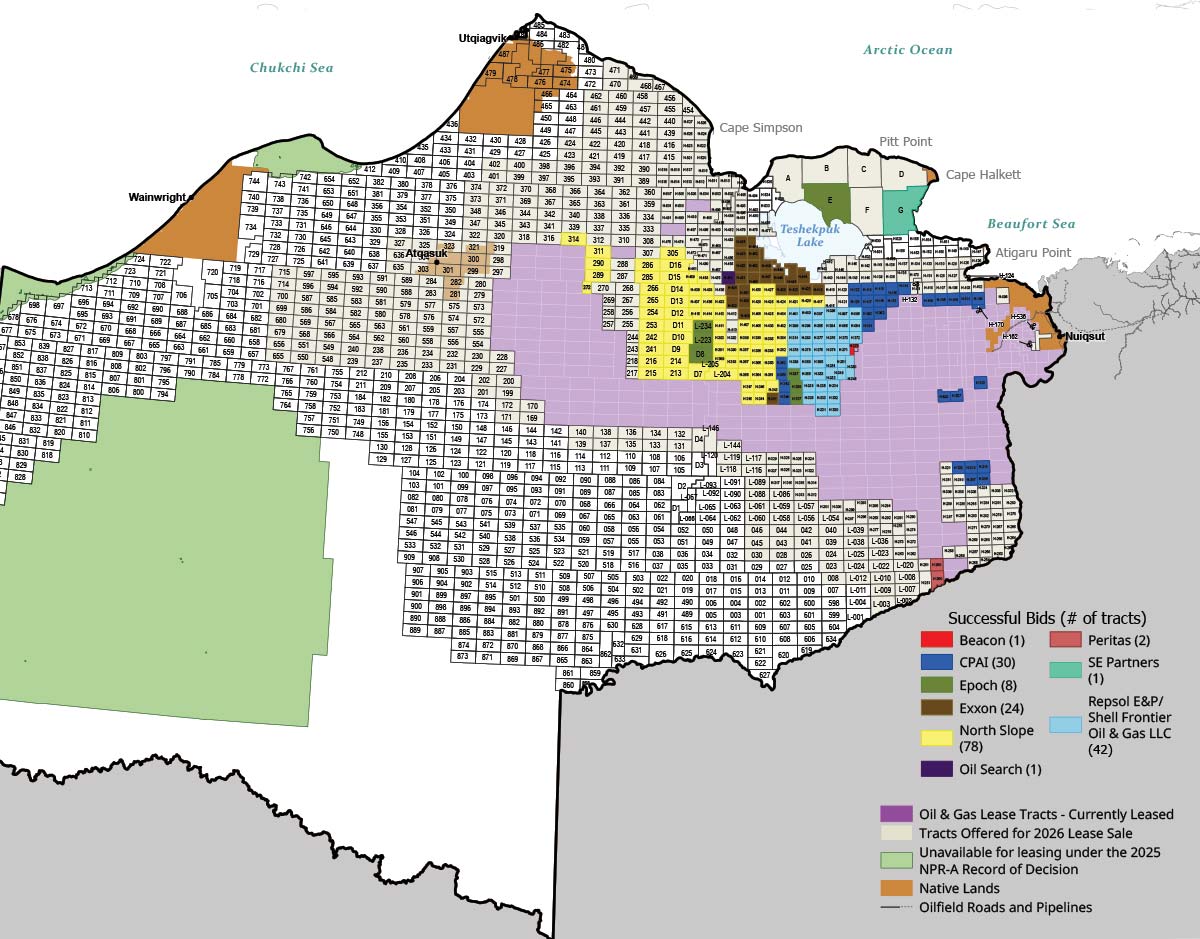
The most active bidder was North Slope Exploration, a Colorado-based unit of Armstrong Oil and Gas, winning leases on 78 tracts southwest of Teshekpuk Lake.
ExxonMobil focused its bids on 24 tracts closer to the lake. A section of forty-two tracts south of Teshekpuk Lake were picked up by affiliates of Repsol and Shell bidding about $90 million together. Repsol, a Spanish company, owns a stake in Pikka, the project soon to enter production under the operating control of Santos.
The industry has noticed Santos’ successful drilling into a geologic feature called the Brookian Sequence, which includes the oil-bearing Nanushuk Formation. “All of a sudden you’ve got a lot of international companies, and the big ones, taking notice of the Brookian plays,” said Pete Laliberte, Santos’ vice president of business development, at the March conference of the Alaska Support Industry Alliance. The Brookian results, he said, are “driving the overall, like, renaissance on the Slope.”
Santos affiliate Oil Search also bid on NPRA tracts, as did smaller players Beacon, Epoch, SE Partners, and Peritas, which bid on tracts along the Colville River.
ConocoPhillips, which is already producing from units inside NPRA and is nearing completion of the Willow project, successfully bid on thirty tracts adjacent to its current positions. Willow is set to produce an estimated 600 million barrels, peaking at 180,000 barrels a day. ConocoPhillips Alaska Vice President of Development and Execution Marc Lemons told Alliance conference attendees that the company is devoting up to $9 billion to Willow, currently halfway toward first oil in early 2029.
Murkowski credits ConocoPhillips with demonstrating how to produce from NPRA. She says Willow, greenlit in 2023 during the Biden administration, was “the first step” and that infrastructure built for the project could make additional prospects more attractive to bidders. “This is what I think has attracted the number of bidders that you have,” Murkowski says. “I think it has helped with the higher prices for some of the lease sales that we saw, which were pretty impressive.”
The senator also welcomed Shell back into the mix of Alaska explorers. “Shell had been up in the state on the offshore side a decade or so ago,” she notes, “so to have them back in the state is going to be welcome.”
The federal government splits half of the NPRA leasing receipts with the State of Alaska, putting nearly $82 million into the state treasury. A portion of those proceeds benefit North Slope communities through the National Petroleum Reserve in Alaska Impact Mitigation program.
However, just as Pikka has proceeded with cooperation from, and to the benefit of, the nearby village of Nuiqsut, its neighbor about 160 miles deeper inside NPRA, the village of Atqasuk, is counting on resource development to spell prosperity for the surrounding area.
“Today’s lease sale is an exciting step in the right direction for Atqasuk, which has stewarded the NPRA for millennia,” said Native Village of Atqasuk President Mary Bordeaux. “We have seen firsthand how responsible development improves our community, and we look forward to working with the federal government and industry representatives to advance projects beneficial to both our economy and Iñupiaq culture.”
Regional lobbying groups likewise have confidence that NPRA development will be a net positive.
US Bureau of Land Management
More than 95 percent of North Slope tax revenue is generated by taxes on resource development infrastructure, which fund essential services. The expansion of educational institutions, healthcare facilities, advanced water and sanitation systems, and comprehensive wildlife management has been associated with a significant increase in the average lifespan of North Slope Iñupiat, rising from 34 years in 1969 to 77 years at present.
“Today’s lease sale proves what we have been saying for years: when there is meaningful policy in place supporting responsible onshore development, industry interest will follow,” said Voice of the Arctic Iñupiat President and CEO Nagruk Harcharek. “This successful NPRA lease sale is a gratifying reminder of our work that will strengthen our self-determination for generations to come.”
In the nearer term, the latest batch of NPRA leases gives energy companies new assets to leverage, with the potential for more acres in future lease sales.
“Investor confidence in Alaska’s energy future is not only strong—it’s growing,” says Steve Wackowski, president and CEO of the Alaska Oil and Gas Association. “That confidence is critical to advancing responsible development of Alaska’s vast resources, supporting jobs, sustaining the Trans Alaska Pipeline System, and strengthening US national security in an increasingly uncertain world.”