

and animals attract visitors to the Alaska Wildlife Conservation Center (AWCC) near Portage, from the elk, deer, muskox, moose, and wood bison to the bears, lynx, and porcupines. Situated at the head of Turnagain Arm as it is, AWCC also looks toward the marine habitat. This month, AWCC is opening the Matson Ocean Education Center (MOEC), a space where science, culture, and community converge. The new facility is designed to educate students and the public about Cook Inlet, its tides, its glaciers, and its wildlife, with a special focus on the critically endangered Cook Inlet beluga whale.
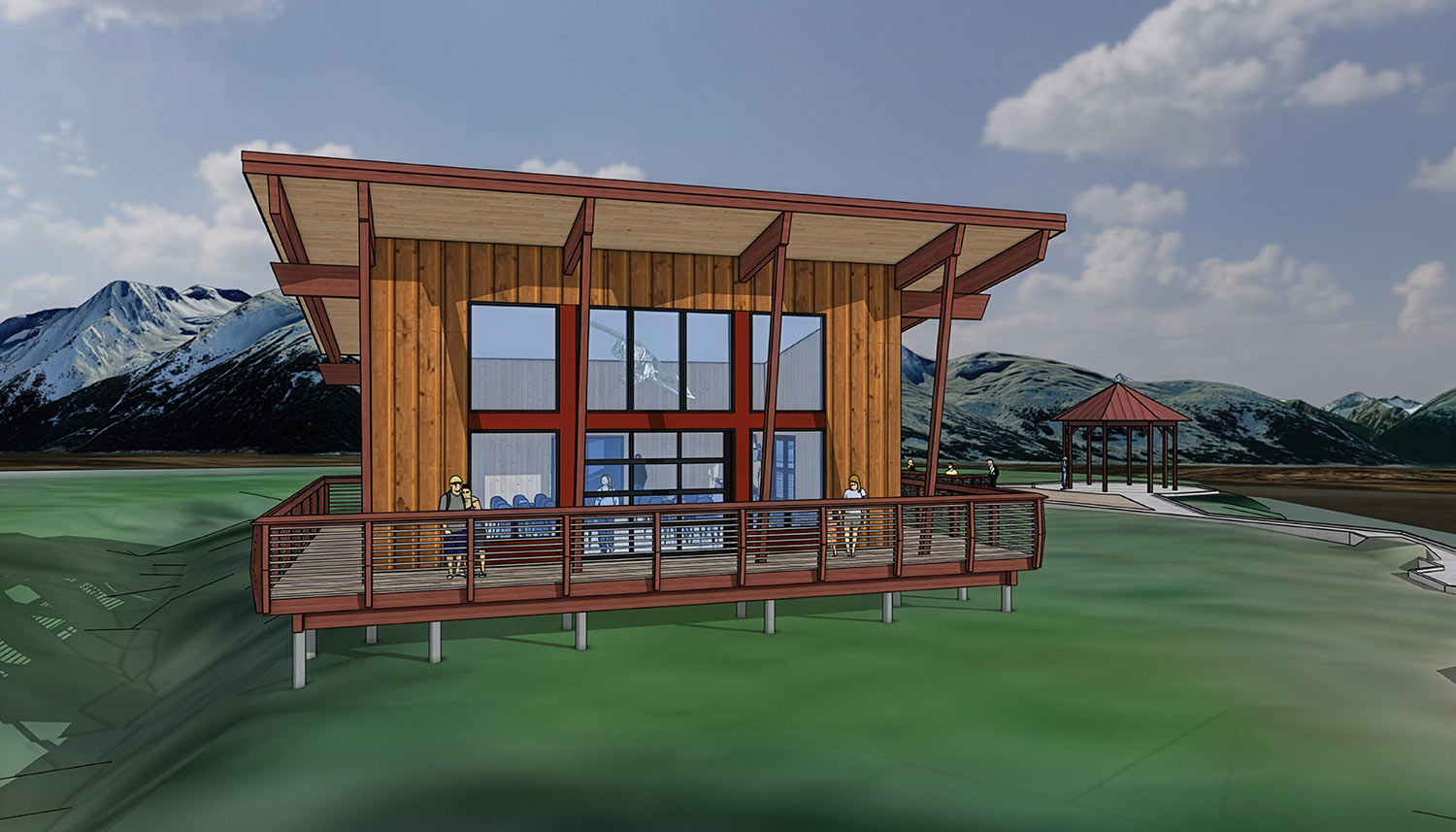
The MOEC is strategically positioned at “The Point,” a sweeping boardwalk that overlooks Turnagain Arm. It’s a scenic place with surging tides, glistening glaciers, and abundant wildlife—including beluga whales that frequently swim past. For years, the boardwalk has offered a peaceful vantage point for AWCC visitors. But on rough-weather days, it can be one of the harshest spots on the property. The new building changes that. “The location is pretty special,” says AWCC Executive Director Sarah Howard. “Having a building out there will still allow people to appreciate the space but also be able to get out of the weather and be sheltered a little bit.”
The 1,000-square-foot structure is intentionally designed to amplify the environment to create an immersive experience—even from indoors. For example, Howard envisions a classroom full of children watching the tide rise and then suddenly spotting belugas chasing salmon into the inlet. “Just imagine that experience as a kiddo in school,” she says. “There’s not a lot of schools that have something like that available to them. I’m really excited that we’ll be able to offer that and leave that kind of experience with kids when they go home.”

Alaska Wildlife Conservation Center
The MOEC is a versatile, classroom-style facility designed to share Alaska’s ocean environment with students and other visitors. It features floor-to-ceiling windows facing the inlet, lab tables and workspaces for hands-on learning, and a dramatic “tide gut” beside the building that fills and empties with Cook Inlet’s powerful tides. Turnagain Arm experiences some of the largest tidal variations on Earth, with tides rising and falling by more than 30 feet.
“Anyone who’s visited AWCC before knows how special The Point boardwalk area is,” says Dylan Faber, Matson’s government and community affairs and business development director for Alaska. “Its location, at the very end of the Turnagain Arm between the Portage and Turnagain valley drainages, is surrounded by a natural cathedral of mountains and glaciers. There’s truly nowhere else quite like it in the world.”
Alaska Wildlife Conservation Center

Matson and AWCC have forged a strong partnership because of their common values around environmental stewardship. Faber served on the MOEC project’s board since its inception in 2022, working alongside AWCC staff, architects, engineers, and contractors. They collaborated for three years—and hundreds of hours—to bring the center to life following delays due to the COVID-19 pandemic and building design modifications.
“We’re excited to see the center finally become a reality,” Faber says. “The way it blends location, science, and local art is really well done, and a building dedicated to AWCC’s educational offerings will be a great addition to AWCC’s campus.”
In addition to AWCC staff, board volunteers, and all the contractors who helped build the new center, Faber says he is grateful to other corporate supporters, such as Hilcorp, which donated piling for the project, and Big Dreams Transport, which trucked the piles free of charge.

Kerry Tasker
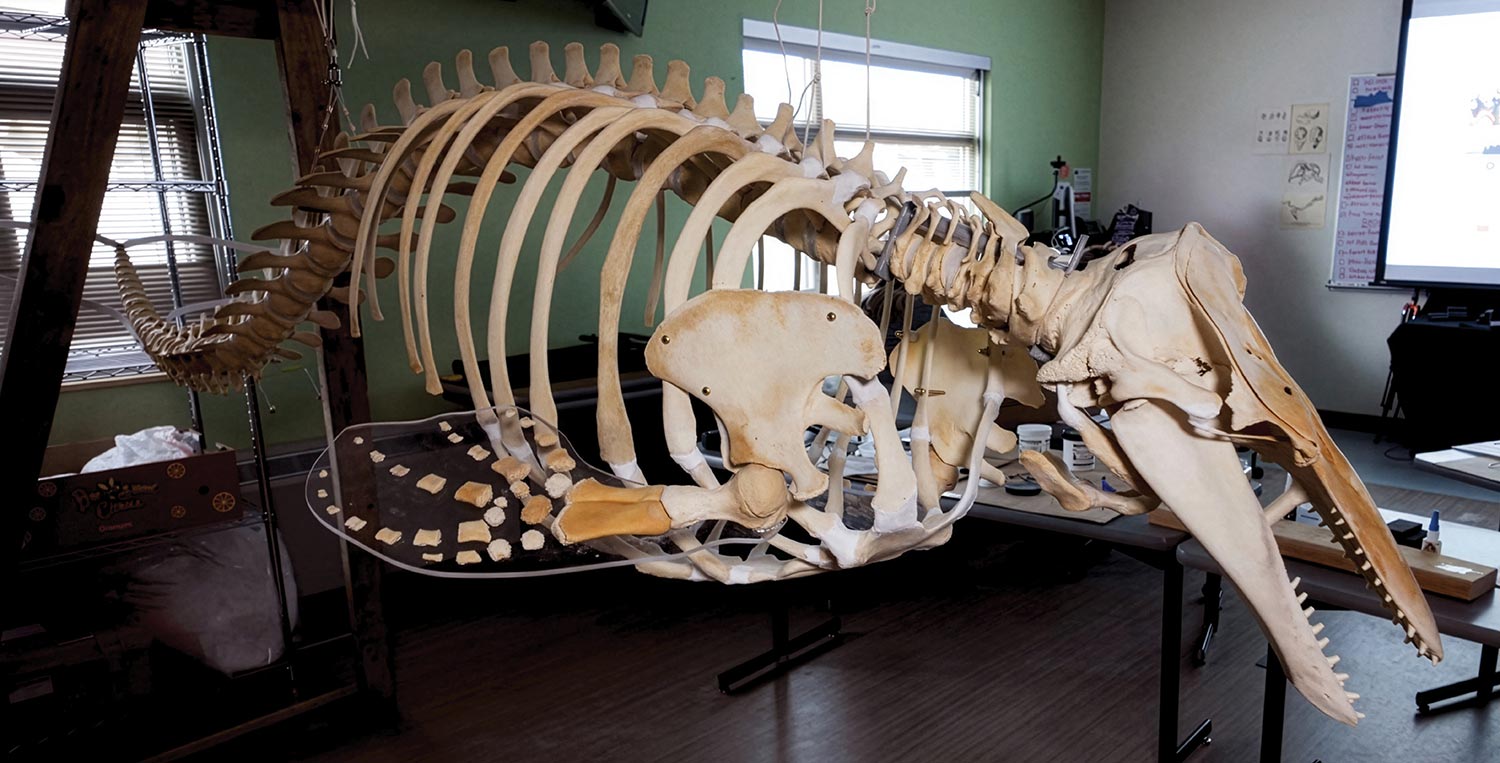
When Matson learned that AWCC would be receiving the skeleton, it adjusted the building’s design by raising the roof high enough to safely accommodate the addition. “We expect the Cook Inlet beluga whale skeleton exhibit, which will hang from the ceiling, to leave a lasting impact on everyone who visits,” Faber says.
The beluga whale skeleton, which weighs 40 to 50 pounds, is 123 inches long from nose to tail, 36 inches wide from flipper to flipper, and about 24 inches high around mid-body, according to AWCC Director of Education Lily Grbavach. “Had this individual lived to adulthood, it could have grown to 11 to 16 feet in length,” she says. “The specimen was necropsied [the animal equivalent of a human autopsy] and collected to contribute to ongoing Cook Inlet beluga whale conservation and education objectives.”
The MOEC’s skeleton is from a subadult Cook Inlet beluga whale that the center’s staff calls “Qunchi,” which to the local Kenaitze tribe means “the one that comes upward” in Dena’ina Athabascan. Qunchi had washed up on the eastern shore of Cook Inlet in 2019, where staff from the Alaska Veterinary Pathology Services conducted a necropsy on the beach, assisted by students from the UA Kachemak Bay Campus in Homer. The students and their professors spent more than a year cleaning, aging, and reassembling Qunchi’s bones.
The beluga whale skeleton exhibit underscores AWCC’s role as a station for the Alaska Beluga Monitoring Program and its commitment to “citizen science.” Staff and volunteers track beluga activity during spring and fall migrations, helping raise awareness for a species listed as critically endangered. “The belugas are our wild neighbors, and we care about them,” Howard says. “We have an incredible opportunity to help protect them and share their story.”
Raising awareness about the declining population of the Cook Inlet beluga whale—which is genetically distinct from other belugas in Alaska waters—is a key priority for AWCC. According to the US Marine Mammal Commission, Cook Inlet beluga whales were formally listed in 2008 under the Endangered Species Act. They are also protected under the Marine Mammal Protection Act, which applies to all beluga whales across their range. Cook Inlet belugas once numbered around 1,300 whales, but the population declined by 75 percent since the ‘70s. Today, the population is estimated at around 330 whales (based on 2022 data), showing only slight signs of stabilization.
“She was more than happy to help us out with putting a beautiful mural on that container,” Howard says. “She incorporated all things Turnagain Arm, and we especially wanted her to highlight belugas. So there are fun belugas on there, including a calf that she even painted the correct color [gray]. It’s super bright, colorful, and eye-catching. I think it’s fabulous.”
Besides displaying Gerety’s work, the MOEC hosts a Jordan Anderson sculpture, Turnagain Embrace. The lifelike, three-dimensional piece depicts a mother and calf beluga swimming around each other. Both the mural and sculpture warmly welcome guests to the MOEC and boardwalks. The building will host art on a rotating basis, including Anchorage School District youth art inspired by conservation and Alaska’s wildlife.
In addition, the MOEC and its surrounding boardwalks incorporate updated interpretive signage focused on Cook Inlet ecology for self-guided visitors. The signage combines science, conservation, and art, including designs and photos by AWCC staff.
Matson
“We’re really excited to launch new programs that are all STEAM-based,” Howard says. “We’ve got a whole lineup of beluga-focused programs and ecology-focused programs that go through all the ages for the school groups and beyond for in the summer when we have visitors of all walks of life come through the gates.”
The MOEC will serve local school groups year-round—about 20,000 students—and the 350,000 visitors who come to AWCC annually, mostly between May and September. For many of them, MOEC may be their first introduction to the complexities of Alaska’s marine ecosystems.
Faber says the MOEC will greatly increase AWCC’s ability to further leverage and utilize the area for enhanced educational offerings for multiple grade levels, research projects, daily visitors, indoor and outdoor informative signage and displays, and all kinds of small events. “We want everyone who visits to leave with a greater sense of connection to and understanding of Cook Inlet, its tides, its glaciers, and its wildlife,” he says.
While the MOEC focuses on marine education, AWCC’s broader mission remains central to the experience. AWCC is a 501(c)(3) nonprofit sanctuary dedicated to preserving Alaska’s wildlife through conservation, education, research, and quality animal care. The sanctuary, which shelters orphaned and injured wildlife, maintains more than 200 acres of habitats for resident animals “to feel at home displaying their natural wild behavior as education ambassadors for their species,” according to AWCC’s website.
Alaska Wildlife Conservation Center

In its sanctuary role, AWCC provides long-term care or a temporary holding before placing wildlife in permanent facilities. Space is limited—and demand is growing. “We wish we had more room,” Howard says. “Every year there are more calls for bears, moose, and orphaned wildlife, but we’re at the mercy of the capacity we can handle.”
The new MOEC will help AWCC elevate an important message: that conservation begins at home. Howard is hoping visitors will be motivated to support wildlife in their own communities. “My hope is that the center stands out as a lasting impression that inspires folks to go home and see where they can be helpful with their local facilities,” she says.
For AWCC, community involvement is essential for its ongoing operations. As a nonprofit, the center relies on donors, visitors, and partners to sustain its mission, so AWCC offers a variety of ways for organizations and individuals to get involved, from entry fees to sponsoring memorial benches. “Just coming to visit the AWCC is super helpful,” Howard says. “It keeps things moving. We really appreciate all our donors and visitors… It all goes to the wildlife center and helps keep the animals fed and happy.”
As for Matson, it intends to remain actively involved with AWCC. “Our support for AWCC has always been broader than this one project,” Faber says. “We plan to keep participating on its board and provide an annual monetary grant for equipment and supplies.”