

ight stars of gold have adorned the Alaska flag since the territorial legislature adopted the design in 1927. Stargazing indoors had to wait almost a century, when the state’s first planetarium opened on the UAA campus in 2009, followed within a year by a second at the Anchorage Museum. Now, nearing the centennial of Benny Benson’s astronomical inspiration, the state is getting its third space theater.
The new planetarium opening at UAF this spring is a dream come true. For decades, UAF floated the idea but couldn’t gain solid support until recently. Now, tourists and Alaskans will have a new facility to experience the Great Land and its sky like never before.
The UAF planetarium is connected to the museum as previously planned; however, all the major collaborators decided to start the design from scratch. Pat Druckenmiller, director of the University of Alaska Museum of the North, says there were many aspects to consider when designing a planetarium, from the dome size, display technology, seating, and other details. From that decade of hard work, what resulted is a full-dome experience for residents, tourists, students, and educators.
The 11-meter dome is tipped at 18° toward the front of the auditorium. It has sixty-five reclining seats that allow visitors to view the entire dome above. “It’s a 365° experience where people can view content on any subject matter under the sun,” says Druckenmiller.
The dome’s size dictated most subsequent design choices. In an ideal world, it would be a 12- or 13-meter dome, but each additional meter increased the facility’s overall size and cost. Instead, it was conceptualized as a 10-meter dome, but eventually it was scaled up to an 11-meter dome in the final design, making it one meter larger than the diameter of the UAA Planetarium & Visualization Theater in the ConocoPhillips Integrated Science Building.
Next, designers chose two high-resolution projectors and a software system for the planetarium. Druckenmiller says there are only a few major vendors of this equipment, so they found significant overlap across the different systems. Eventually, they chose four image-generation computers that use the same system as the UAA planetarium, along with a theater-quality sound system.
The other big decision was the exterior. After reviewing several options, designers chose a box design that didn’t detract from the museum’s existing strong architectural statement. In all, the planetarium is a 5,700-square-foot facility, including the dome.
“We tried to find a balance between the dome size, the facility size, and costs,” says Druckenmiller. “When we looked at designs, we started with the Cadillac version in terms of design ideas and then moved our way down to more of a Toyota Camry.”
“The Murdock Trust has been honored to support the collaborative and innovative work of the Geophysical Institute and Museum of the North over the years,” says Elaine Charpentier Philippi, senior program officer for education and leadership development at the Murdock Trust, a Vancouver, Washington-based charity endowed by tech pioneer Jack Murdock.

Bryan Whitten | UAF Geophysical Institute
Bryan Whitten | UAF Geophysical Institute

Eric Marshall | UAF Geophysical Institute
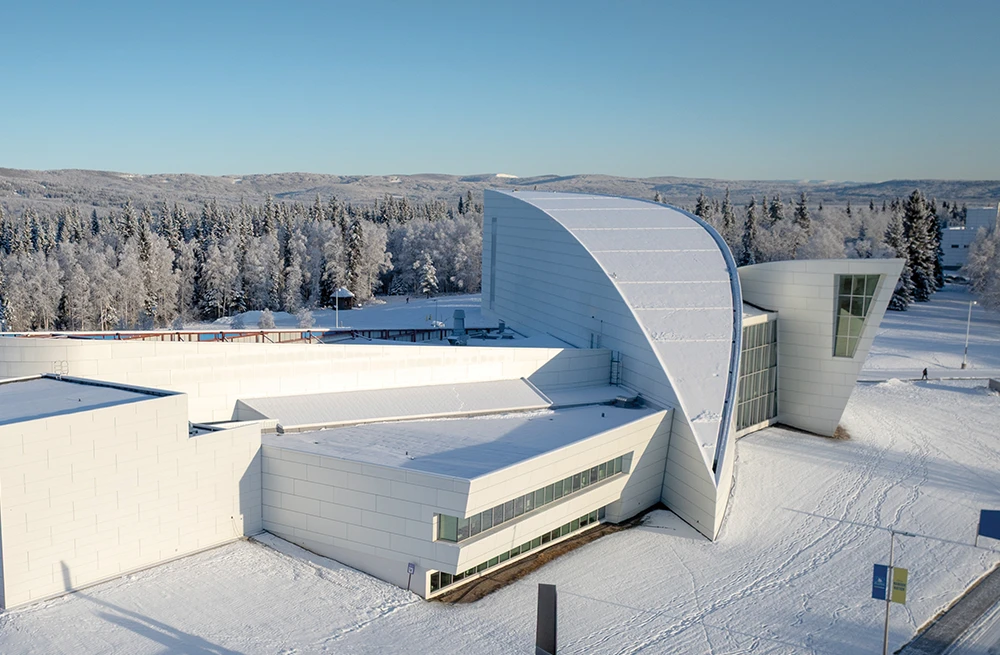
“The planetarium is an addition to the west end of the existing museum building and didn’t affect any of the existing exhibits or public spaces,” says Druckenmiller.
Most construction took place in 2025. By March of 2026, all that was left was a final checklist before public occupancy.

Bryan Whitten | UAF Geophysical Institute
Heading up content creation and curation is Planetarium Director Omega Smith. Born and raised in Alaska and a lifelong astronomer, Smith has twelve years of experience developing content for Anchorage planetariums. Early in the development of the UAF planetarium project, key players in the project reached out to her, seeking her input about planetarium structures and operations. When the position opened in Fairbanks, she immediately applied.
“I’m really excited about being up here because the story of Alaska and our skies is so different from anywhere else in the world,” says Smith. “Having a planetarium in such a unique standpoint gives a new perspective on the natural world.”
Since the planetarium will host a wide range of audiences, how content is developed and delivered must account for factors such as age and existing knowledge of a topic. Material developed for a K–12 classroom is different from exhibits for the general community, tourists, or college students.
Above all, she says this is a chance for the community to connect with scientists and their research. Smith says research can easily get weighed down with complicated data, graphs, and coding. On the surface, those details may seem unrelated; however, the planetarium will allow scientists to share the story behind the research in a meaningful way that makes people feel involved.
“At a planetarium, visitors can be surrounded by the story and see and feel the impact,” says Smith. “It really makes the messages hit home, and it causes a ripple effect of inspiration for people to support more research or even build a career in these fields and do their own research.”
Smith adds that not all the content will be science and research. She says there is also a great opportunity to present community events in the performance arts sector. For instance, it would be possible to host live music while visualizations play on the screen. In addition to learning, the planetarium aims to offer fun activities for diverse audiences on campus.