


he snow in Alaska is long forgotten as the heat of the desert hits you the moment you walk off the plane. However, the work to make the National Center for American Indian Enterprise Development’s Reservation Economic Summit (RES) a success starts well before the winter weather, and even before summer sockeye runs hit the Last Frontier. Once at the conference, handshakes and hugs turn quickly into strategy discussions. Old relationships pick up where they left off, and new ones form with a clear sense of purpose. At RES, connection is not a side effect of the conference; it is where it all begins. The theme for the gathering in late March was “Rising Together.”
For Alaska Native leaders, business owners, and tribal representatives, RES has become one of the most important national stages to understand where Indian Country is headed—and where Alaska can learn and grow within it. Each year, RES brings together tribal governments, Native-owned businesses, federal agencies, and corporate partners from across the country. It is widely recognized as the largest Native-focused business conference in the United States.
But more than its size (more than 5,000 registrations this year), RES is defined by its function: it is where economic opportunity turns the corner into new opportunity, business growth, and policy shifts. One day at RES can feel like three anywhere else; there is so much to learn and so many people to see.
“RES gives us a window into Indian Country at a national level,” says Aaron Leggett, president of the Native Village of Eklutna (NVE) and head of the Eklutna Gaming Authority. “We get to see what’s working, where innovation is happening, and how tribes are building sustainable economies. That’s invaluable for Alaska.”
The ability to move from discussion to collaboration is what keeps Alaska Native entities returning year after year. That means not only learning from others, but identifying where the 49th State can lead.
One of the most visible examples of insight to action is Chin’an Gaming Hall. Owned and operated by NVE, the facility has quickly become a benchmark for tribally driven economic development in Alaska. “Chin’an is about creating opportunity for our people,” says Eklutna village council member Dustin Lorah. “It’s jobs, it’s revenue, and it’s something we can continue to build on.” The development of Chin’an was informed in part by lessons learned from tribes across the country, many of them encountered through RES.
Leggett sat on a panel where he could highlight the economic impact and tribal member benefits that Chin’an Gaming Hall has provided. It was also a chance to share some of the challenges NVE has faced and still faces moving forward.
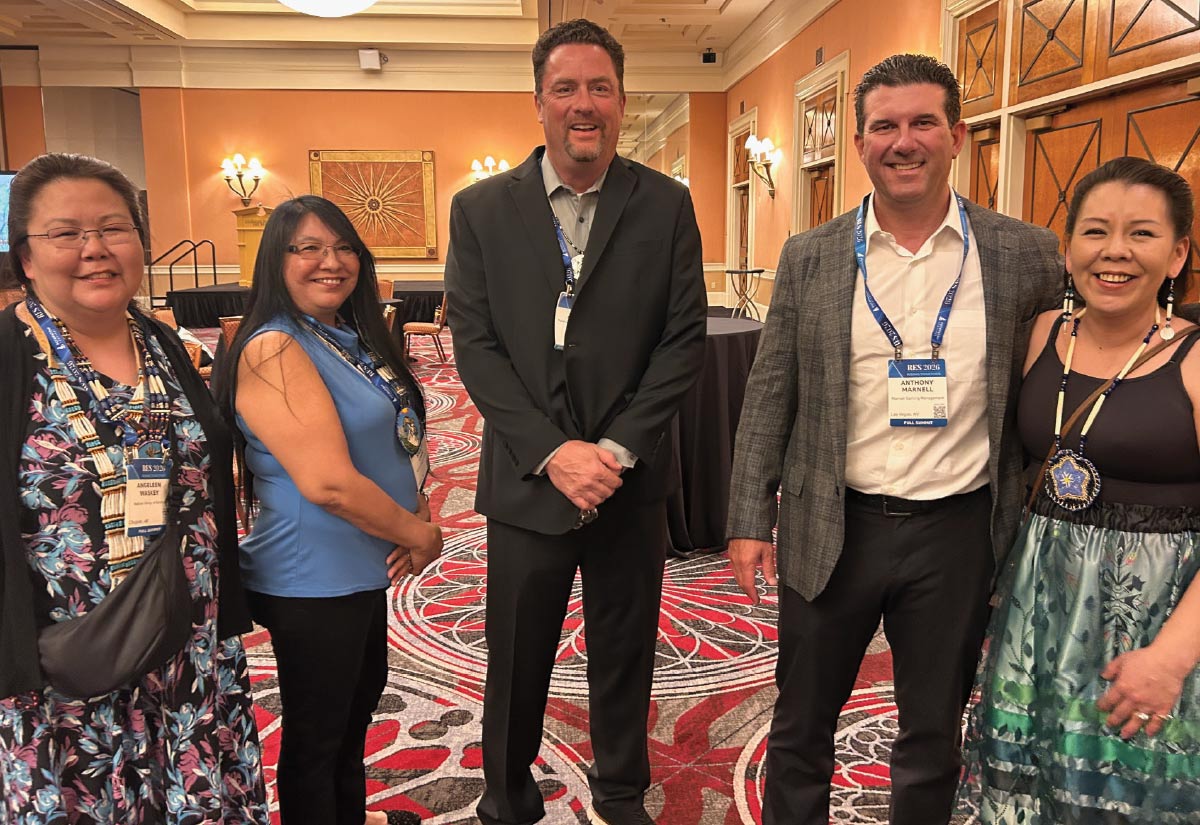
Leggett, along with other Eklutna village council members and Eklutna Gaming Authority members, met with a business mentor and looked for new ways to further help Eklutna tribal members and the surrounding community. They got an up-close view of the Marnell family of companies, a Las Vegas-based business with interests in property development and gaming. The family-owned company built the Bellagio hotel and casino in 1995, the expansion of neighboring Caesar’s Palace in 2007, and is consulting with NVE on the next phase of Chin’an Gaming Hall. Leggett says, “We are proud to have partnered with Anthony Marnell and his family for more than a decade, who we now consider our family. What they do is inspirational, and Anthony’s involvement is helping us provide jobs, economic impact, and new opportunity for our people but also for our neighbors and our state.”
For NVE, the success of its Chin’an Gaming Hall gives a new lens to this conference. “For NVE it is about finding ways to help our members,” says village council member Angeleen Waskey. “You’re learning from people who are actively building businesses and solving the same problems we face. That’s something you can take home and use to help our elders and our youth.”
“At RES, you see how other tribes are tackling similar challenges,” says Eklutna village council member Shirley Chilligan. “Whether it’s workforce development, food security, subsistence, or navigating federal programs, there are real lessons we can take home and apply to help our people.”
That exchange of ideas is central to the mission of the conference, according to Chris James, president and CEO of the National Center for American Indian Enterprise Development. “RES is about bringing Indian Country together,” James says. “It’s about sharing best practices, understanding federal policy shifts, and creating pathways for Native businesses to grow and compete at every level.”
“We’ve learned from others who have been doing this for years,” Leggett says. “How they structure operations, how they manage growth, how they navigate challenges. That kind of knowledge is incredibly valuable.”
For Leggett, the success of Chin’an Gaming Hall reflects a broader shift. “We’re seeing Alaska tribes step into new spaces,” he says. “It’s about economic self-determination and building something sustainable for the future.” At RES, those kinds of success stories are both shared and studied—creating a feedback loop of innovation across Indian Country.
Federal funding and regulatory frameworks often shape the viability of major projects in Alaska, so that access is critical. John Oceguera, a former Nevada legislator and, since January 2026, the CEO and owner of multi-state public affairs and communications firm Strategies 360, emphasizes the importance of translating those conversations into strategy. “RES brings decision-makers and practitioners into the same room,” Oceguera says. “That creates a level of clarity you don’t often get. It helps organizations understand not just what’s happening but how to position themselves.”
Across panels and conversations, several key trends are shaping the economic landscape for Native communities. “There’s a strong focus on diversification,” says Nathan McCowan, who chairs the Alaska Native Village Corporation Association. “Tribes and Alaska Native corporations are expanding into new sectors and building more resilient economies.”
Thomas Mack, CEO of The Eyak Corporation, says economic development goes hand in hand with sustaining Native people. “Not just financially, but culturally. In Alaska, we have unique challenges—logistics, climate, remoteness,” Mack says. “But we also have unique strengths. Seeing how others are innovating helps us think differently about what’s possible.”
In recent years, Alaska’s footprint at RES has grown—not just in participation, but in influence. From gaming and tourism to infrastructure and energy, Alaska Native organizations are increasingly contributing to national conversations about economic development. “Alaska brings a unique perspective,” James says. “And that perspective strengthens the entire ecosystem.”
“It’s about being part of the conversation,” Lorah adds. “And making sure Alaska’s voice is represented.”
Application requires adapting national strategies to local realities, but it also builds on something established at RES: relationships. In the end, RES is not just a conference; it is a catalyst, celebrating forty years of convening. It is where ideas become strategies. Where relationships become partnerships. Where information becomes opportunity.
For Alaska, the summit is a critical link to the broader landscape of Indian Country—a place to see emerging trends, engage with federal decision-makers, and identify new pathways for growth. When attendees return home, the snow may still be there, but the new ideas and the energy that created them provide fuel for creating new opportunities.
And, perhaps most importantly, summit attendees take pride in being a part of Alaska showing up—not just to listen, but to lead.