

multinational mining corporation and a nongovernmental fish advocacy group might seem like strange partners—but not in Alaska.
Kinross Alaska, the operator of Fort Knox gold mine north of Fairbanks, has worked with Trout Unlimited to take military veterans and active members of the armed forces fishing for several years, and now the organizations are collaborating to reclaim historic mining sites in the Turnagain Arm area under the Alaska Abandoned Mine Restoration Initiative. The inaugural project focuses on Resurrection Creek in Hope. The multi-year undertaking has been progressing since 2021 and is scheduled for completion this summer.
The historic project brings together mining companies, conservation organizations, the US Forest Service, the National Oceanic and Atmospheric Administration (NOAA), the National Forest Foundation, and others—all sharing the goal of improving Alaska’s fish habitat.
“This took months, if not years, of planning to ensure that we had crafted a shared vision together,” says Anna Atchison, director of US external affairs for Toronto-based Kinross. “Bringing these types of partners together is rare but not unheard of.”
By co-founding the Alaska Abandoned Mine Restoration Initiative with Trout Unlimited, Kinross is focusing on bringing resources and expertise to projects that improve fish habitat and watershed health while demonstrating responsible resource development, Atchison says. “This is not our first time teaming up with Trout Unlimited,” Atchison says. “We had the pleasure of working together to help improve fish and water access in other western states, although we believe this is the first partnership of its kind in Alaska.”
Trout Unlimited brings tremendous expertise in watershed science and salmon habitat restoration, and working together allows both organizations to contribute what they do best, Atchison says. Their partnership aligns closely with Kinross’ long-term strategy of improving the overall quality of life in its host communities while being responsible stewards of the environment. “For us, that extends beyond the mine footprint,” she emphasizes.
Atchison points out that today’s mining industry operates very differently than historic mining. Modern operations, both large and small, are held to strict environmental standards, and companies like Kinross invest heavily in reclamation and environmental stewardship. “The Resurrection Creek project reflects that evolution and demonstrates how responsible resource development can contribute positively beyond active mine sites with the right partners and mindset,” she explains.
Kinross
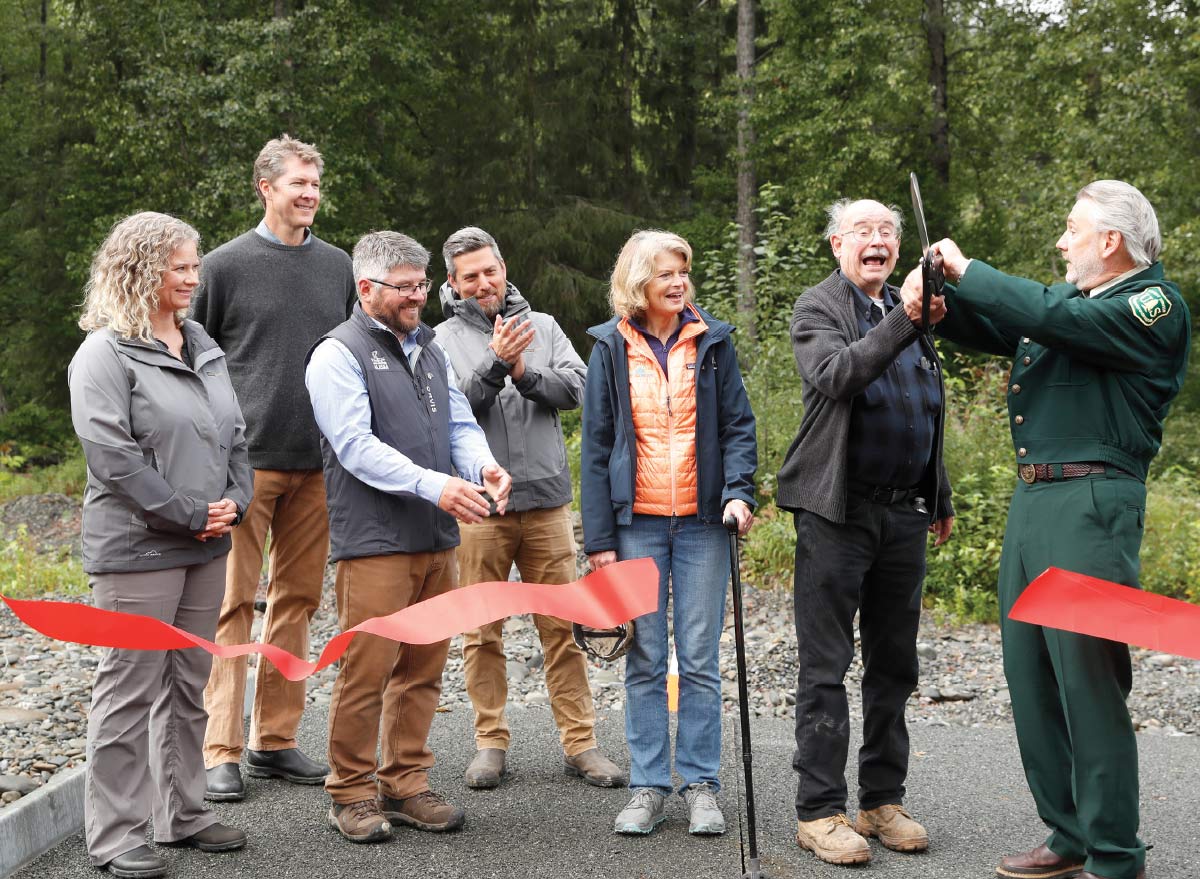
“Our private funding also opened up significant federal dollars made available through the Infrastructure Investment and Jobs Act and other mechanisms,” Atchison says.
The Alaska Abandoned Mine Restoration Initiative builds upon an earlier restoration of Resurrection Creek—Phase I—that was done when the US Forest Service restored 1.5 miles of upstream habitat. That work in the mid-2000s brought salmon back to spawn in increasing numbers. “After the Forest Service completed its Phase I project upstream of where we’re working now, it saw six times as many king salmon using the restored areas as they saw there beforehand,” says Austin Williams, Trout Unlimited’s director of federal relations. “That’s a big deal that should get people’s attention.”
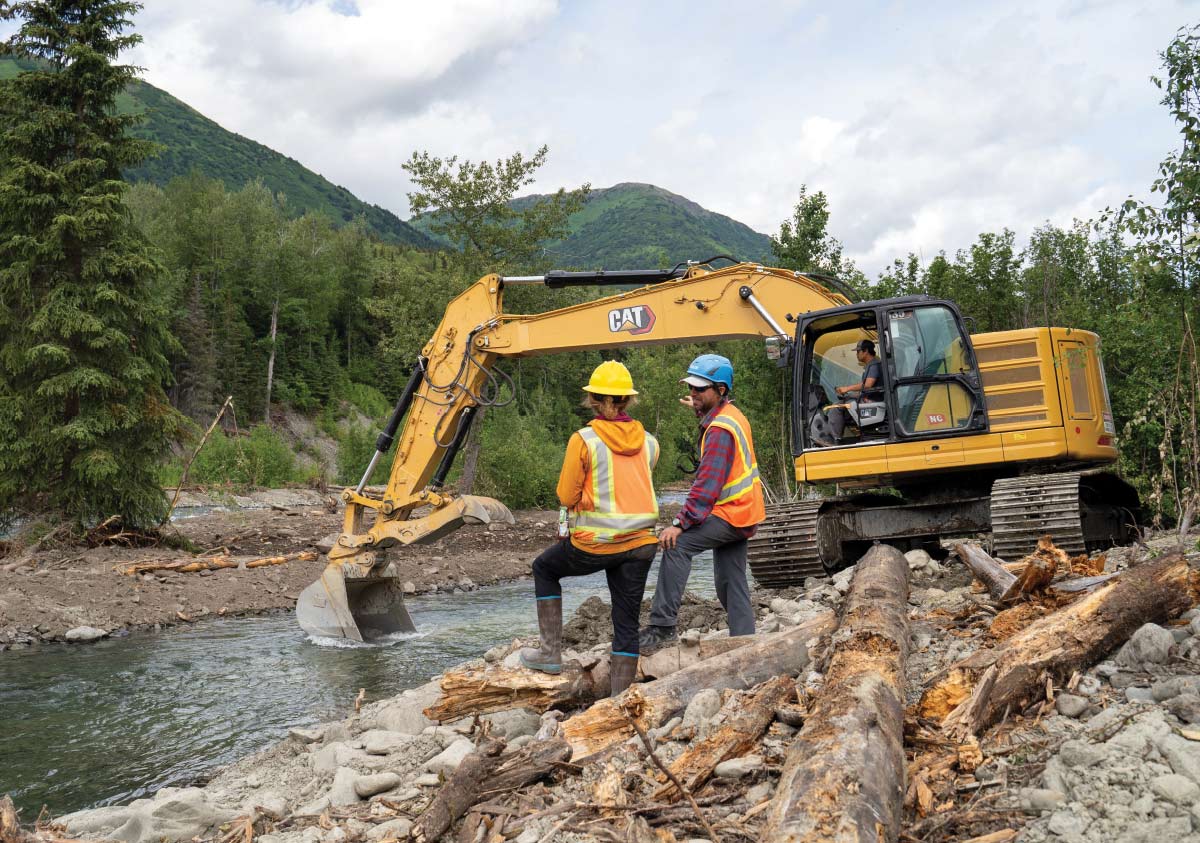
Phase II is building on that success. According to NOAA, the project includes restoring 2.3 miles of stream and 74 acres of floodplain habitat, constructing 8,500 feet of side channels, building log jams with more than 1,000 large trees, creating gravel beds and pools tailored to the needs of multiple salmon species, and transplanting 21,000 willow trees.
Since restoration efforts began, the Forest Service has seen significant improvements in habitat quality and ecosystem function. Restored sections now include “deep pools, suitable spawning and rearing habitat, stable riffles, and more complex woody structures” that support all life stages of salmon, according to Forest Service hydrologist Angela Coleman. Reconnected floodplains have improved groundwater exchange and created side channels, backwaters, and off‑channel rearing areas that were previously absent.
Biologists have documented increased spawning utilization and use of restored habitat almost immediately after construction in many sections. “We’re also seeing broader ecological benefits: improved riparian vegetation growth, better sediment distribution, and increased habitat opportunities for other species, from aquatic invertebrates to birds and mammals,” says Coleman, who is stationed at the Chugach National Forest Glacier Ranger District office in Girdwood. “The stream is functioning much more like a natural system again.”
While restoring historically mined streams is imperative, many communities may not realize the urgency of doing so. That’s because impacts to salmon and salmon streams often occur gradually over a long period of time. “It’s almost never a here-one-day-gone-the-next situation,” Williams says.
He adds: “With Resurrection Creek, many of the impacts occurred so long ago nobody is left to remember how things used to be. This makes it incredibly important to share the story of Resurrection Creek and its restoration. Multiple times each year, we host community open house events, give project tours, or partner with local businesses to help spread the word.”
National Forest Foundation
Williams also highlights the collaboration between conservation groups and resource-extraction industries. “There’s simply no way this project ever could have gotten off the ground without such a strong partnership behind it,” he says. “If we want to take on big projects like restoring Resurrection Creek, we need to build big partnerships that leverage the fact that we have a lot more in common than you might think at first blush.”
The Resurrection Creek project fits perfectly into Trout Unlimited’s broader strategy for restoring cold-water fisheries in Alaska for several reasons. “First, the Forest Service already had success restoring a smaller, upstream portion of Resurrection Creek that gave us confidence this project would succeed,” Williams says. “Resurrection Creek is also an incredibly popular and beloved fishery, where families and young kids often catch their first salmon. And lastly, numerous other partners—including the National Forest Foundation and Hope Mining Company—were eager to help make the project a success.”
Hope Mining Company also directed its miners to collect boulders, topsoil, and trees for the Forest Service to use. “We had miners stockpile this stuff for them, so the Forest Service did not have to spend money on these items,” Johnson says.
Regarding the current restoration efforts, Johnson says, “They’re doing a good job.”
To lay the groundwork for a successful project, Hope Mining Company has worked to inform miners about the project, its purpose, and the importance of preserving environmental and topographic changes from the new corridor installation, according to Vice President James Roberts. The biggest impact has been with collaboration between the miners and the project contractors—Western Construction and Equipment—so that mining and restoration activities could take place simultaneously, safely, and without disruption of temporarily co-joined operations.
Moving and restoring a waterway is a herculean task initially requiring invasive heavy equipment and temporary, noisy disturbances. Initially, the public viewed the outward byproduct of restoration activities as destructive mining operations. Thus, efforts were made to inform the community about the restoration, its overall value, and the planning that went into its design, including considerations about air quality, noise, vegetation, and wildlife to heritage, social, and economic resources.
Supporting the collaborative project has been one of the most fascinating experiences of his life, Roberts says. “There’s a lot more to it [the restoration] than noise, dirt, and traffic,” he notes.
Besides benefiting salmon and wildlife, the restoration project can also reduce flood risks and improve safety for the 160 residents of Hope, which is just 1.5 miles downstream from the restoration site. Reconnecting the creek to its floodplain disperses peak flows, protecting nearby homes and businesses.
Additionally, the project generates a significant economic boost for the region by creating multi-year employment opportunities. Around $6 million is allocated to local equipment operators, construction workers, youth crews, and others. That money flows into the local community where the workers reside during the summer months.
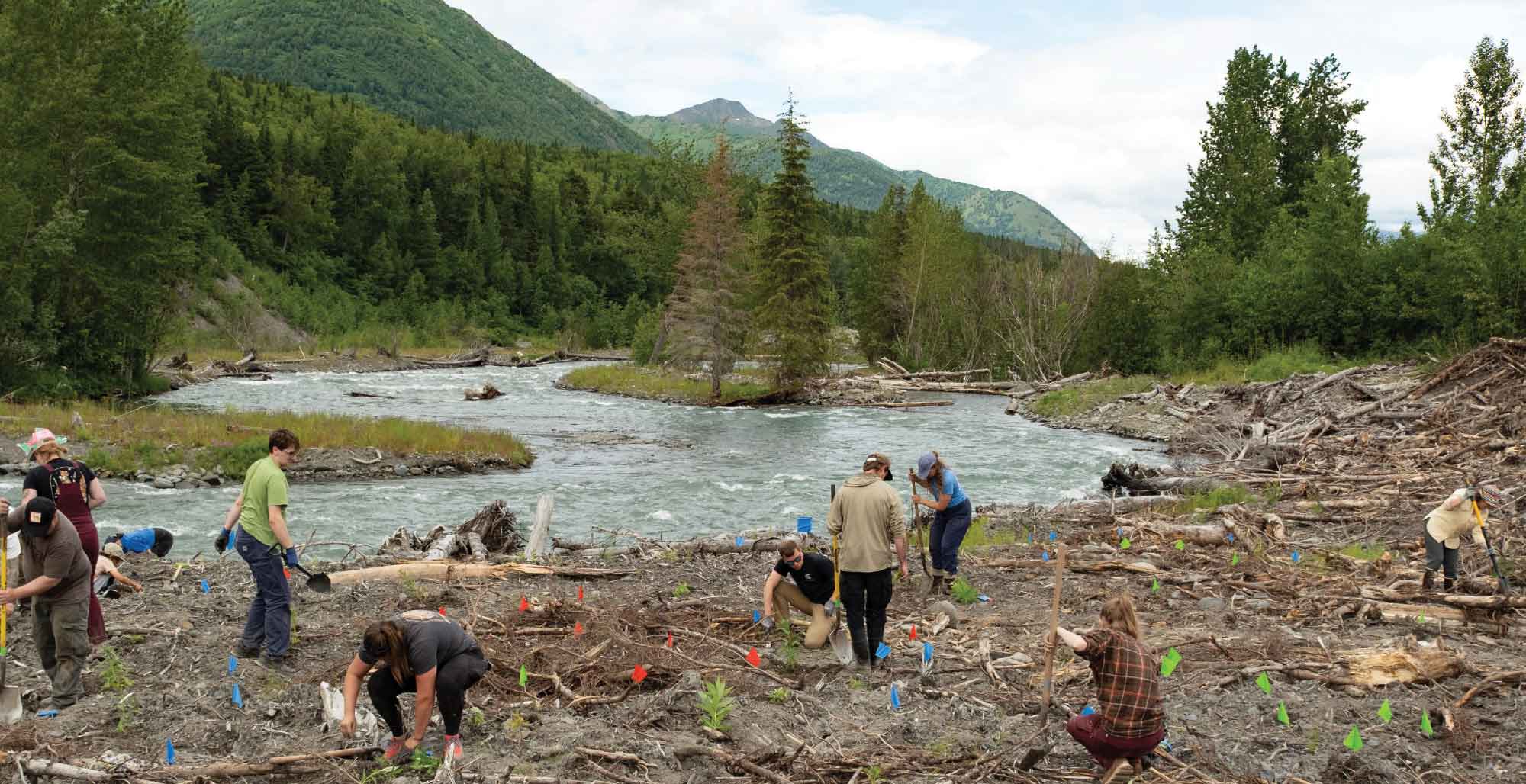
While much of the project has relied on heavy equipment, engineering, and specialists that must be hired out, Trout Unlimited’s members and community volunteers have played a significant role planting trees and shrubs to relegate and stabilize the stream banks. “It’s great to see so much support from the community and people willing to spend their weekends helping to make this project a success,” Williams says.
Building on the success of the Resurrection Creek project, Kinross and Trout Unlimited are continuing their partnership through a second effort under the Alaska Abandoned Mine Restoration Initiative—the restoration of Cripple Creek. The project, located off Chena Pump Road in Fairbanks, will focus on reconnecting a historic creek channel that was rerouted during early gold mining operations. Slated to begin this summer, it aims to restore natural drainage patterns and improve rearing habitat for Chinook salmon.
“Our approach is focused on rebuilding the natural stream profile by reestablishing the channel, installing large woody structures, and reconstructing floodplain surfaces where they had been lost,” Coleman says. “Logistically, moving historical tailings and reshaping the valley floor required careful planning and heavy equipment work in a sensitive environment. The Forest Service addressed these challenges through detailed design, phased implementation, close contractor oversight, and continuous coordination with the local mining company and all of our partners.”
What lessons from Resurrection Creek might inform future restoration of historically mined streams in Alaska? A key insight is the value of taking a watershed‑scale, long‑term approach. “These systems require more than small fixes; they need comprehensive reconstruction to restore ecological processes,” Coleman explains.
Another lesson: Success depends on strong partnerships. Or, as Coleman puts it: “Large restoration projects are challenging for any single agency to accomplish alone, and collaboration with industry, conservation groups, and local stakeholders is essential.”
For its part, Kinross has learned that strong alliances are crucial. Restoration requires coordination among land managers, conservation groups, mining partners, and local stakeholders, Atchison says. Early collaboration helps ensure projects are both environmentally meaningful and logistically feasible. “Parts of Phase II are in active claims that the Hope Mining Company holds, so it was important to collaborate to ensure the 2.2-mile riparian habitat was restored in tandem with their operations,” she explains.
For Hope Mining Company, the project exemplifies the power of collaboration among entities that jointly use the shared resources—the people who enjoy it, the company that extracts minerals from it, and government managers. “The use of the resource may be different, but collaborating from the outset has made partners out of disparate entities—all of which are realizing the value of the incredible transformation that the success of this project brings to fruition,” Roberts says.
Roberts is hoping that Alaskans understand that mining is not just a carefully overseen and regulated industry but a prudent, environmentally responsible user of the state’s natural resources. He says, “Our hope is that Alaskans learn that miners are excellent stewards of the land and, when a need comes along to take specific environmental and restorative action, mining is an eager partner.”