

rom fishing line to fertilizer, food to medicine, kelp has a long history of use in Alaska Native technology. The state’s much newer formalized kelp industry, however, is still finding its way. When a major mariculture grant program ends this year, the kelp industry will face one of its biggest tests thus far.
“Shellfish and aquatic plants have historically been crucial to the subsistence and livelihoods of many Alaskans,” his order noted, yet the nascent industry had struggled to achieve more than modest profits. The stakes involved more than money; in the face of “future environmental threats,” kelp “can produce healthy foods and supplements, increase and preserve habitat for fish and invertebrates, and assist with bioremediation efforts in areas that contain excess carbon loads,” he wrote.
A nearly $49 million matching grant provided another boost for the industry in 2022. Southeast Conference won funding for its Alaska Mariculture Cluster through the US Economic Development Administration as part of its Build Back Better Regional Challenge program.
“That has been a real motivator for a lot of people,” says Kathryn Carovano, one of the owners of Kachemak Kelp, an innovation collaborative in Homer. “It de-risks the involvement.” Challenges in the commercial fishing industry have also drawn people interested in other ways to supplement their income, Carovano adds, while allowing them to remain connected to the water.
“From a farm establishment perspective… Alaska is somewhere kind of in the middle… of difficulty to access mariculture business opportunities,” says Lindsay Olsen, a kelp farmer in Homer who also directs training and support for the mariculture-focused nonprofit GreenWave, based in Connecticut.
Farming kelp can involve up to three separate production stages: the hatchery that produces a seed string; the farm that grows and harvests mature kelp; and the processor. A policy of ADF&G often called the “50-50 rule” dictates that hatcheries create seed strings from “broodstock parent plants [that] must consist of 50 unrelated individuals and be collected from within 50 km by water of the out-planting locations,” says Michelle Morris, permit coordinator for the aquaculture section in the commercial fisheries division.
“There’s a lot of debate whether it needs to be that diverse,” Carovano says of the parent plant requirements. Olsen says the industry has been pushing for changes. She compares the 50-50 rule to “a corn farmer being asked to go forage… and then send in corn kernels.”
In practice, farmers like Olsen often collect the samples themselves, which involves finding the right kind of kelp bed, scuba diving, and then plucking only kelp that has reproductive tissue. Once a diver gets enough of the right kind of samples, they submit them to the hatchery along with details of the collection process. As the permit holders for that part of the process, hatcheries must submit year-end reports to ADF&G that detail the total number of samples collected and where they came from.
After a hatchery—of which Alaska has seven, currently—creates the seed lines, farmers usually put them out in the water late in the year. Harvest time varies slightly by region, but it usually occurs in the spring.
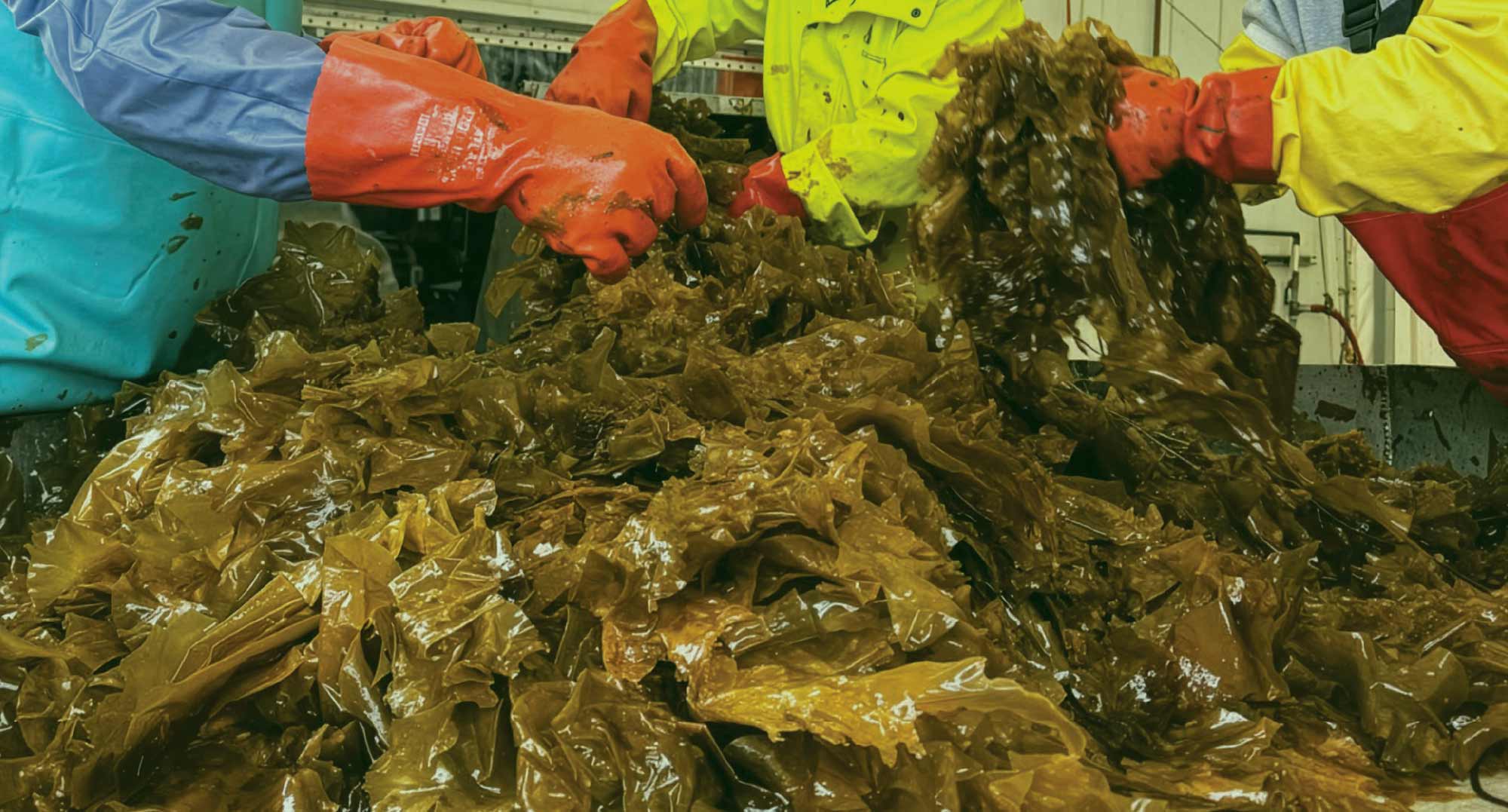
Kelp stabilization methods can include drying, blanching, freezing, salting, and fermenting. These vary in terms of the equipment and storage required, as well as the processed kelp weight. Processing capability also limits kelp’s end uses and farmers’ selling options. “Nobody really wants to buy wet seaweed,” says Matthew Perkins, CEO of California-based Macro Oceans, which makes seaweed-based biomaterials used in beauty, food, and other products. His company has been buying Alaska-grown sugar kelp for about four years.
For farmers to work with a separate processor requires infrastructure that exists in only a few parts of the state. Olsen says processing “could happen on a very small scale,” like the deck of a boat, but that involves close coordination with buyers. “You have to know the exact recipe that you’re supplying before you’re stabilizing,” she says. Only some farmers choose to process the kelp themselves.
Others choose to work with a nearby processor like Kachemak Kelp. Carovano says its partners have chosen to focus on kelp research and processing, creating some products they sell directly and selling other forms of kelp to food manufacturers like Juneau’s Barnacle Foods. Kachemak Kelp buys its kelp from farmers.
Kodiak Island Wildsource mainly processes fish, but CEO Chris Sannito says the company started processing kelp about ten years ago, after different customers asked about it. “In the springtime, it’s good with the fisheries,” he says. “There’s usually a spring lag in the processing.”
Owned by the Sun’aq Tribe of Kodiak, Wildsource usually allocates about one month each year for kelp processing. Its current equipment mainly supports drying, blanching, and freezing.
Currently, Macro Oceans buys seaweed that is transported as frozen blocks from Alaska to California. “We’re paying to ship water from Kodiak,” Perkins says. “We want to move as much of that preprocessing as close to the farm as possible,” in order to ship concentrated extracts. Once the new KP3 facility opens, he says it will “be able to move… thousands of pounds of kelp a day.” Macro Oceans will also be able to pay more for the extracts KP3 will produce than it would pay for raw kelp.
In 2025, Macro Oceans partnered with Koniag to secure a $2.3 million grant for the Sun’aq Tribe of Kodiak to cover most of the KP3 building’s equipment, and Wildsource is handling the building funding and construction. As of press time, Sannito says about half of the $3 million construction goal has been raised. Long-term, Perkins says the KP3 facility could provide a model that other communities could replicate.
Morris says ADF&G has seen five kelp farms or hatcheries close already in 2026, and she knew of at least three more planning to do so.
“The next few years will be very telling,” says Max Stanley, co-owner of Barnacle Foods, the Juneau-based maker of kelp sauces and pickles. “Hopefully all this money you put in for infrastructure and training and whatnot has really built a foundation… but I think there are some challenges with finding markets for kelp, especially as you have larger volumes of kelp to sell.”
Despite the closures, kelp farms and hatcheries drove a significant increase in aquaculture permit applications, Morris says. From 2016 to 2025, the state received 150 applications, almost two-thirds of these kelp related, versus 46 total applications from 2006 to 2015.
“Originally, I had hoped that [the industry] would be a lot further along than where it is now,” says Nick Mangini, who started the state’s first kelp-only farm in 2016. Mangini also serves as mariculture director for the Southwest Alaska Municipal Conference.
At first, much of the state’s kelp industry focused on foods, but even though Costco sells imported seaweed snacks and salad, “American don’t eat a lot of kelp,” Mangini says.
“Talk of kelp being the new superfood… didn’t seem to really materialize,” says Stanley. Barnacle Foods now sells food products in about 1,500 stores across the country and buys about 50,000–100,000 pounds of kelp a year. (The weight depends on sourcing, as wet kelp weighs much more than dried forms.)
Despite Barnacle Foods’ success, Stanley says the brand has downplayed the emphasis on seaweed over time. “It still has the same amount of kelp,” Stanley says, “but we’re selling the flavor, we’re selling the Alaska story, we’re selling sustainability.”
By this route, Barnacle Foods has proved to be one of the few food-related success stories in the Alaska kelp industry.
Another answer echoes a longstanding Alutiiq use: gardening. In a 1991 interview, elder Natalie Simeon described the kelp beds of her childhood on Woody Island and how traditional gardeners used the seaweed as fertilizer.
Along the same lines, Pacific Kelp Company has seen similar success with a plant biostimulant called KelpEdge. “It’s not exactly a fertilizer,” Smet says, but a growing body of research shows its effectiveness at increasing plants’ stress tolerance. In 2025, the company received a $500,000 grant from Southeast Conference for field trials of the product in cooperation with Washington State University and Cornell University.
The Washington State University study, done in 2025, looked at how KelpEdge applied to leaves and soil affected wine grapes grown in Washington and California. The two Washington trials involved vineyards facing leafroll and water stress, while the one in California compared fruit from kelp-treated plants to a control. In all cases, the grapes from plants treated with kelp had more of the properties desired for winemaking.
This year, Pacific Kelp Company’s grant-funded field trials with Cornell University are looking at how seaweed affects turf grass soil health. Smet says one thing the study will look at is whether use of kelp yields the same greenness with reduced water and fertilizer use.
Macro Oceans’ products present another possible large-scale use of kelp. In the beauty industry, products have two main types of ingredients, Perkins says: functional and those providing “specific, targeted benefits,” like hydration. Functional ingredients provide things like structure or texture. “Kelp can do both those things,” he says.
On the benefit side, kelp’s polysaccharides (long-chain sugars) have “pretty well-documented benefits” related to hydration and reducing inflammation or redness, Perkins says. “These are all things which the kelp does naturally by itself in the water,” Perkins observes. “It’s trying to protect itself from all the sunshine [and] to heal itself from bumps and scrapes as it gets bashed around.”
Kelp also has applications as a functional ingredient. Perkins says seaweed cellulose can make something called a “rheology modifier.” Beauty brands can use it to replace synthetic thickeners. “Polymers are all synthetics made from petrochemicals and petroleum, and a lot of people are trying to replace these because consumers increasingly see these synthetic polymers as microplastics,” Perkins says.
At the same time, a single farmer might not always produce enough kelp for a large order, so buyers might contract with several small farms. However, the work involved to communicate with several smaller farms versus a larger operation might discourage some buyers. To address that and other challenges, kelp farmers including Mangini recently formed the Kodiak Ocean Growers Cooperative. It might benefit newer farmers more than established ones like Mangini, but “in the end, we all saw the value of being able to fulfill larger orders, the insurance of having another farmer farm for the same order,” he says.
Depending on the type of kelp grown and on what products, farmers must also deal with the mismatch between harvesting season and when stores might want to stock something. That particularly affects agricultural products like KelpEdge.
Pacific Kelp Company won’t have the trial results until October—just months before a large distributor might want to have the product in its warehouse (for example, March, if customers would need it for April planting). “Timing with the kelp farmer production and the land farmer use, that is something that we think a lot about,” Smet says. Pacific Kelp Company mostly uses Alaska giant kelp, a variety with more year-round availability, but so far only a few farms produce it, Smet says.
“It takes a long time to get… the flywheel going,” says Perkins. “I’m very optimistic about the Alaska story because I’m out there, talking to brands every day. And they love the Alaska story.”