

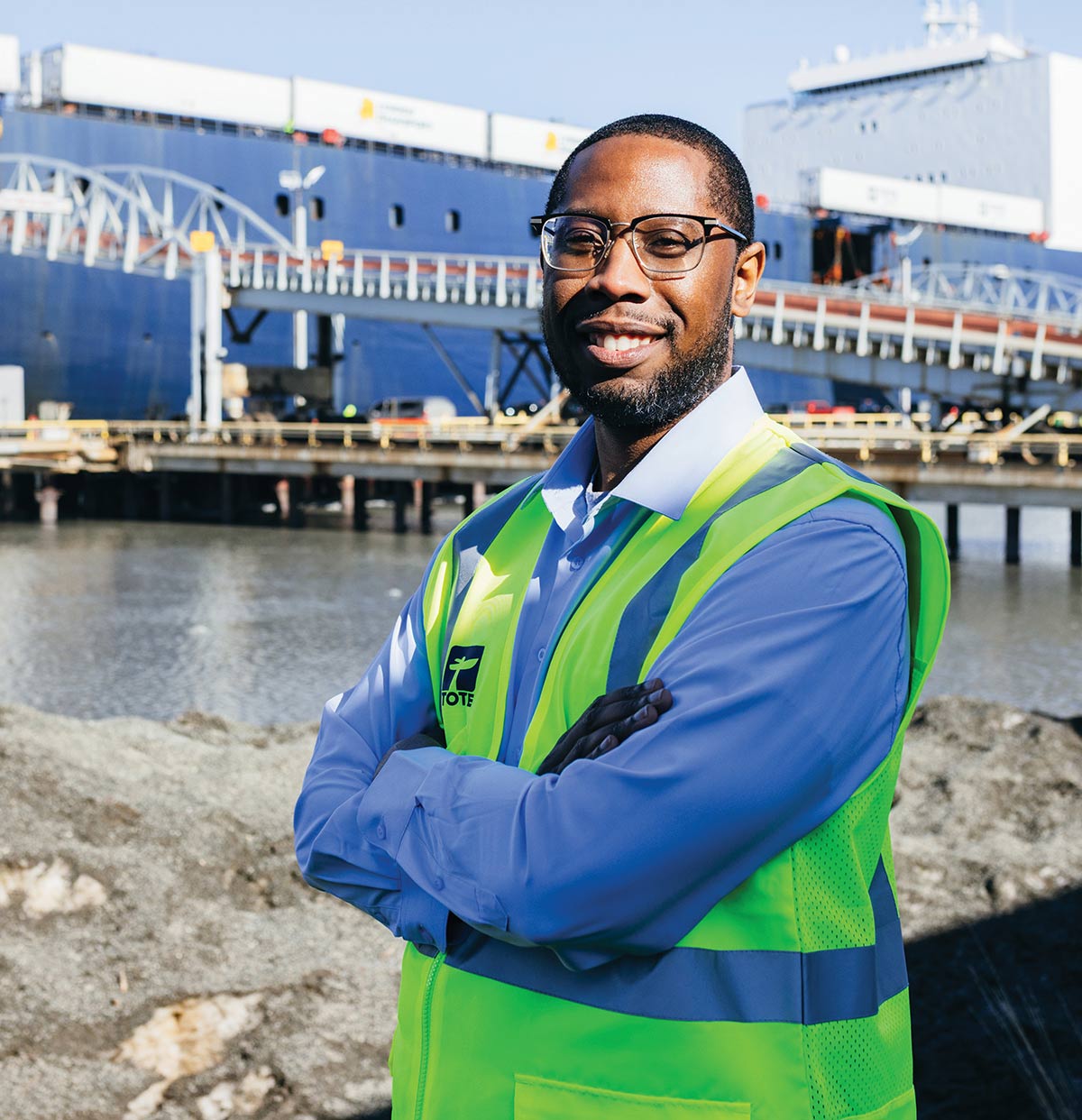
orey Nichols’ retail career has served him well—from Sam’s Club and Walmart to Amazon—and he brings that experience into his role as vice president and Alaska general manager for TOTE Maritime Alaska—a position he embarked on in December.
“I started in retail early in my career, and when a leadership role opened up, I moved into the management side,” says Nichols, who has a bachelor’s degree in environmental studies and an MBA from American Public University. “My openness to relocate is essentially what propelled my career. Being willing to move anywhere in the US took me to Washington, Colorado, and ultimately, Alaska.”
The manager’s duties involved traveling to Nome, Kotzebue, and Bethel to become familiar with challenges facing residents in getting freight to their villages. Then he would return to his Anchorage office and figure out the best way to ship their merchandise during long winters while ports remain frozen.
One incident that drove home the difficulty of getting supplies to the Bush involved a resident who ordered three mattresses from Sam’s Club.
“I forget which village it was, but Bethel was the closest hub, so the mattresses were flown there, but then I had to find someone with a snowmachine to take them to another hub and then find another person with a snowmachine to take them to the actual destination,” Nichols recalls. Realization set in: “There absolutely is no road system in the Bush during the summer! And in the winter, people use frozen creeks and rivers to travel between villages.”
“Crisco was a huge item,” Nichols notes. “They would mix the Crisco with berries they had harvested or whatever else they had on hand and call it akutaq, or ‘Eskimo ice cream.’”
When Nichols took over managing Walmart’s Alaska supply chain in 2021, he began working with TOTE more directly.
“TOTE was a great partner and instrumental in helping me build out my strategy,” Nichols says. “When you work with a company as your vendor, you get a real sense of their values and how they work. When TOTE’s previous Alaska GM and vice president took a promotion with the company and relocated to Tacoma, Washington, I knew it could be a good fit for my career and my vision for how I want to serve Alaska.”
TOTE Maritime Alaska has been serving Alaska for the past fifty years.
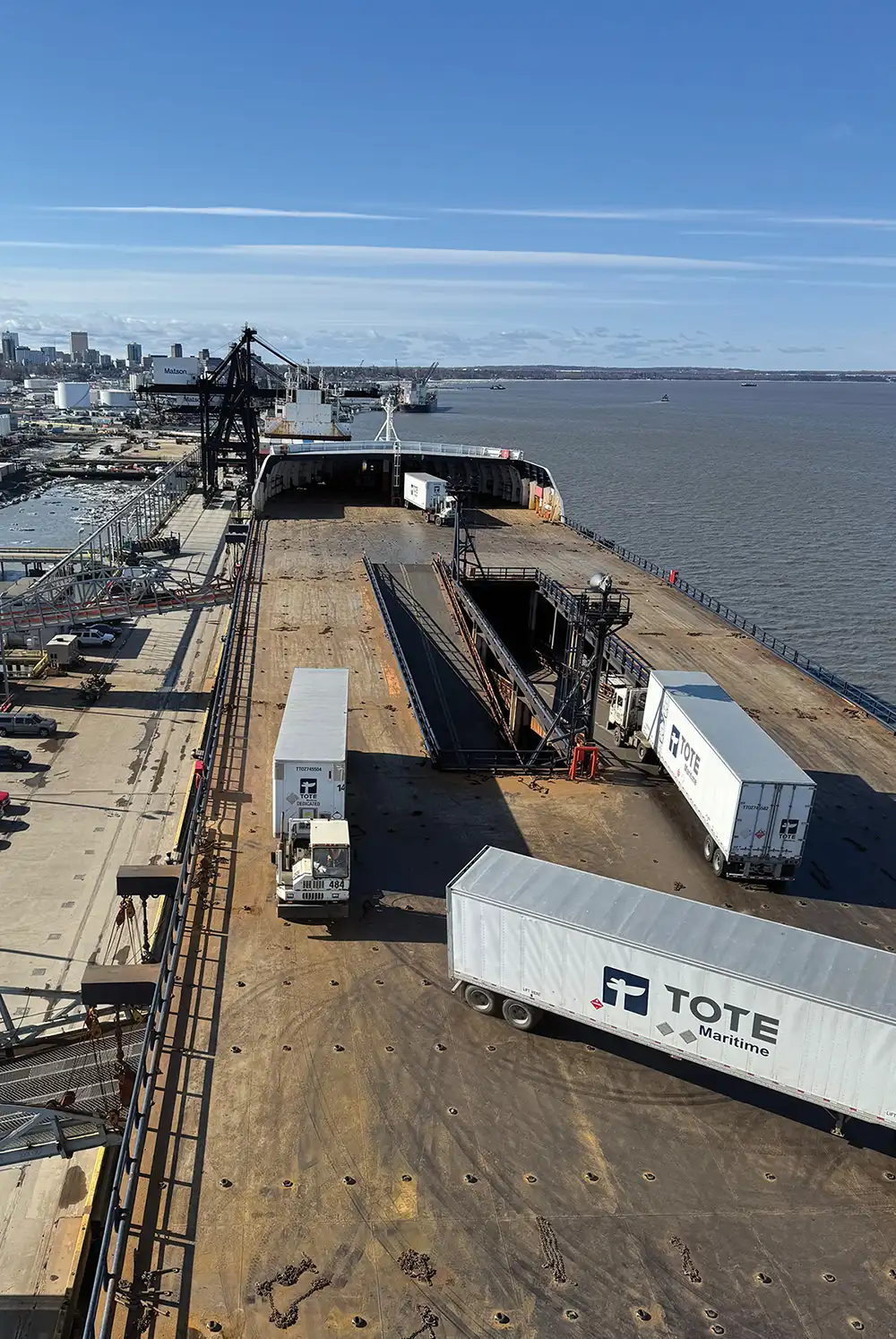
“We have unique roll-on/roll-off vessels with customized operations that are designed to support the unique needs of Alaska,” the VP explains of his new position. “As part of the Saltchuk family of companies, we’re backed by an organization that takes a long-term, community-focused approach to doing business.”
Because Alaska doesn’t manufacture a lot of goods, Nichols’ retail experience taught him the importance of implementing an uninterrupted supply chain from the Lower 48. “I had to take complex situations and develop strategies that accounted for all the variables that Alaska brings,” he explains. “Whether that’s weather, trucking capacity, staffing, shortages at stores—essentially, I learned that you need end-to-end solutions to deliver the results.”
Both of those ends can entail various challenges.
For Nichols, it begins on the Tacoma side, where a wide range of supplies are loaded onto TOTE vessels for shipment to the Don Young Port of Alaska.
“There are times that a customer is running behind—they have until 11 p.m. of the day the ship departs to get their cargo on board,” Nichols explains. “Sometimes they’ll call us and go, ‘Hey, we’re not going to be there until midnight.’ If we can, we’ll hold the ship. Otherwise, do we have it driven over the road on the Alcan Highway because it missed the departure? That’s just an example of things on the Tacoma side.”
TOTE’s cargo vessels normally operate on three of four engines, but they can utilize the fourth engine for an extra boost when needed. “Those are just some of the things we deal with week-to-week that are fairly normal,” he says.
“We’ve gotten so good at being reliable, a lot of people don’t even realize the shoal crossing is an element of our three-day transit schedule,” Nichols adds. “The same way you would use your GPS to drive from point A to point B, our vessel team is constantly assessing the voyage, timing the crossing, and watching for inclement weather to make sure we can arrive safely and on time.”
Monica Sterchi-Lowman | Alaska Business
“At TOTE, we focus on the things we can control. That starts with consistency in our service: keeping a reliable sailing schedule, investing in our vessels and terminals, and making sure our teams on both ends of the route are set up to operate efficiently,” he says. “When the outside environment gets unpredictable, our customers need to know they can still count on us showing up the same way every week.”
Nichols believes his responsibility is to serve Alaska—its customers and communities who rely on TOTE. “Whether that means making sure we have resilient port and contingency plans, ensuring we have reliable service and a best-in-class customer experience, modernizing our vessels to run on liquified natural gas, and looking to the future to adapt when things shift,” he says.
That is the exact goal Nichols’ position with TOTE allows him to accomplish. He observes, “Any commodity I purchase, any store I go into, there’s a good chance that item came to Alaska on a TOTE vessel, whether it’s a new vehicle, clothing, or groceries.”
“My three boys—ages 11, 8, and 5—basically their hobbies are my hobbies,” he says. The boys are involved in football and wrestling, so family weekends are spent traveling to sporting events.
Nichols says his wife and sons help take the pressure off any job-related stress.
“I do a lot of gardening. I have a big greenhouse. I have chickens. I love growing leafy greens, tomatoes, peppers,” he says. “That is my perfect day—just doing stuff in the yard.”
Food security for Alaska is his hobby, and it’s also his career. “We don’t produce much up here, so if it can’t come over the water, we could be in trouble,” Nichols states. “This is the most fulfilling, rewarding, and high-pressure job I’ve ever had.”