

Recklessness
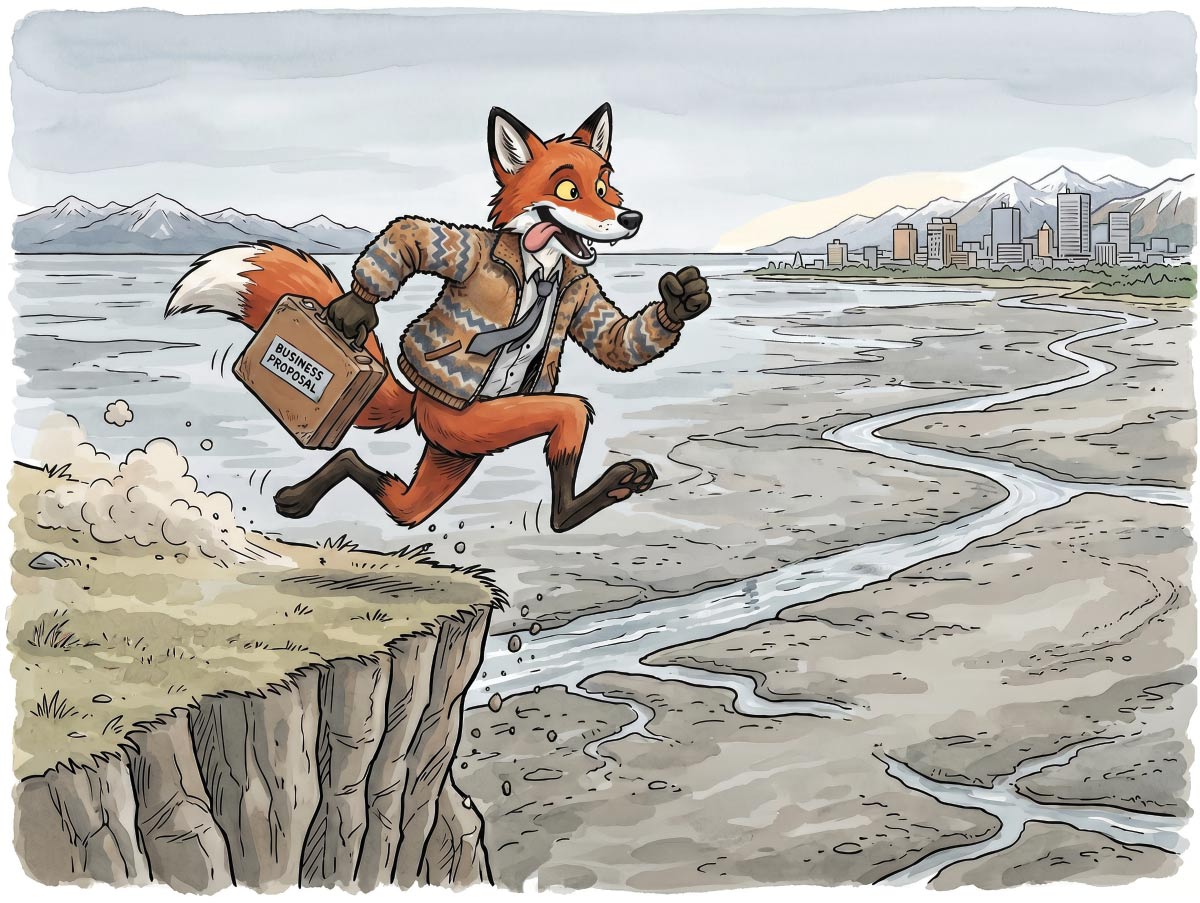
icture it: an 800-mile engineering marvel traversing Alaska’s rugged wilderness. An immense zinc mine powering Northwest Alaska’s economy. World-class sustainable harvests feeding global markets with seafood.
The Trans Alaska Pipeline System, Red Dog mine, and the Alaska fishing industry: These massive ventures represent high-stakes investments in infrastructure and resources that have transformed Alaska into a powerhouse of global energy, minerals, and food. Today, we call these ventures inspired, but that label masks a fundamental nuance and common misconception: there is a distinction between the risky and the reckless.
That line between bold visionary and reckless gambler is usually written in ink only after the dust settles and the checks clear. Winners are often labeled as geniuses while thousands of leaders who made similar bets but went bust are ignored. When you see any winner in the marketplace, their strategy can look like a guaranteed blueprint for success. This is survivorship bias in action, obsessing over the front-runners while ignoring the graveyard of those who made the same choices. Recklessness is a classic leadership trap, in part, because it is very easy to mistake good luck for repeatable strategy. Our brains are wired to find patterns in chaos, even when they don’t exist, and when a gamble pays off, it is easy to invent a story to explain why it worked. This explains, in part, why high-risk behavior is often rebranded as “visionary” in the business world.
Understanding the mechanics of recklessness can help a leader spot the difference between a smart move and a predictable bad one. It is the contrast between a high-wire artist using a safety net and having practiced the route, versus one who just hopes they don’t fall. The first one is making calculated moves, and the second is wishing for the best.
For most leaders, recklessness exists on a spectrum. While “main character” thinking is dangerous, there is an equal but opposite threat: the paralysis of an over-analyzing leader, where the cost of inaction can be higher than the cost of a failed experiment. If you swing too far toward safety, you are not actually eliminating risk; you are simply trading the risk of failure for the guaranteed risk of obsolescence. True leadership requires finding that narrow path between the two. You must have enough moxie to grab big opportunities before your more cautious competitors even get off the starting line while maintaining enough caution not to be purely impulsive.
The shift from calculated risk-taker to gambler happens when you dismiss dissenting voices as slow or when you view contradictory data as a nuisance. You may be able to spot these patterns by checking if your decisions rely more on the adrenaline of a possible big win than the logic of how it will work. If you’re cutting out safety nets because they feel like a drag, or if you’re doubling down on a failing bet to prove a point, you’ve crossed the line.
To survive a move-fast-and-break-things boss, you need to stop being a passenger and start being the anchor. Instead of just being the “no” person, which may get you sidelined, become a risk translator: when they pitch a wild pivot, don’t kill the idea—just show them the price tag in terms of what other projects will have to die to make it happen. You also have to act as a human shock absorber for your team: wait 24 hours before passing down a visionary whim to see if it’s still a priority by morning, and always keep a paper trail of sanity to document these fast-moving shifts. It’s about building a pre-mortem culture where you imagine the failure before it happens, allowing you to build the safety nets they’re too busy to see.
Gillam’s firm is an investment and research powerhouse comprising McKinley Alaska Private Investment, which focuses on Alaska-relevant private companies; McKinley Research Group, the state’s largest economic and policy research firm; and ownership stakes in Alaska Cargo and Cold Storage, Alaska Growth Capital, Inc., and Denali Advisors, the nation’s largest Alaska Native-owned registered investment advisor specializing in quantitative public market strategies. It is safe to say he has been quite successful managing organizations that rely on rigorous data and institutionalized dissent to keep vision and strategy front-and-center.
Q: Recklessness is often defined only in hindsight. How do you define it?
Gillam: First, there is a big difference between risky and reckless. Reckless is always risky, but risky is not necessarily reckless… at least not in business… and certainly not in a portfolio of businesses.
Every business—frankly, every person—has to take some risk to grow, learn new things, and challenge themselves. If we don’t try new ideas and take on some risk, our state is doomed to decline. There’s that quote attributed to Albert Einstein, “We cannot solve our problems with the same thinking we used when we created them.”
When managing risk, the key is to align the amount of risk you take with the intended goal you hope to achieve. We talk with our investors about risk tolerance. This generally means the more risk an investor is willing to accept, the more opportunity they have for growth. But increased risk also means more volatility and potential for a less desirable outcome. In general, I believe risk is good and healthy as long as it’s well-communicated and outcome-managed.
As the leader of a business, my job is to put out guardrails ahead of time for employees to make sure we manage risk for both our firm and our investors. We know we can’t eliminate risk, but with strong processes and good policies and procedures, we can manage it.
Q: In many industries, “yes” is rewarded, and “no” is seen as a lack of ambition. How do you reward your team for spotting a reckless move and stopping it, as well as making sure the loudest voice isn’t the only one heard, and the team doesn’t mistake a previous run of good luck for a repeatable strategy?
Gillam: We use a team approach to business decisions, which helps make sure all viewpoints are heard and considered prior to making a decision.
I understand how easy it is to get stuck in a rut listening to yourself. It probably comes from my investment experience, but I think it’s important to look for, ask for, and really listen to other perspectives before making decisions. People trained in a different expertise or with different experiences might see things you don’t see. At the very least, they help you prepare for the question down the road because they aren’t the only ones who will ask it.
As an analytically based business, we have a deep respect for data and fact-driven decisions.
Q: Even the best quantitative analysts are human. What guardrails do you have in place at the leadership level to prevent narrative fallacies, where the team falls so in love with a potential outcome that they begin to ignore the data suggesting a reckless path?
Gillam: A disciplined process with clear policies and procedures helps us manage the more emotionally driven viewpoints you sometimes see. It’s important to encourage enthusiasm and passion in your team. However, it’s equally important to provide the structure to make sure this natural emotion is balanced with rigorous process and due diligence.
We believe a good idea has to be stress-tested against many variables to rise to the top as the right choice.
Q: When volatility spikes, the line between a visionary who is holding the line and a gambler who is doubling down becomes incredibly thin. How do you distinguish between fundamental signals and emotional noise during a drawdown? What are your hard-stops or non-negotiables, regardless of what your gut or your vision is telling you?
Gillam: Market volatility is simply a manifestation of a change of opinion by market participants. It can be beneficial in that it forces you to revisit your original investment thesis, which can result in scaling down, staying the same, or increasing your position. People fear volatility, and I think that’s wrong; volatility simply means a fear or a euphoria is being manifested in price, and investors have to guard against being swept up by either.
The same is true of volatility in business. Fear or euphoria can occur in an organization when new information is made available. I rely on a strong team with clear policies and procedures to block out the noise of fear and euphoria and instead focus on what can be learned from the volatility to either make a new decision or stay the course with the decision already made.
The difference between recklessness and inspired triumph isn’t just the final outcome; it is the discipline to invite dissent and stress-test assumptions early on. By building these safety nets into the foundation of a project—much like the resilient supports that still carry the Trans Alaska Pipeline System across the state—you transform a high-stakes gamble into a sustainable legacy.
Join us next month as we explore incompetence.
Throughout 2026, Garrick’s leadership series is exploring different ways for leaders to align their values with ethical conduct and create lasting positive impact.