

OIL & GAS
Ten Terms
Talk like a petroleum pro
By Scott Rhode
Motion and Flow Control Products

Motion and Flow Control Products
Ten Terms
Talk like a petroleum pro
By Scott Rhode
T
hings every Alaskan should know: how to swim, how to start a fire, when to play dead for a bear and when not to, the five species of Pacific salmon, and basic petroleum geology. The oil industry has driven the last half century of the state’s development, and a share of its profits lands in Alaskans’ bank accounts every fall, so this glossary will help every Alaskan become a petroleum geologist at heart.
Conventional Resource
Crude oil is not dinosaur juice. True, most petroleum is found in rocks laid down during the Mesozoic Era, the Age of Dinosaurs, but the organic precursors were plankton and algae. These goopy critters accumulated on the seafloor and were compressed until the carbohydrates in their bodies converted into hydrocarbons. The lightest carbon-hydrogen molecules are methane, the main part of natural gas, which might be dissolved in oil or water contained in rock. More carbons in the chain make gas condensates, ideal for synthesizing plastics. Crude oil is a mixture of various carbonaceous gunk. What makes it “conventional” is the ease of accessibility from porous and permeable rock formations like sandstone or limestone, where hydrocarbons flow through interconnected pathways. Alaska has historically relied on conventional reservoirs.
Unconventional Resource
A distinction between conventional and unconventional resources was unimportant, if not unheard of, before the oil shocks of the early ‘70s. Then geologists began considering how to extract oil from more difficult reservoirs, like low-permeability shale or high-viscosity tar sands. Shales used to be considered the source rocks where conventional oil “cooked” before it seeped upward. By the ‘90s, hydraulic fracturing coaxed resources out of their hiding places by cracking shale with injected water. In Alaska, unconventional resources include the Shublik Formation, the Kingak Shale, and the Hue Shale, layers underlying several North Slope units, from bottom to top, respectively, and beneath the National Petroleum Reserve-Alaska. Companies can’t just drill straight down; they have to induce permeability to access those shales.
Oil Play
Where specific geologic conditions—such as source rock, reservoir rock, seal layer, and trap structure—create an accumulation of oil or gas, a group of similar prospects is called a “play.” A large unit like Prudhoe Bay can tap multiple plays: the Ellesmerian play (with multiple reservoirs at different depths) as well as the Kuparuk River play and several satellite formations. Or a single play can contain multiple oil and gas fields. The Nanushuk play has generated a lot of headlines. It’s the target of the Pikka Phase 1 project, and it crosses underneath the boundary into the National Petroleum Reserve-Alaska, where ConocoPhillips Alaska’s Willow project is also tapping Nanushuk. While technically a conventional sandstone reservoir, Nanushuk demands unconventional horizontal drilling techniques to be commercially viable.
Proved Resources
Alaska holds 3.1 billion barrels of proved crude oil reserves, according to the US Energy Information Administration using 2024 data. “Proved” means that geological and engineering data demonstrate with reasonable certainty (typically at least a 90 percent probability) that resources are recoverable under current economic and operating conditions. Aggressive exploration on the North Slope increased Alaska’s proved reserves from 3 billion barrels in 2023, even as the rest of the United States saw lower reserves while prices dipped, making recovery less economic. The increase from 97 trillion cubic feet of natural gas to 103 trillion cubic feet from 2023 to 2024 also defied national trends. Texas, North Dakota, and the Gulf of Mexico outrank Alaska in terms of proved reserves.
Probable Resources
When Prudhoe Bay was first developed, the field contained an estimated 9.6 billion barrels of proved reserves, out of 24 billion barrels of probable reserves. Probable resources are less certain, and the US Securities and Exchange Commission regulates when data support reclassifying a 50 percent probability as 90 percent proved. Prudhoe Bay has, over its lifetime, produced more than 12 billion barrels, thanks to technology not available during the initial estimate. The US Department of Energy estimates probable reserves across the North Slope at 22 billion barrels, including undiscovered resources, plus 124 trillion cubic feet of natural gas. The Alaska Outer Continental Shelf has 26 billion barrels of probable reserves, and 132 trillion cubic feet of gas, but that includes hard-to-access tracts of ocean.
Pre-production Wells
Wildcat wells, also called exploration wells, are drilled in unproven areas, far from known production fields or into deeper, untested geological zones. These multimillion-dollar ventures are not shots in the dark; targets are chosen based on surface reconnaissance. If the exploration well discovers a resource, the next step is drilling appraisal wells to delineate the size and characteristics of the reservoir. Some companies specialize in pre-production with no earnings from oil itself, such as Pantheon Resources, which has spent $350 million in Alaska while its Great Bear Petroleum subsidiary explores contingent resources at the Ahpun and Kodiak projects on the North Slope.
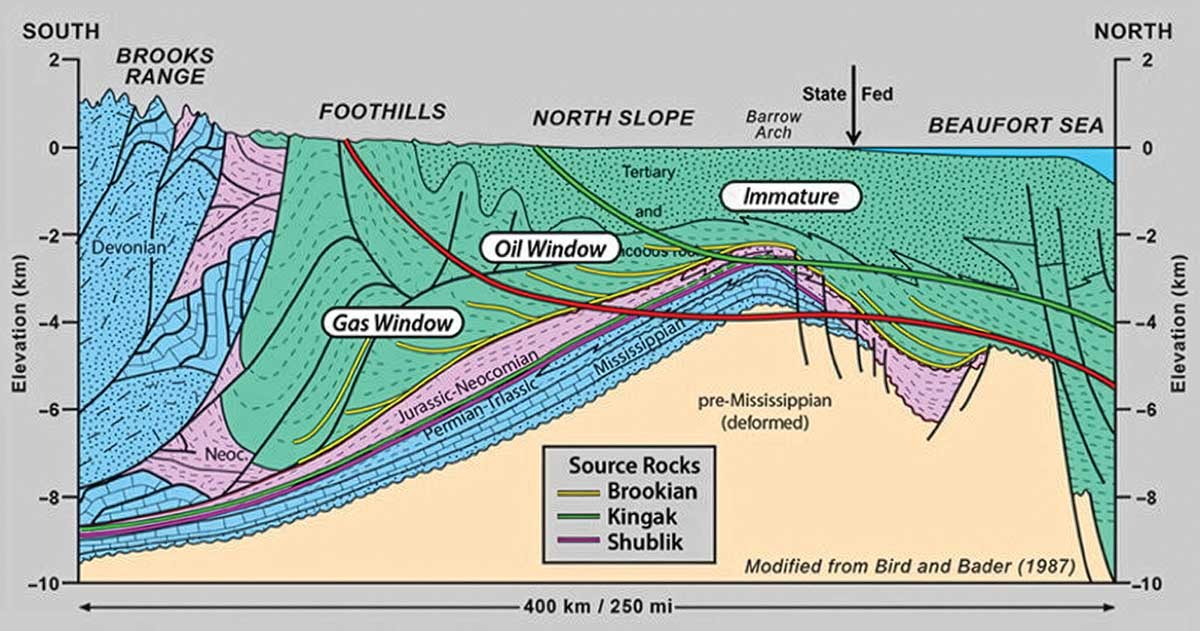
Imagine a slice of the North Slope, 10 kilometers deep. This diagram shows the shale formations, laid down as ancient seabed, from which oil and gas seeped into formations accessible by conventional drilling.
The Journal of Petroleum Technology
Production Wells
When a company knows where oil is, and deems it worth retrieving, it’s time to drill a development well. These roughly eight-inch conduits can descend more than a mile and extend up to 7 miles horizontally, forming steel-cased pathways for black gold to reach the surface. Fields in production for decades continue to gain new wells. For example, ConocoPhillips Alaska plans to drill ten development wells at the forty-four-year-old Kuparuk River Unit for 2026 and 2027, and its 2026 plan for the Colville River Unit includes up to five new development wells targeting the Qannik pool (not an underground lake but a geological layer beneath the main Alpine reservoir). Mature wells can be older than the roughnecks who tend them.
Upstream Sector
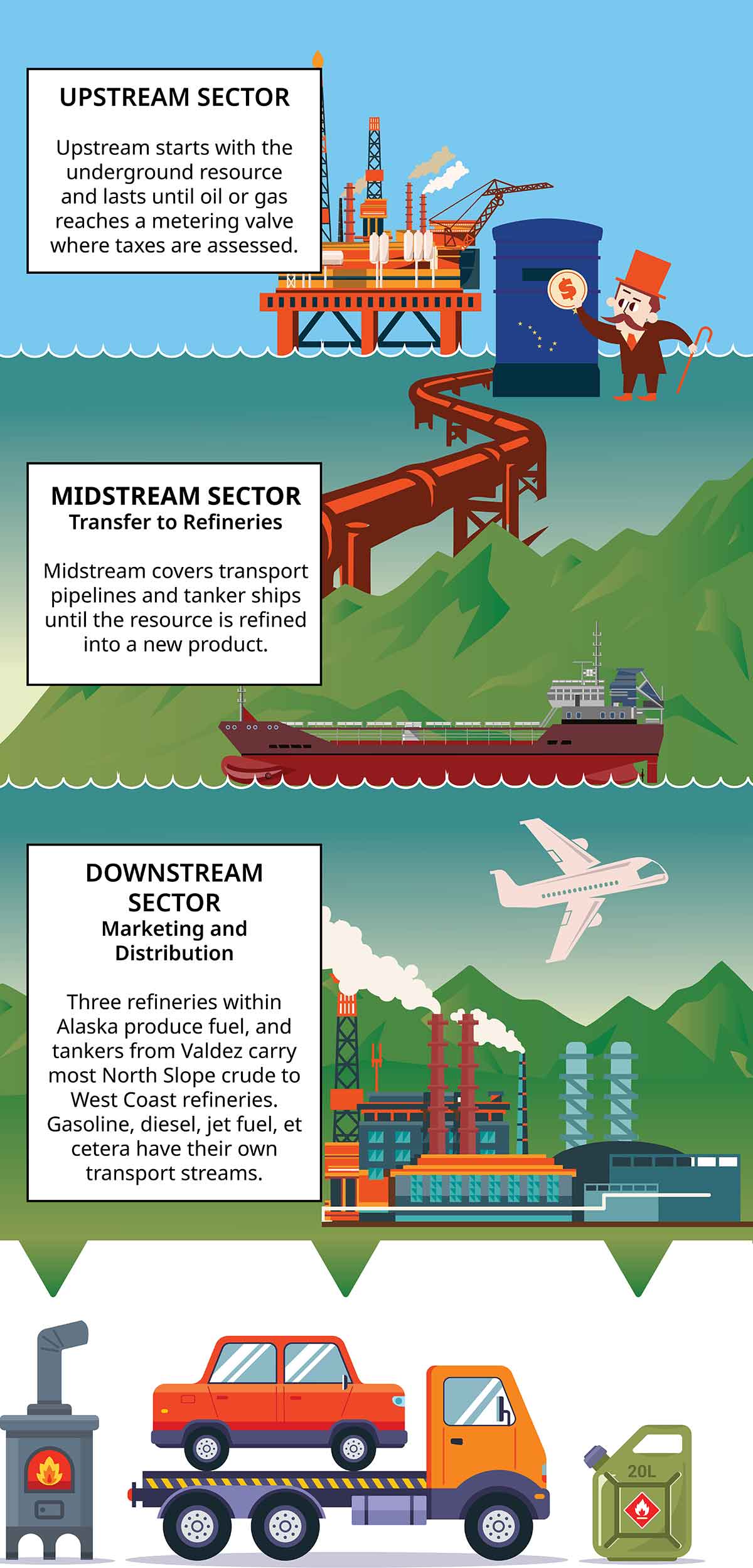
The above terms pertain to one of the three petroleum industry “streams.” Upstream covers exploration and production, until crude oil reaches a lease automatic custody transfer unit, a metering platform where taxable value is measured. North Slope fields rely on dozens of transfer points to feed the Trans Alaska Pipeline System, while the Cook Inlet basin has closer to twenty. Because tiny variations in flow or temperature can result in massive financial discrepancies, transfer points utilize highly precise Coriolis meters, ultrasonic flowmeters, and in-line gas chromatographs. From these readings, the State of Alaska figures its royalty cut (12.5 to 20 percent charged as the landowner) and production taxes (35 percent of gross value minus operating and capital lease expenditures, adjusted by a per-barrel credit).
Alaska Business
Midstream Sector
When crude oil moves horizontally, that’s midstream. Hilcorp’s sister company Harvest Midstream operates the Milne Point, Endicott, and Northstar pipelines that gather oil to Pump Station 1. Harvest Midstream also holds Hilcorp’s 49 percent share of the Trans Alaska Pipeline System, the largest midstream asset in the state. Alyeska Pipeline Service Company celebrated the 19 billionth barrel moved since 1977 in September 2025. And midstream doesn’t end at Milepost 800 in Valdez, where tankers load. ConocoPhillips subsidiary Polar Tankers has five Endeavour-class ships on a twice-monthly circuit to West Coast refineries. The slightly smaller MT California and MT Washington were formerly ExxonMobil’s SeaRiver Maritime ships, acquired by Crowley Alaska Tankers. In Cook Inlet, natural gas pipelines that connect offshore platforms to onshore customers are also Harvest Midstream’s domain.
Downstream Sector
The middle stream leads to refineries, where “downstream” begins. Alaska has three main refineries. The Valdez and North Pole refineries operated by Petro Star, a subsidiary of Arctic Slope Region Corporation, turn North Slope crude into heating oil, kerosene, diesel, and jet fuel. The Marathon Petroleum refinery in Nikiski processes up to 68,000 barrels per day of Cook Inlet crude into gasoline and jet fuel for Southcentral. Marathon reported outstanding performance in 2025, with 94 percent utilization across thirteen refineries nationwide. The stream continues with delivery of refined product, thanks to transporters including Petro Star and sister company Sourdough Fuel, family-owned Petro 49, Vitus Energy, Crowley, and NorthStar Energy subsidiaries Delta Western and Inlet Energy, part of the Saltchuk logistics network.