

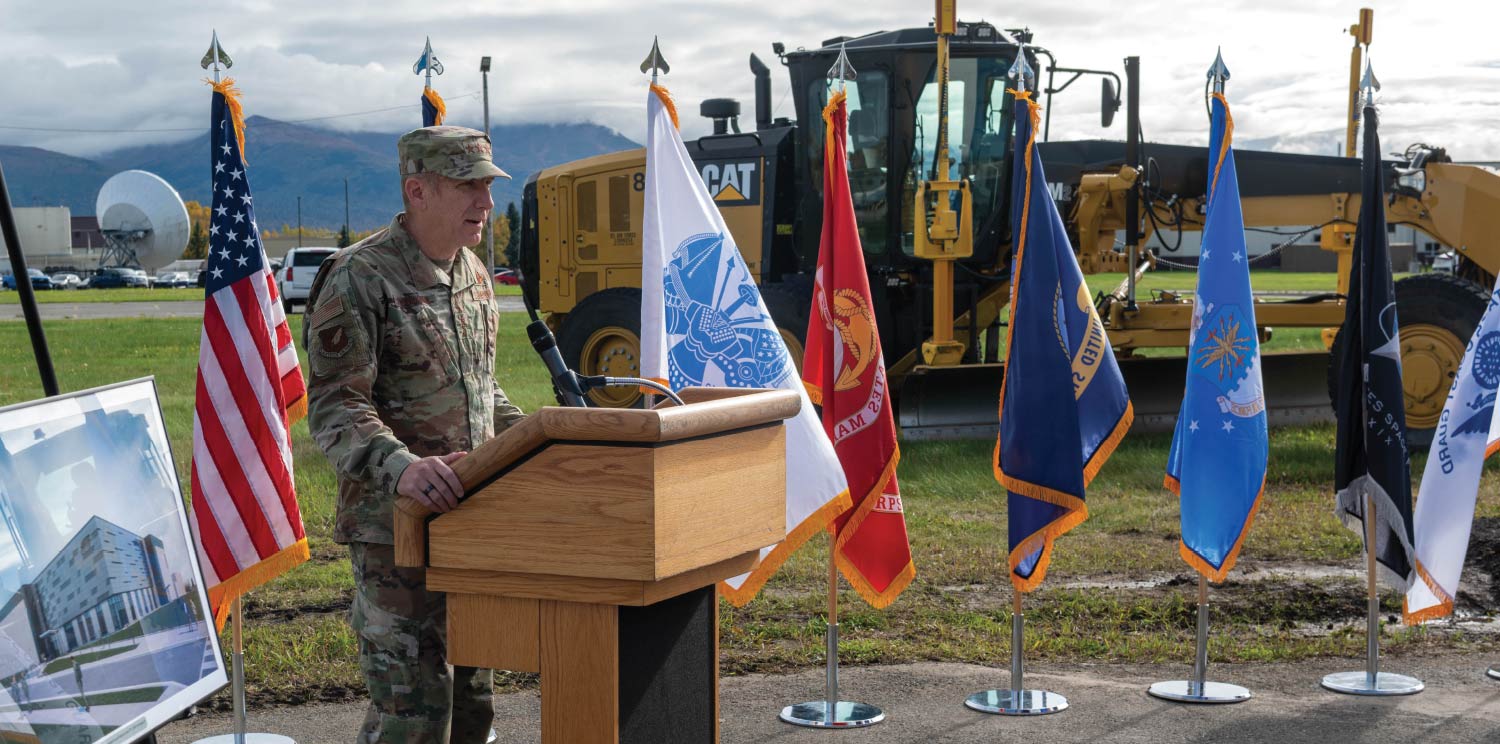
ilitary operations in the Far North go back decades, but the region has taken on growing significance for the US Department of War. US military operations are organized as geographic commands, and two of the seven now conduct regular exercises in the Arctic. The US Indo-Pacific Command, sometimes called the Pacific Command, operates Northern Edge, while the Northern Command conducts Arctic Edge.
With that increased importance comes a need to update and expand existing facilities. The $332 million Joint Integrated Test and Training Center-Elmendorf (JITTC-E) adds a 150,000-square-foot facility with significant simulation capability to Joint Base Elmendorf-Richardson (JBER) in Anchorage.
The facility “will provide a state-of-the-art, single-site, joint simulation environment that allows military forces to train together in realistic, complex scenarios across multiple domains,” Lancaster says. The two-story structure will include simulator and briefing rooms, a 200-person auditorium, and several other spaces, says Thareth Casey, project manager in the US Army Corps of Engineers (USACE) – Alaska District’s Air Force Projects Section.
“It’s going to be a premier facility,” says Cameron Carlson, dean of the UAF College of Business and Security Management. “There’s only one other facility like this in the Air Force,” he notes, at Nellis Air Force Base in Nevada. A former lieutenant colonel, Carlson served as the site lead for a similar facility at Fort Wainwright.
“Elements of this type of training exist across various platform-specific simulators and live-fly exercises,” Lancaster says. “However, the level of integrated, secure, and large-scale training that JITTC-E will provide does not currently exist in a single location.”
One of those limits is geographic: JBER hosts F-22 Raptors, while two squadrons of F-35As call Eielson Air Force Base home. For pilots of the different fighter jets to train in joint scenarios, they must meet at the Joint Pacific Alaska Range Complex, but with JITTC-E they can avoid that commute. Eielson and JBER crews can meet in a simulated environment for exercises that are too massive, secretive, or dangerous for the open-air training range.

Senior Airman Johnny Diaz | DVIDS
According to a 2025 Congressional Budget Office report, “Availability, Use, and Operating and Support Costs of F-35 Fighter Aircraft,” 2023 costs per flying hour varied from $47,000 to $60,000, depending on the plane. These costs included both operation and support.
In recent years, both the US Navy and US Air Force have reduced estimated yearly flight hours for the planes. The Government Accountability Office reports that cost-saving measures have focused on things like maintenance, parts quality, and reducing engine damage caused by “foreign object debris.”
Using more simulator-based training would also reduce costs. “I really never thought about the cost of fuel,” Carlson says of his military days, but a simulator’s cost savings could add up quickly. “If you are able to fly in simulations and you’re doing long simulations,” he says, “you can see very easily” how the savings add up. Using 2023 per-hour costs, a single six-hour simulation could save $282,000 to $360,000, depending on the aircraft.
Carlson says less practice in actual planes also reduces the wear and tear on them. “The more you use the aircraft, the more you have to rebuild the aircraft,” he says, which increases the already-high maintenance costs.

Senior Airman Joshua Kleinholz | US Air Force | DVIDS
ASRC Builders-Caddell won the contract for most of the JITTC-E project: a $290 million award announced in July 2025. The project broke ground a few months later. Arctic Slope Regional Corporation owns ASRC Construction, which formed ASRC Builders-Caddell as a joint venture with Alabama-based Caddell Construction.
Both parts of the joint venture have experience with government projects. ASRC Construction has worked in communities across Alaska. Caddell Construction’s government projects include work on multiple US embassies, including in Kabul, Afghanistan; Beijing; and Mexico City.
The project is currently in the construction phase, Casey says. If all goes according to schedule, work on the test center should finish in 2029. AECOM is the designer of record, while USACE is the design construction agent. Given the project’s location, AECOM and USACE have designed the building to meet heating and air conditioning standards for an International Energy Conservation Code zone 7 climate. The standards establish requirements for thermal efficiency and condensation control; Southcentral falls into this zone. Casey says the building will also meet certain seismic design requirements.
Once finished, in order to be commissioned, the structure will require an extensive process to test all building components for working order in both normal and various emergency scenarios.
Carlson says the JITTC-E project should provide “a tremendous economic boost for Alaska.” Casey says the construction requires hundreds of workers.
Lancaster adds that the project “represents a significant investment in the local community, creating construction jobs and ultimately jobs requiring science, technology, engineering, and math backgrounds to support the training housed in JITTC-E.”

William R. Lewis | US Air Force | DVIDS
“It’s a very good thing for Alaska to have this,” Carlson says. Having “a more robust portfolio [should] draw individuals here for training.” He notes that both Australia and Japan, which are Indo-Pacific Command affiliated partners, fly F-35s.
“JITTC-E is designed as a joint and coalition capability,” Lancaster says. “The facility is expected to support participants from all military services and many of our coalition partners. By enabling forces to train side-by-side in realistic scenarios, JITTC-E will strengthen interoperability and improve the ability to operate together during real-world contingencies.”