

n mid-May it was 19°F and windy at the Aurora Hotel in Deadhorse. As I stood in the parking lot surveying the surroundings, I chatted with a gentleman from Texas who works for Nabors Alaska Drilling and was in town as part of a crew tasked with getting a previously inactive drill rig up and running. He said that, according to his supervisor, spring is the windy season on the North Slope. The gusts were bracing, numbing the fingers holding my camera, but most of my attention was focused on what I could capture through the lens: work trucks, shipping containers, buildings obscured by snow whipped up by the wind. That morning I had flown out of an Anchorage that was laboring to move past winter, plodding through a gray, chilly spring. But in Deadhorse the sun was out in full force and I paused to soak the first beams of 2026 that actually felt warm. Despite the sun working overtime, it had not yet cleared the heavy lift of melting the ice and snow from the Arctic tundra; beyond the trucks and containers and buildings were miles and miles of bright white.
It was just a matter of time, though. Spring was coming, and—two hours by road to the west—so was first oil at Pikka.
What does first oil really mean? Oil has been drawn from the ground at Pikka as far back as 2013, when Repsol and Armstrong Energy drilled Qugruk 3, the site’s “discovery” well, and subsequent exploration wells drilled in 2015 also drew up oil. While on site at Pikka in May, Santos Senior Vice President of External Affairs Joe Balash clarified, “There’s been oil coming out of the ground here at Pikka, at this drill site, since 2023… but that doesn’t constitute production because it’s not being put into marketable conditions.”
This is in part because the oil now being produced at Pikka is new oil; while it naturally contains some water and gas, it does not yet hold water or gas that has been injected back into the ground to maintain pressure to produce more oil. According to Trevor Palaniuk, operations and maintenance manager for Santos on the North Slope, “It’s remarkable that the North Slope has gone so many years without this [Pikka] being developed, because we’ve had very little gas to deal with, very little water—very high-quality crude.” Palaniuk says at present, the “water cut,” or amount of water, is approximately 5 percent, and the amount of gas is so low he couldn’t estimate a rough percentage. “We are actually buying gas from Prudhoe Bay to provide fuel gas for our operations, and we’ll need to do that for some time,” he clarifies.

Monica Sterchi-Lowman | Alaska Business
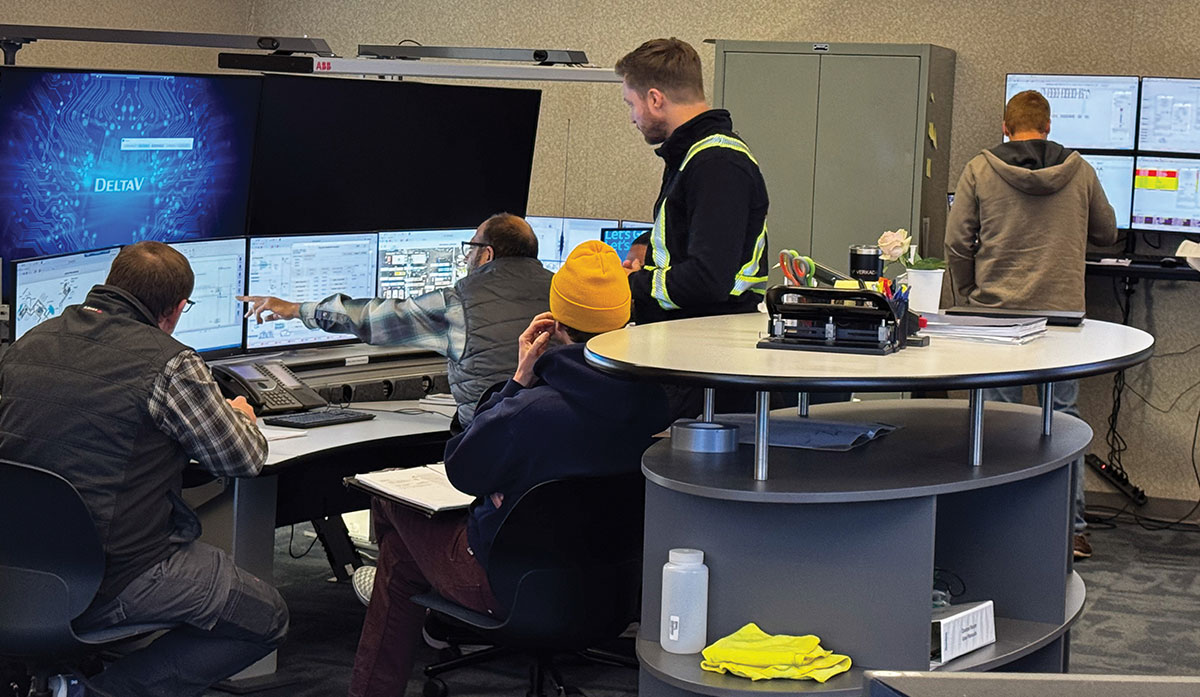
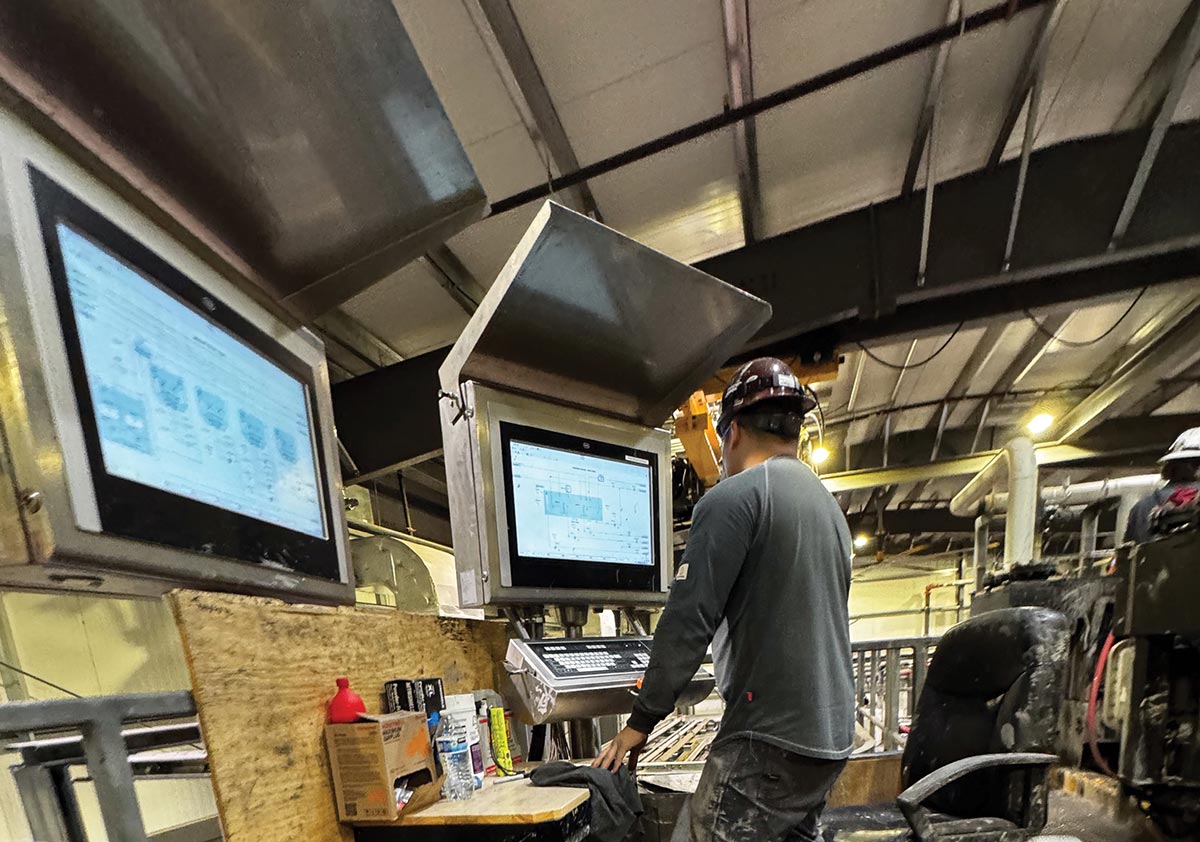
In mid-May, days before first oil, the control center was full of people finalizing the commissioning equipment. One supervised instrument automation; two were controller moderators who operated equipment remotely; another was overseeing crude processors; and many more were reviewing, consulting, and calibrating.
Pikka’s control room design is unique on the North Slope. According to Palaniuk, “A lot of the older design of the facilities—they call it ‘facility siting’—wasn’t really well understood, and a lot of control rooms were built in hazardous areas. That’s the biggest driver here,” he says, speaking of the Pikka control room, “that we got them [employees] away from the site, so if there’s a major incident [on site], these guys are safe.” He clarifies that the modern control room and automated equipment doesn’t completely replace the need for employees on the ground: “You can’t replace a human walking through the facility—what they hear, what they smell, what they see—so that will always be part of our operation.”
And in mid-May, Pikka was buzzing with people. Palaniuk estimated approximately 650 personnel were on site, though Santos anticipates closer to 400 long-term employees at Pikka. The additional 250 were wrapping up construction and working on calibration.
Workers were housed in multiple locations, but the largest group was at the mancamp situated within the Pikka Operations Center, which is also new.
At the Pikka Operations Center mancamp, all of the rooms are “singles” and contain a bed, wardrobe, desk, and TV, as well as a bathroom with a toilet, sink, and shower. Residents have access to a thermostat to heat or cool the room to their personal preference. Gyms, laundry facilities, and a healthcare clinic are available to all residents, as is the cafeteria and 24-hour spike room, which is a small convenience store (minus the need to pay) complete with nachos, hot dog, and soft serve machines, fresh fruit, and a range of snacks and beverages.
What the mancamp doesn’t have is a lot of noise. Contrary to portrayals in modern cinema of rowdy camps bursting at the seams with violence, alcohol, and illicit drugs, the Pikka mancamp observes quiet hours around the clock and, like all North Slope oilfield facilities, alcohol, marijuana products, and non-prescribed medication are strictly prohibited. Because employees work a variety of shifts, the expectation is that all conversations in the halls and rooms will be at a courteous decibel.
Monica Sterchi-Lowman | Alaska Business
Monica Sterchi-Lowman | Alaska Business
On our way to tour Rig 272, which was working during our visit, we passed multiple wellhouses, and the Santos team described the wellheads working within as “Christmas trees.” At the drill site, one wellhead had yet to be housed: ND-BI39. Balash explains the “I” indicated it’s an injector well, which injects water or gas back into the formation, and those without an “I,” like the neighboring ND-B40, are production wells.
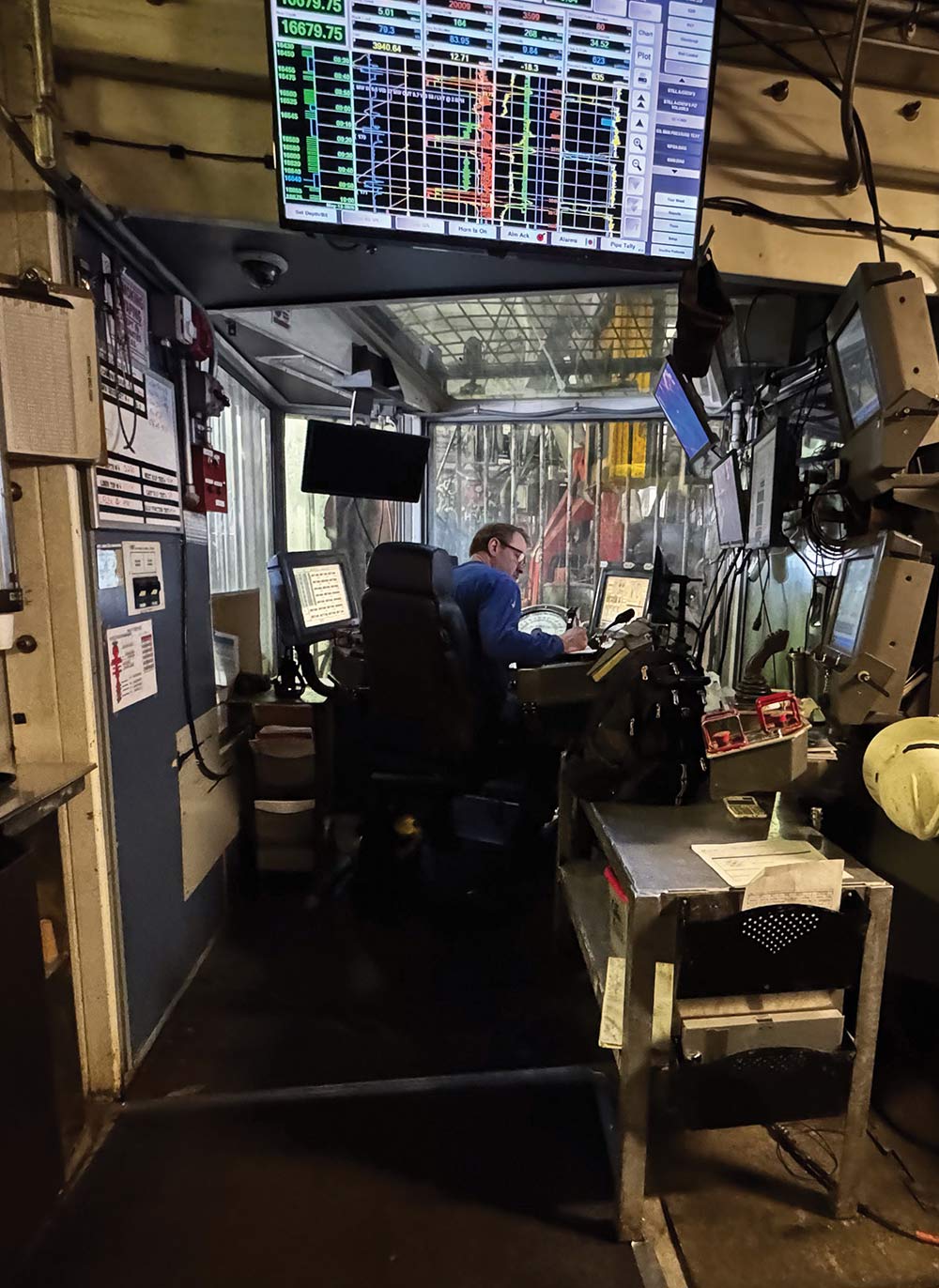
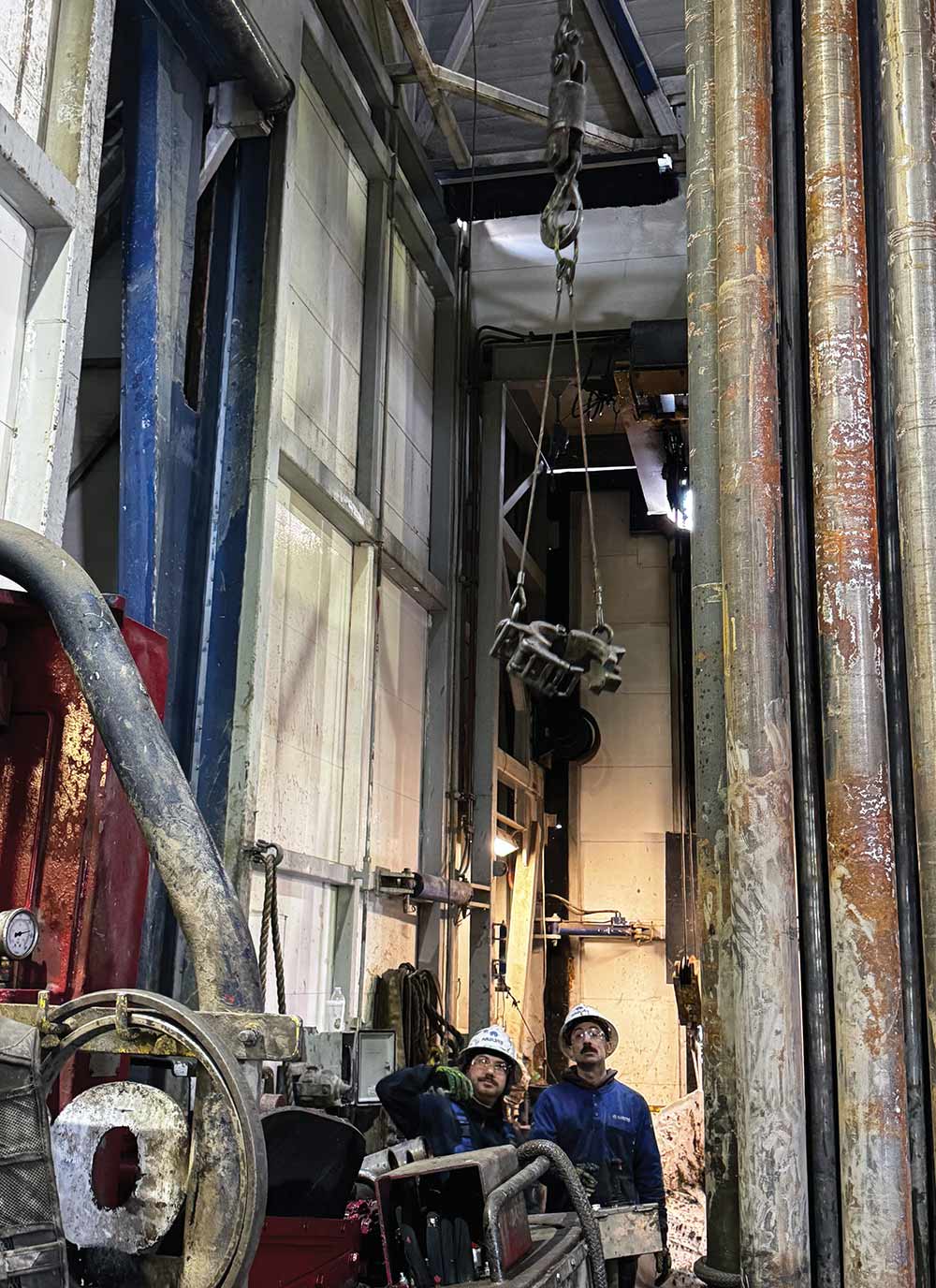
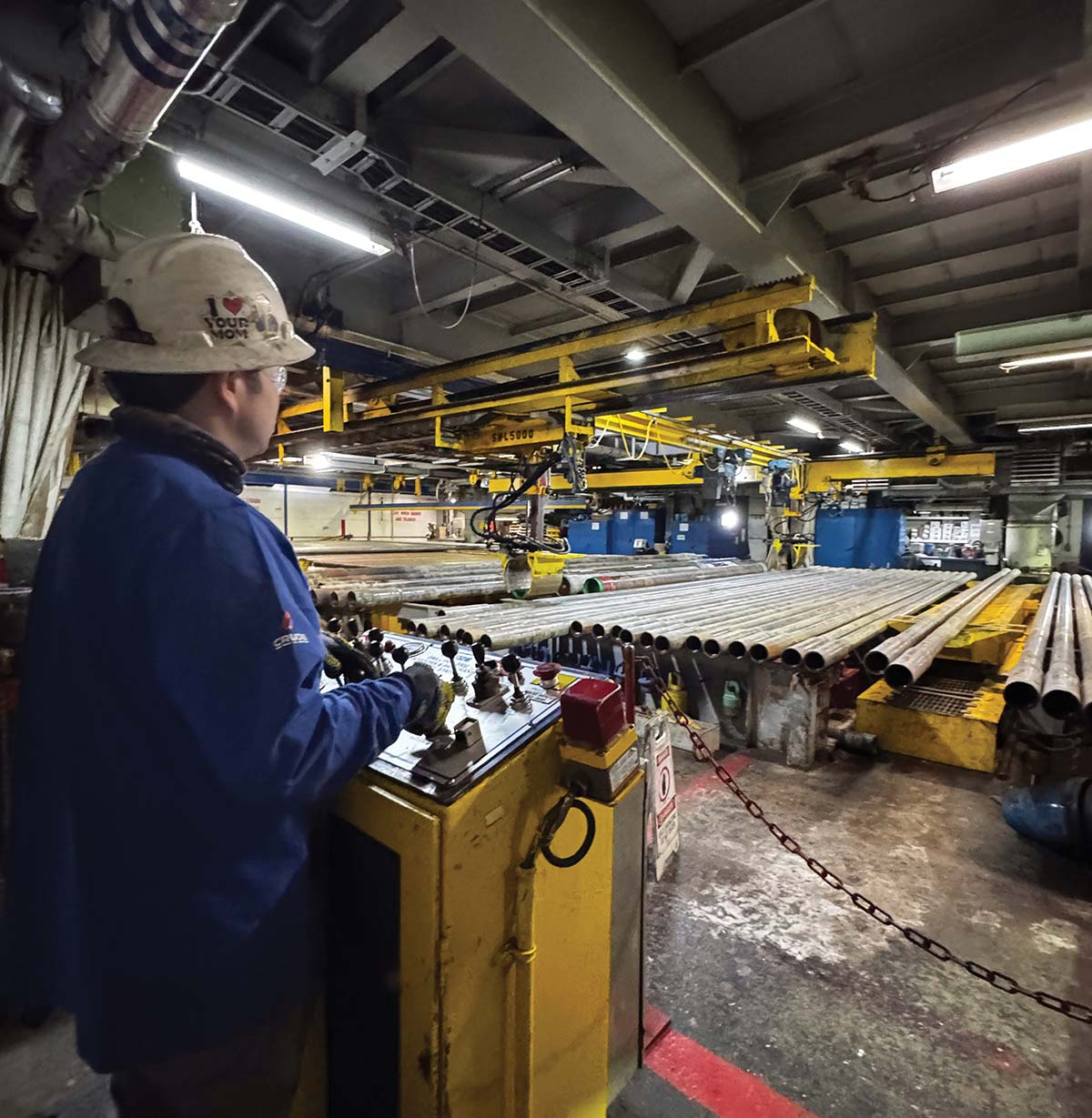
At Rig 272, a crew was working on a new production well; on the ground level, a machine picked up pipe and moved it up the drill rig to a team of three, positioned several flights of stairs higher: two were staging pipe for imminent drilling, and a third was in the “dog house,” the colloquial name for the seat of an engineer who monitors the crew and drilling operations from behind a metal cage (hence the nickname).
Unique on our tour of Pikka, Rig 272 is not new. Tony Sherman, who works for Nabors, helped build it and its sister rig, 273 (which in mid-May was performing work for Hilcorp), in 2010 in Vancouver, Washington.
To get to jobsites in Alaska, Rigs 272 and 273 were barged as modules into West Dock, and it took approximately three weeks to get them all onshore once they had arrived. “It was pretty impressive,” Sherman says. “You’ve got the three units… just shy of 10 million pounds of steel right there.”
Rig 272 started its career by transiting North, and it remains a mobile rig today, albeit under its own power; it drove to ND-B in 2023. For its current operations, as Sherman says, “[The crew] will drill the well and complete the well, and then when the rig finishes drilling activities, it will move.” What look like observation rooms on the side of the rig allow an operator to drive it down the road and on to its next job.
Monica Sterchi-Lowman | Alaska Business
Larry Skanderbeg, completions frac supervisor for Santos, is the expert on the fracking part of the non-rig activity. According to Sherman, Pikka crews are drilling long, horizontal wells into tight rock, so fracking makes a big difference in how the wells produce.
Skanderbeg says that, earlier in Pikka’s operations, they used “smaller” units that could hold approximately 1 million pounds of the sand used for fracking. “We’d do the fracks over about four or five days in-between them and have three or four frack days. With this unit here,” he says, gesturing to a large structure labeled “Sahara” before continuing, “we can hold 3.5 million pounds of sand, so it’s enough to do the whole well at once. It’s cut down the in-between frack days and the number of frack days.” He says it also has a smaller footprint.
The Sahara structure itself was trucked to the North Slope in approximately twenty tractor loads, and it holds sand (more specifically proppant, which is a sand-like material that is most commonly made of processed silica sand or man-made ceramics) that is sourced in the Lower 48, put on a rail car, transported across the United States, put on a barge in Seattle, shipped to Whittier, put back on the railroad, moved to Fairbanks, loaded into trucks, and then brought up the Dalton Highway. The journey takes two months.
And, because the investment in getting the material to Alaska is significant, Santos purchases man-made proppant. “When you spend that amount of money on transportation to get it up here, it’s not that much more to get a good-quality proppant,” Skanderbeg says.
In addition to fracking, Santos also uses proppant in producing wells to help prevent scale. “When certain fluids are mixed together, and they’re not meant to get together… some of the dissolved ions in the water will precipitate out, and that scales up the tubulars [an oilfield pipe] and production equipment.” Chemicals added to the sand injected into the well dissolve over time in the formation and help prevent the precipitates, he explains.
Monica Sterchi-Lowman | Alaska Business
Monica Sterchi-Lowman | Alaska Business
Monica Sterchi-Lowman | Alaska Business
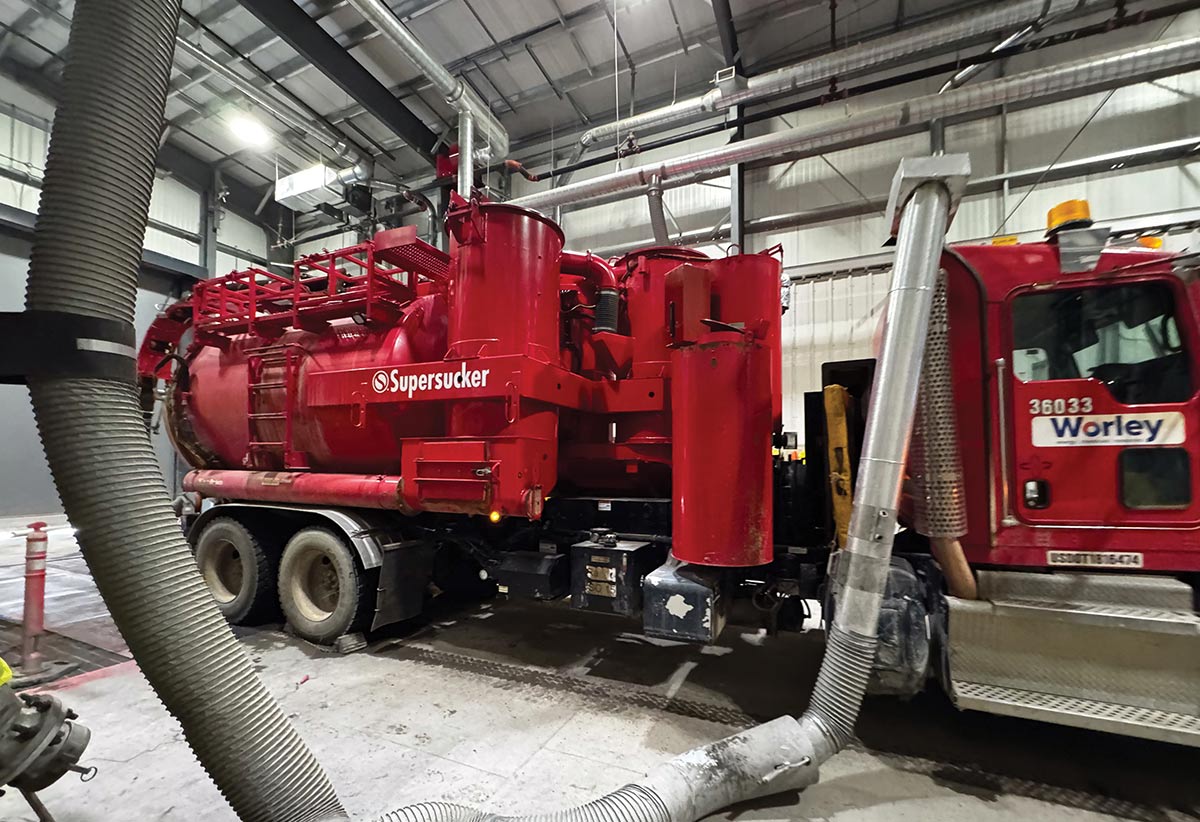
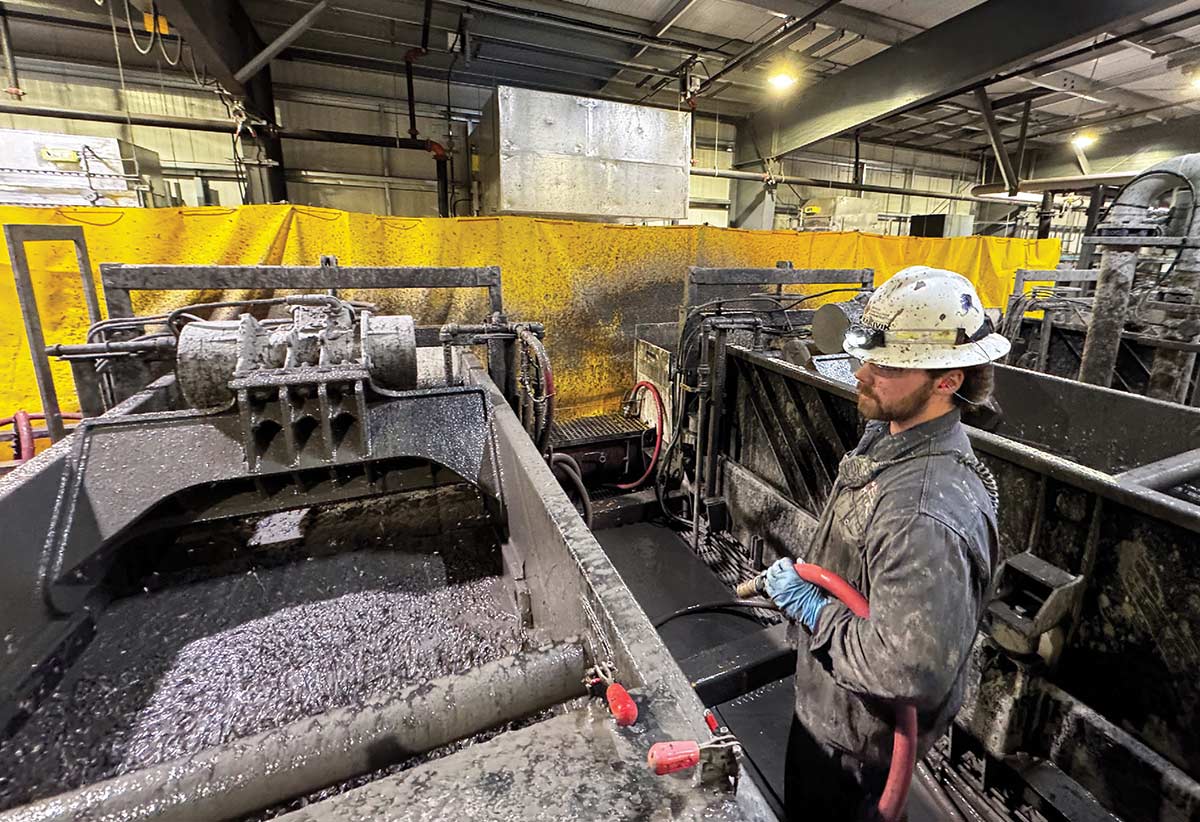
The solution is a literal solution: grinding down the rock into a slurry and injecting it into an underground reservoir via a disposal well. William Rauchenstein, fittingly nicknamed “Rock,” manages the Nanushuk Grind and Inject (NGI) facility. He says, “We don’t do oil here… what we do is we take the big rocks from the rig and we crush them to dust, put it into a slurry—which is the equivalent of going into a milkshake—and inject it into the ground.” The consistency, he says, specifically allows the mixture to be injected underground without it separating.
The underground reservoir that holds the slurry is a permitting formation (i.e., permeable and porous rock), and the well that fills it was specifically drilled for waste rock disposal.
Before Pikka finished constructing the NGI, it trucked its waste to Drill Site 4 in Deadhorse. Doing so required twice as many trucks as processing the rocks on site; the round-trip journey from Pikka to Deadhorse is 10–12 hours in the summer due to road conditions. “Lots of trucks, lots of men, lots of food, lots of money,” Rauchenstein says.
Although the waste rock trucks are now running shorter routes, there are still trucks making the trek to Deadhorse to transport NGI’s “mud” supply, an oil-based mud mixed in Deadhorse that can be adjusted to various viscosities to suit its purpose. “If we’re drilling the well with ten-pound-per-gallon mud, our spike fluid will be thirteen- to fifteen-pound-per-gallon mud, and we’ll dilute it, giving us more mud volume. That buys us time to control the well, or continue drilling the well, while the trucks go to Deadhorse and get more mud for us,” Rauchenstein says.
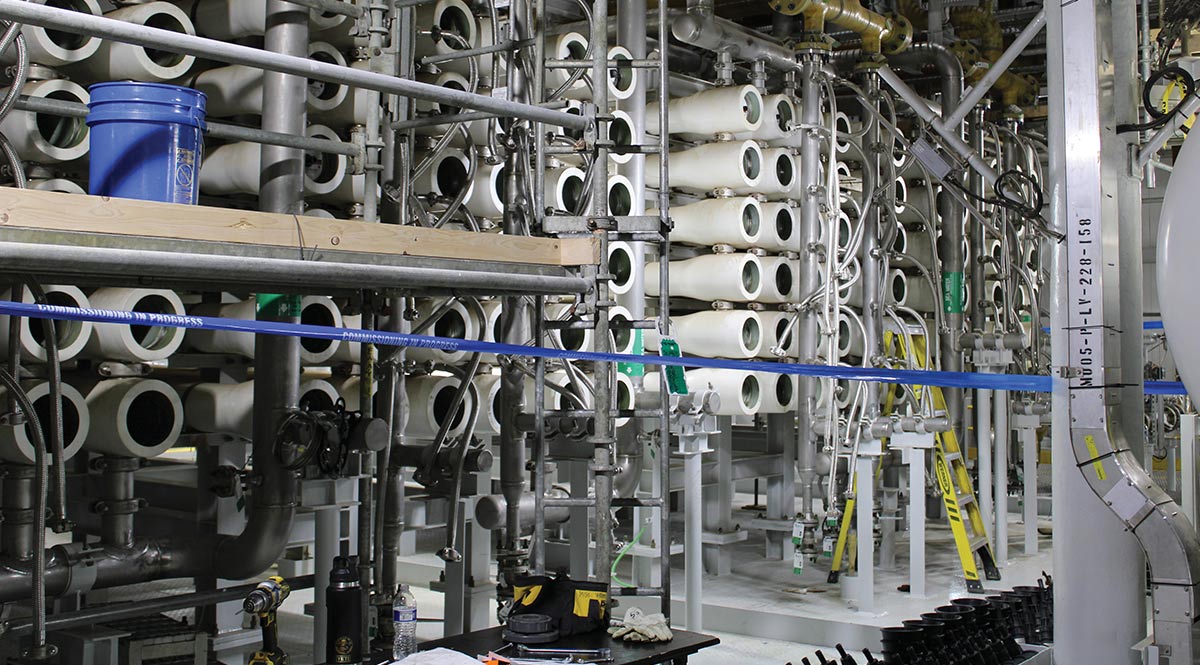
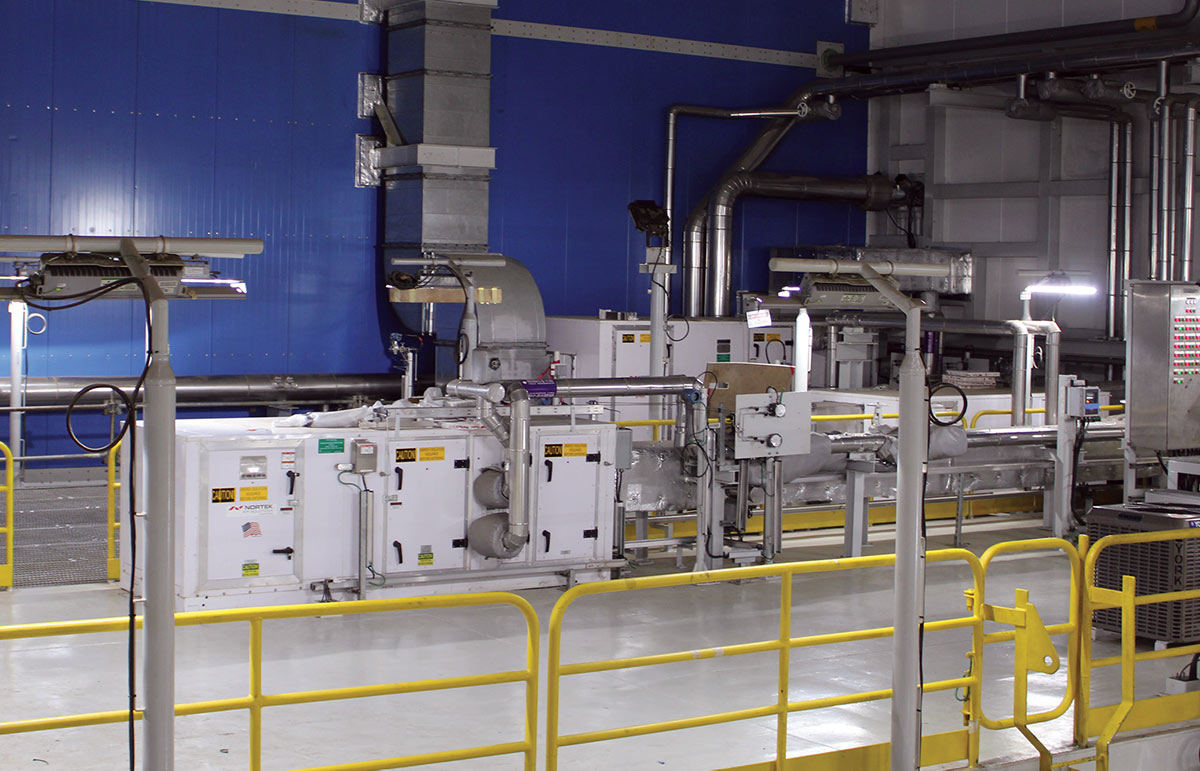
A steady supply of processed seawater flows from the Seawater Treatment Plant (STP) to other Pikka operations. Tim Brown, lead operator for the STP, says the facility processes about 100,000 barrels of water per day at its current configuration. “One of the things that makes this facility unique from the other facilities on the North Slope that process seawater,” Brown says, “is we use all-membrane technology; others use different forms of filtration.” The benefit of the membrane system is that it’s much more compact, Brown explains.
The seawater is processed to remove solids, which have an erosive effect on production infrastructure; sulfates, which, “when you put them down the hole, they’ll bind with strontium and barium and make a really difficult scale to get out of the process piping”; and air, which can promote the growth of bacteria and create hydrogen sulfides, according to Brown.
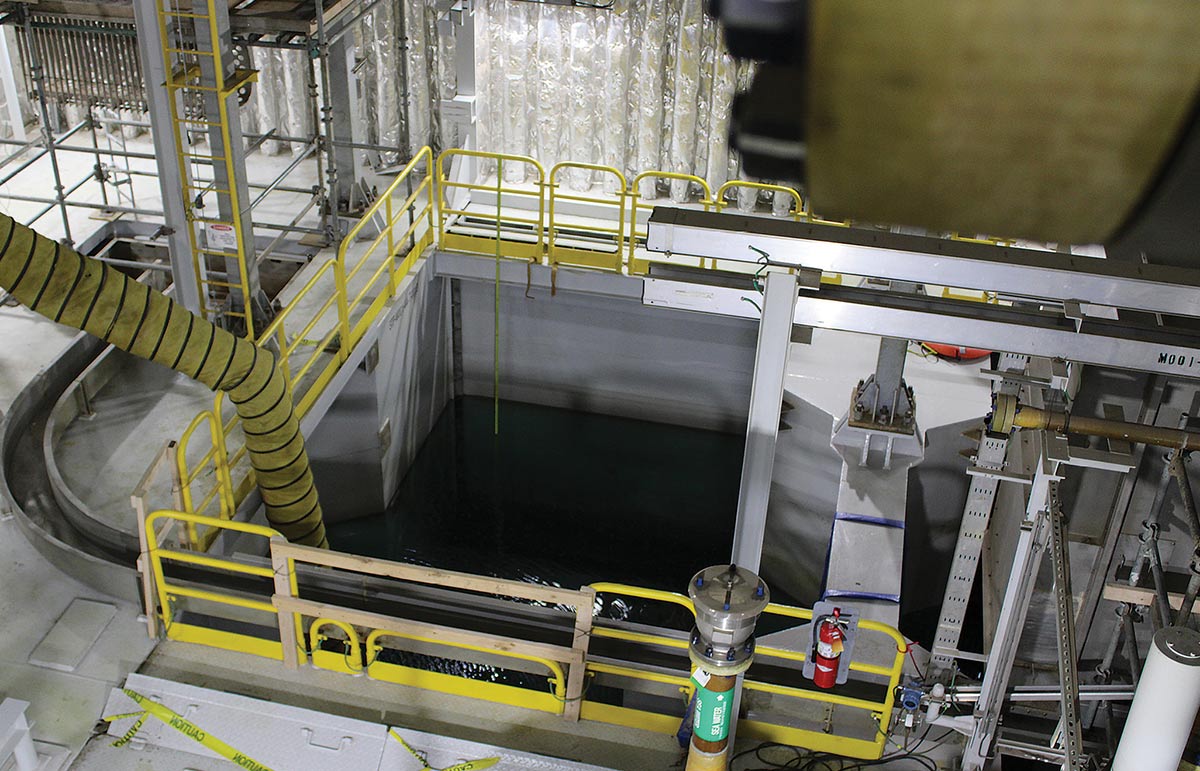
The STP sits on the shoreline and pumps in water directly from the sea. Unlike every other module at Pikka, moved north by truck, the STP facility was fully constructed overseas and traveled by ocean. Arriving in Alaska, the facility was ballasted down, and its ballast tanks were filled with gravel, settling it securely and permanently in its current location.
It’s not surprising that Santos, with such a significant investment, is already looking at how to stretch those investment dollars far into the future.
Pikka Phase I has marked first oil; Phase II is a logical next step, and the company is already making plans.
As one example, Brown says the STP can be configured to increase output to 140,000 barrels of water per day to support Phase II operations.
Balash said in mid-May, “We have some extra [workers] around… we expect we’re not really going to have a significant dropoff. We’re going to be moving to the next drill site… That’s the near-term plan here at Pikka. Once we get our arms around reservoir performance, facility performance, we’ll be looking at how to expand the capacity of our processing facility.”
He says Santos estimates that Phase I will ultimately produce 400,000 million barrels of oil in approximately thirty years. Balash also says that’s a conservative estimate. “Oil fields tend to grow,” he continues. “As long as the world continues to demand energy that’s made of hydrocarbons and there’s a market for it.”
Pikka Phase I is targeting the Nanushuk 2 and Nanushuk 3 formations. “We haven’t delineated the 4, 5, and 6 for their viability, but we will, eventually,” Balash says. “That’s the reason the [National Petroleum Reserve-Alaska] lease sale in March was so extraordinary: this particular resource is widespread across the Slope, and a lot of the work that this team has done to demonstrate the viability of the resource—our company took a big risk and it’s paying off—but there’s so much more available.”
Monica Sterchi-Lowman | Alaska Business
One obstacle to production further west is that doing so economically may require a permanent bridge over the Colville River, and Balash says local communities are debating whether a bridge meets their needs and expectations. “Historically they haven’t wanted infrastructure close; some are reconsidering that, but I would not say there’s a consensus in the community,” Balash says. John Kunaknana, Santos Community Field Coordinator and Kuukpik shareholder with family in Nuiqsut, says that’s his impression of the community sentiment, as well.
“As responsible investors, we want to make sure we’re using the best available technology,” Balash says. “We’re looking for the smallest footprint possible as we deliver the benefits of the project to Alaska, and the nation, and our shareholders.”
What are the benefits? For Alaska, specifically, there’s the money. “The royalty revenue, in particular, is going to be considerable. We expect this next year, on a conservative oil price, we’ll be contributing somewhere around $250 million to the treasury. And over the life of the project, it gets closer to $7 billion, and that’s just Phase I. As we continue to make investment in production, those numbers are going to grow,” Balash says.
He summarizes: “This truly is a world-class operation we have.”
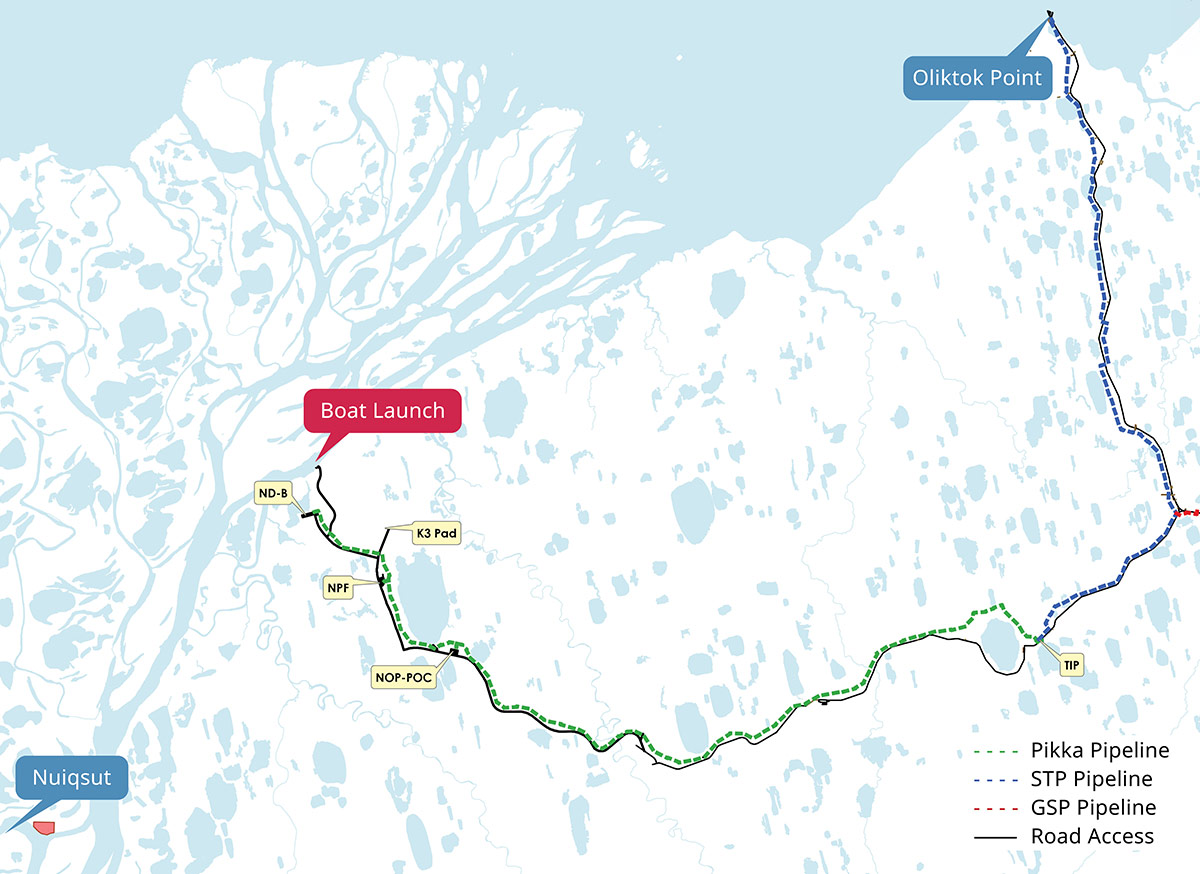
Nuiqsut residents travel on the Colville River for subsistence and gathering activities, hunting caribou and seals, for example, as well as traveling to Deadhorse and other communities. Since the boat ramp was completed in 2021, “It’s been positive feedback,” says Santos Community Field Coordinator John Kunaknana, who is also a shareholder of Kuukpik, the village corporation representing Nuiqsut.
Kunaknana now resides in Anchorage, but he has family still living in the village who use the ramp, and he has utilized the ramp himself. He says, “Before [the boat ramp], they would have to drive [via boat] all the way to Oliktok Point, which is another hour and a half drive.” Located in the Nikaitchuq oil field operated by Hilcorp, Oliktok Point is the northernmost extent of the Prudhoe Bay road network.
Of the approximately 400 residents of Nuiqsut, Kunaknana reports that more than a quarter have taken advantage of the boat ramp. On a summer day, there may be up to fifty vehicles parked on the pad near the ramp.
“This is something that the community very much wanted,” says Lisa Houghton, a senior communications consultant for Pikka, of the boat ramp that Santos built and maintains. “We don’t use it: it’s for the Alaska Native residents.”
Tasha Anderson | Alaska Business
Hollopeter says safety comes first, but really it’s omnipresent. Every task, such as leaving a building, is governed by rules and best practices that consider the safety of infrastructure, equipment, the environment, and people.
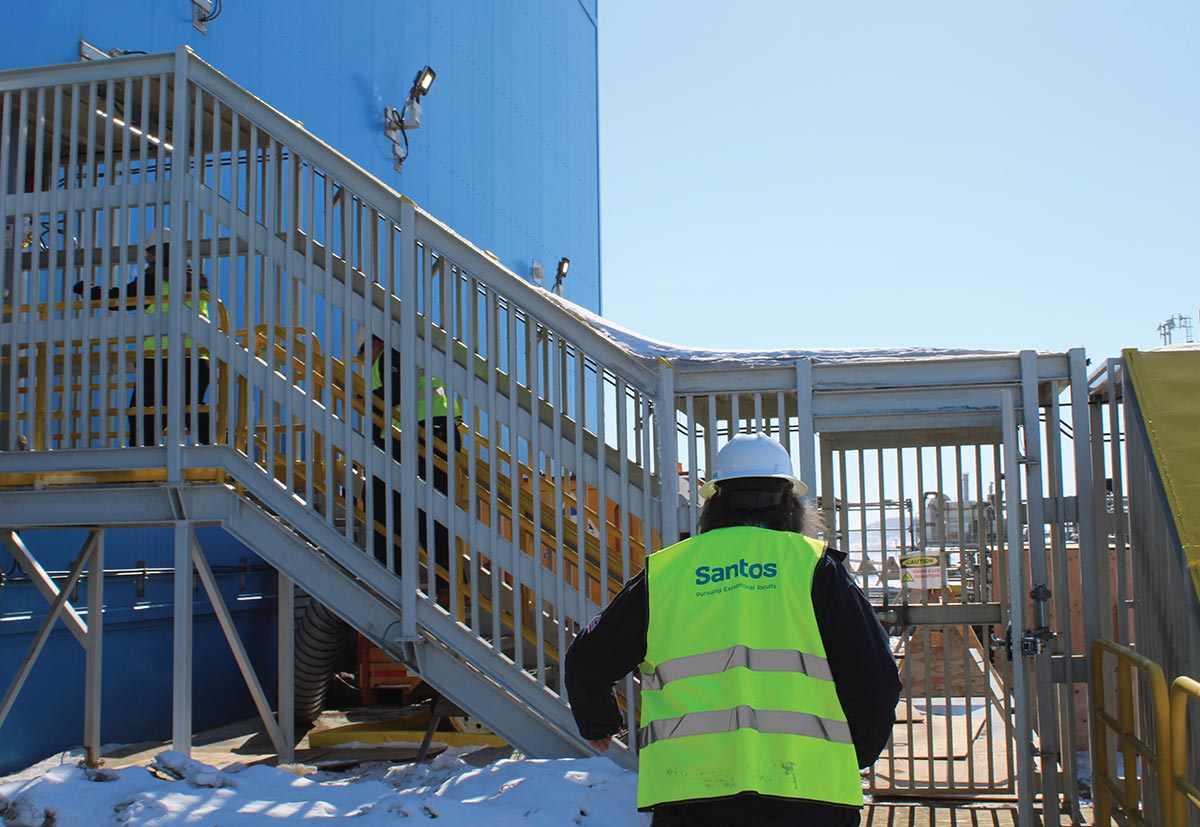
For example: at the Seawater Treatment Plant, every external door to the structure is surrounded by steel bar walkways; those leaving the building can move within these “bear cages” safely and survey the surroundings to check for polar bears, which frequent the area, before moving toward a vehicle or outdoor task.
The number of employees allowed to operate a vehicle on the North Slope is limited, and those who are permitted to drive are expected to follow posted speed limits at all times—including the signs that read 7 ½ miles per hour. Santos Operations and Strategy Manager Todd Lirette’s take on the unique speed limit is that it encourages drivers to be particularly mindful of how fast they’re driving.
On the day of the media tour, in an early-morning briefing, Hollopeter covered everything from personal protective equipment, muster points, and the emergency number in the event of a polar bear sighting to being aware of the massive equipment running on site. “The big iron is going to win,” he cautioned. His briefing was supplemented at every job site with specific safety hazards, required safety equipment, and onsite personnel giving timely “duck here” or “make sure you have cleats on” warnings throughout the tour.
He summarized his briefing with classic advice: “When we’re going out and about, you know, try not to touch things.”