

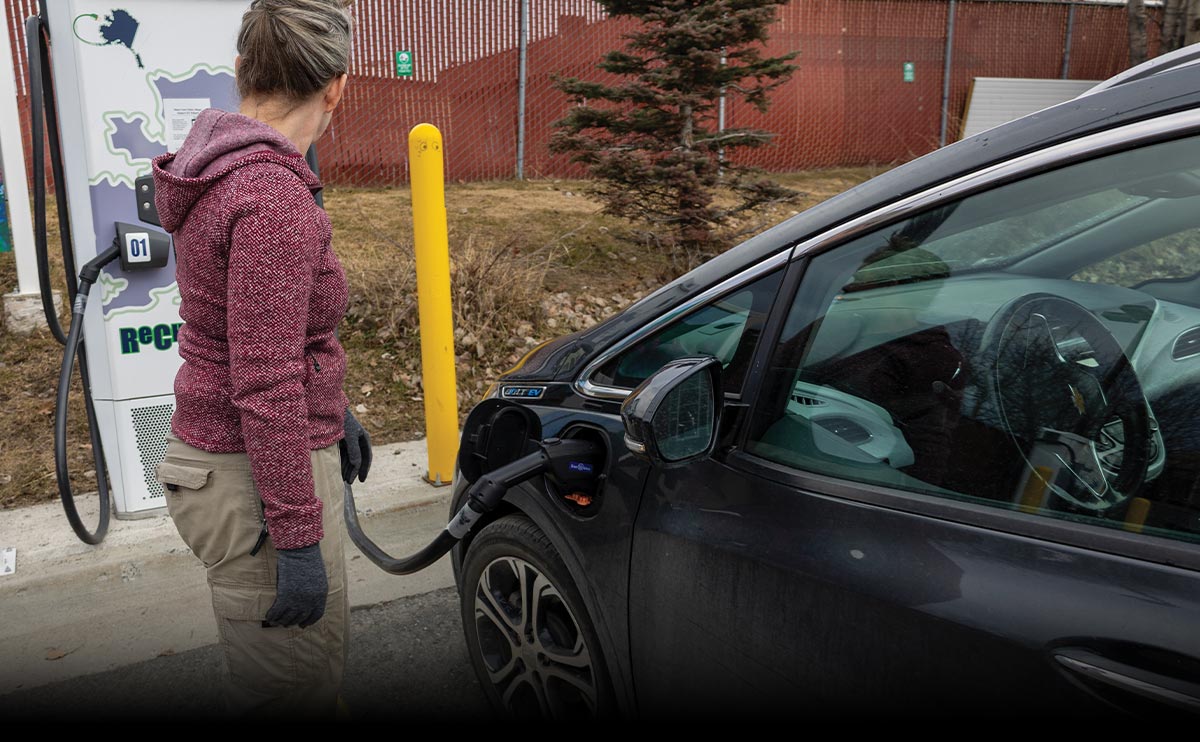
ire beats cold. That elemental understanding explains the intuitive preference for internal combustion engines in Alaska’s climate. Combine that intuition with the observation that batteries, when stored in a freezer, lose their get-up-and-go, and Alaskans reasonably cast a skeptical eye on electric vehicles (EVs).
Furthermore, in communities where electricity prices are crushingly high, plugging in a two-ton appliance for daily recharging seems like madness.
“I certainly started with the presupposition that—in these rural, outlying Alaska communities like Kotzebue and Galena that rely on a lot of diesel generation for electric power and that get pretty cold in the winter—it might not be a good economic transition,” admits Michelle Wilber, a research engineer with the Alaska Center for Energy and Power, a laboratory based at UAF. “There might be a lot of energy used to keep the battery in the vehicle warm; very few people have warm garages to store their vehicles in; there would be a lot of energy, and that would translate into really high costs.”
To test that assumption, Wilber and a team of University of Alaska researchers began formulating a research question around 2019, and by 2025 they published a result that challenged her presupposition. Under the right circumstances, electricity beats fire.
The study “Are Electric Vehicles a Solution for Arctic Isolated Microgrid Communities?” published in World Electric Vehicle Journal concludes that EVs can indeed reduce overall emissions and save costs, under the right conditions.
“Because people are idling gas vehicles a lot, like parking them outside the grocery store and keeping them running while they’re inside because it’s cold,” Wilber explains, “it would make financial sense from a fueling standpoint to switch to an EV.”
The break-even point depends on electricity at $0.40 to $0.60/kWh. The statewide average is about $0.25, and some communities pay as much as $0.80/kWh, but Wilber says most of the typical uses did pencil out in favor of EVs. In only four out of twenty-one use cases did net fueling costs increase, mainly in communities with less renewable energy and where vehicles were driven short distances (less than 31 miles in a day) and combustion engines needed less idling or fewer plug-in heaters to stay warm.
Researchers did recognize shortcomings of EVs in cold conditions. “EVs’ automatic battery thermal management systems may allow for less user flexibility and may actually lead to higher fueling costs and emissions in certain boundary cases,” the study notes. “EVs currently available on the market will continue to use energy while parked in the cold to maintain battery health.” Furthermore, the fueling cost comparison depends on state-subsidized electricity, and charging an EV might push some households above the subsidy cap.
Thus, the study concludes, “It is likely that innovations in vehicles, power systems, and incentives will be needed to enable Arctic communities to fully and equitably participate in the transition to electrified transportation.”
A report in April by the Alliance for Automotive Innovation tallied 152 EVs sold in Alaska in the last three months of 2025, or 2.56 percent of new light-duty sales. The previous quarter saw 3.64 percent, and it was 3.77 percent a year earlier, during the fourth quarter of 2024. For all of 2025, about 3.13 percent of new vehicles sold were EVs, putting Alaska near the bottom of the nation but ahead of twelve other states in terms of EV market share. The national rate was 9.6 percent of new light-duty sales in 2025.
Wilber observes, “We are late adopters in Alaska.” She compares the state to Norway, with similar climate, geography, and lifestyle, where 96 percent of new passenger car sales in 2025 were EVs. Of course, although Norway is likewise endowed by oil wealth, its local electricity is nearly 90 percent from relatively cheap hydropower.
Norway as a whole, then, has more in common with Juneau. From nearly any corner in the capital city, it doesn’t take long for a Nissan Leaf or other EV to pass by. Steve Behnke, a founding member of advocacy group Renewable Juneau, estimates approximately one EV for every ten households in Juneau.
Behnke himself bought a used Nissan Leaf in 2017, and he considers himself a late adopter. Behnke says, “It works perfectly fine for my needs. I don’t even pay attention to the cost for electricity. It doesn’t even register in terms of my electric bill.”
Will Juneau become Alaska’s first all-EV city? Behnke sees some competition. “Gustavus could beat us to it because it’s so small,” he says of the Glacier Bay community, which Alaska Power & Telephone supplies with 100 percent renewable energy from Falls Creek Hydro. Behnke notes that plugging in an EV is easier than shipping in fuel, even when electricity costs are relatively high.
“For most people, they’re driving a handful of miles every day,” says Wilber. “There’s no range anxiety even in the coldest temperatures, as long as they can plug in and charge overnight or when they’re not using the vehicle. Home Level 2 chargers [240V, like an electric hair dryer] or some chargers at the grocery store are probably good enough for early adopters at this point.”
Cordova, where 83 percent of electricity demand comes from hydropower, is another example of a town with hardly anywhere to drive. “Everyone lives within 7 miles of town center,” notes Cordova Electric Cooperative CEO Clay Koplin. Gasoline is expensive while excess hydropower goes unused. Therefore, he says, “Use cases are general commuter transportation, forklifts in canneries/freezer plants, and more recently trucks for hauling boats, hybrids for transportation, and maybe even tractor/mowers. Boating is gaining interest.”
Furthermore, offroad vehicles are welcome on the streets of Alaska’s smallest towns, and those showed the most robust net benefits of electrification in Wilber’s study.
To further define the benefits of offroad EVs, Kotzebue Electric Association is testing a battery powered snowmachine. “The electric snowmachine functions well here,” says Tom Atkinson, CEO and general manager of the co-op. “Broader acceptance would hinge on two things: increased range (only about 60 miles now) and decreased weight.”
Wilber agrees that the weight distribution of the battery makes the snowmachine handle differently. “With a gas snowmachine, the tail end is really light, and you can pick up that track and put it back on at the trail,” she says. “But with the electric one, it’s a big battery all along the bottom. It’s equally heavy everywhere, so you need more people to actually get it back on the trail.”
Another glitch is shortcomings in local data infrastructure, as experienced by the Kotzebue tribe’s test of a second electric snowmachine. “There was a throttle error code that just needed to be cleared, but where they had it parked didn’t have WiFi, so the manufacturer couldn’t make the connection and clear it,” Wilber reports.
Then there’s the question of maintenance. Wilber says researchers often heard, “Can we even change the tires on the car without shocking ourselves on the high voltage system?” Thus, the University of Alaska spun off a rural intensive course on automotive electronics and EVs from its EV certificate training program to ensure locals can gain an understanding of the safe maintenance of high-voltage systems.
Leaving town is trickier. “Every time we want to do a road trip, we have to think about it a lot,” Wilber says, relying on apps to locate charging stations. “Even though I’m a researcher in this, it’s still that learning curve, and it’s big.”
For now, EVs are best for around-town trips, especially for high-mileage vehicles like delivery fleets and taxis. In off-road communities, “Having fast charging for the vast majority of people is not going to be necessary,” says Wilber. “There are some cab drivers and delivery drivers that drive many miles in a day, and they might not have too much downtime.”
Her study found that high-mileage fleet EVs perform well in Arctic communities because they are constantly in use, mitigating the “cold soak” effect on the battery. The study calculates that Bethel, with its unique density of taxicabs, could see savings of roughly $2,000 to $4,000 per vehicle each year by switching to EVs.
One problem, though: Bethel has no local car dealerships. New EVs must be shipped over the water, and that’s not so easy.
That’s horribly inconvenient for communities off the road system, including Juneau. Behnke acknowledges that, for shippers, it’s not just a financial risk; an on-board fire could disrupt the economic lifeline for Southeast. Renewable Juneau has been trying to work toward a solution, holding a panel discussion with shippers in February.
Alaska Marine Lines President Don Reid told the panel his company wants to be able to ship all vehicles, but based on the technology available today, shipping EVs is too risky.
That leaves the Alaska Marine Highway System, but EVs are limited to two per ferry. “That’s better than nothing, but it really put a crimp,” says Behnke. “Not only do you have people trying to bring vehicles up from down south; you also have our car dealers trying to bring up electric vehicles there.”
The state-run ferry system adapted by implementing new procedures: EV drivers are instructed to limit the charge in the batteries, and crew inspect the EVs with infrared cameras every hour while in transit. With the installation of more thermal cameras and fire extinguishers, the ferry system is trying to accommodate the growing share of EV drivers.
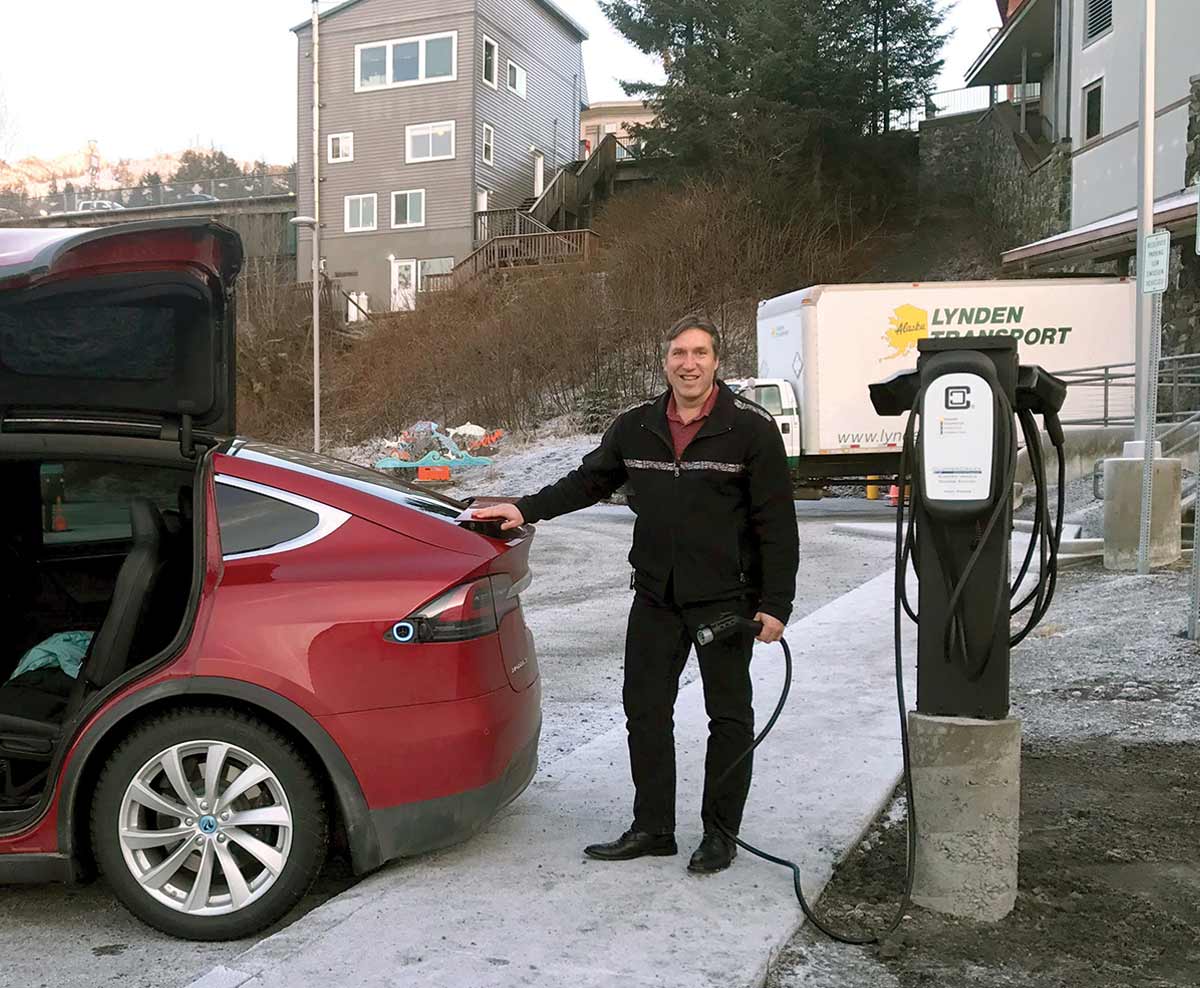
Cordova Electric Cooperative
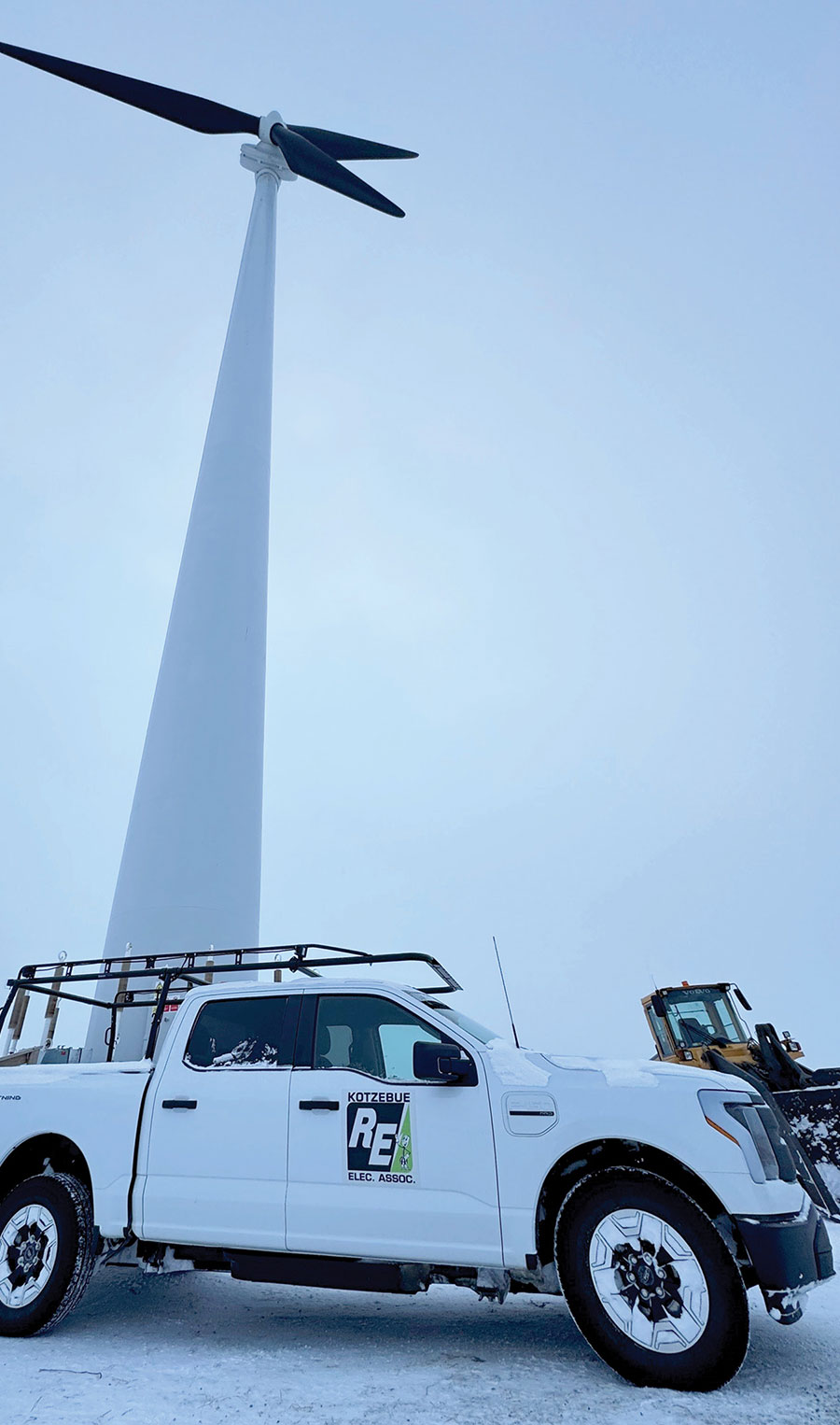
Kotzebue Electric Association
Alaska Energy Authority and Alaska Department of Transportation and Public Facilities received $41 million in NEVI funds from 2022 through 2024 to install charging stations in Fairbanks, Nenana, Cantwell, and Trapper Creek. The Phase 1 charging stations include at least four and up to eight Combined Charging System ports, each capable of delivering 150 kw.
Although NEVI funding was temporarily paused in early 2025, Tesla moved forward with construction of its charging sites without NEVI funding. Alaska requested that these publicly accessible sites be recognized as NEVI-creditable installations.
The Alliance for Automotive Innovation ranks Alaska 29th among the 50 states for the ratio of EVs to public chargers. By the end of 2025, there were about 5,400 EVs on the road and 196 public charging ports, or 27 EVs for every outlet. That includes 89 DC fast chargers, with 25 net new chargers added in the last quarter of 2025.
The national ratio is 31 EVs for every charger.
Behnke is looking forward to some of that Phase 2 money coming to Juneau. “Even though we’ve got this high proportion of electric vehicles, the charger networks down here have all been very local,” he says. “Juneau’s charger network is basically a volunteer collaborative community effort with several different entities kicking money in.”
The 40 miles of road available around Juneau is at the edge of a Leaf’s capabilities, Behnke says, so more charging would be helpful. “One of the things that our utility is quite interested in is how to incentivize and support EV charging for renters and people living in multifamily housing, which is 30-plus percent of Juneau,” he notes.
Cordova might not get a share of NEVI Phase 2 funding, but Koplin says his utility might partner with Southeast Conference to add some chargers.
Once the shipping obstacle is overcome—either thanks to new battery chemistry or if logistics companies or their insurance policies become more comfortable with EVs—electrified transport becomes a practical option for more Alaskans, whether on the road system or in its most remote communities.
“It’s probably inevitable,” Wilber says. “As the transition pulls Alaska along, we’re ready to take advantage instead of being disadvantaged by it. And this may be on the order of a couple decades; I’m not saying it’s tomorrow.”