
he first pilot to buzz through Alaska’s sky was James Vernon Martin in the summer of 1913. He took off in his open-cockpit biplane from a ballpark in Fairbanks, soaring about 200 feet above the town as folks watched wondrously from front porches.
Martin had barely two years of experience when he brought aviation to the territory. A merchant mariner by trade, he became interested in aeronautical engineering within five years of the Wright Brothers’ epochal flight in 1903. He then went to England in 1911 to learn to fly the first production-line biplanes. After his visit to Alaska, Martin secured a patent for retractable landing gear, a rather influential bit of hardware.
Today, Alaskans from all backgrounds and corners of the state obtain licenses to fly planes and helicopters, earning a golden ticket to freely explore the state’s 665,000 square miles of rugged and fascinating terrain. Alaska boasts six times the number of certified pilots per capita compared to the rest of the country, on average, with 1 in every 100 Alaskans qualified to fly.
Plenty of businesses around Alaska offer pilot training, yet one company does things a little different: Fly Around Alaska Flight School.
In other programs, students may schedule lessons based not only on their schedules but on instructor availability. Some may take just a handful of lessons over time and lose interest. Others may stick with it and chip away and end up spending more money on flying lessons as time passes, Hammond says.
Fly Around Alaska offers a streamlined and fast-tracked pilot training program. Students are supplied with materials needed for the written test. Then they spend two straight weeks one-on-one with an instructor at the company’s Palmer base, completing a series of flight instruction segments before a final certification flight with a Federal Aviation Administration (FAA)-designated pilot examiner.
Fly Around Alaska’s program costs an estimated $16,000—that covers classroom materials and instruction, flying time, a dedicated instructor, and more. Because it’s intensive, in a bookended two-week period, students leave the program ready with their rating or pilot certificate. Modeled after US Air Force and US Navy flight training, Hammond says it’s an efficient approach for both the students and his business.
“The national average is over seventy hours to get a private pilot’s certificate,” Hammond says. “In our program, people get it in two weeks and an average of forty-five to forty-eight hours [of flight time]. So we’re somewhat in the neighborhood of half of the normal flight school time and costs.”
“It was just a normal flight school once upon a time,” he says. “People would come and take a lesson and leave. We started realizing the industry is somewhat broken. It costs so much to learn to fly, and flight schools take advantage of that. You come in and fly whenever you feel like it. They don’t try to get you on a real regular schedule to get you done.”
The Fly Around Alaska business model fits niche markets, such as Alaskans on rotational job schedules who would be better served by a two-week, immersive experience. Also, people coming in from out of state to learn to fly would benefit from the convenience of a timebound, intensive experience.
“These poor devils who work on the Slope were taking a year, year and a half to get a pilot’s certificate, and we wanted to get a fix for that,” Hammond says.
Today, Fly Around Alaska maintains a fleet of fourteen fully owned airplanes, occupies four large hangars at the Warren “Bud” Woods Palmer Municipal Airport, and trains up to 120 pilots a year. The client base is traditionally split between locals and out-of-staters.
“Primarily it’s people who just want to get a private pilot’s license,” Hammond says. “They think it would be cool. And the locals, it’s no surprise: they just want to go fly around. It’s people who look at flying as a passion, a convenience, and a tool.”
On the first day of the two-week program, it’s all ground school. Instructors gauge the students’ knowledge and develop a learning plan with emphasis on specific areas of need.
Then students begin a regimen of three flights a day, about seventy-five minutes each.
“We use science here as well as knowledge, from the [US] Air Force and others, and we experimented with what is the optimal time is for a flight lesson,” Hammond says. “We found that was somewhere between an hour and fifteen minutes and an hour and a half. That way we don’t burn them out or wear them out.”
Students enjoy thirty-minute breaks between flying lessons, and they end the day with debriefs and homework assignments. This process repeats until students are ready for their longer “cross countries,” when they shift to two longer flights per day, up to about two hours in length. The typical route takes them from Palmer to Talkeetna; from Talkeetna to Merrill Field Airport in Anchorage; and then back to Palmer again.
Bustling Merrill Field is always a benchmark and challenge, where students have their first taste of a towered airport and markedly busy airspace.
Students also enjoy consistency with the same instructor throughout training, which isn’t always the case at regular flight schools, in Hammond’s experience. He says, “You wind up getting multiple instructors, and each has their own way of doing things, and you’re constantly in a relearning mode.”
In Hammond’s time with Fly Around Alaska, he’s only encountered a handful of folks—he estimates four—who simply couldn’t learn the flying portion. Otherwise, the accelerated model has proven successful. Many of the dozen instructors at the company are women, and Fly Around Alaska is seeing increased interest from Alaska Native corporations and various nonprofit organizations to enroll students. Recent examples include the Navy SEAL Foundation and the California chapter of Girls Love to Fly.
“Having your pilot’s certificate in Alaska completely opens up the state for you to enjoy and see,” Hammond says. “We all know there’s so much of Alaska you can’t drive to. But you can fly to it.”
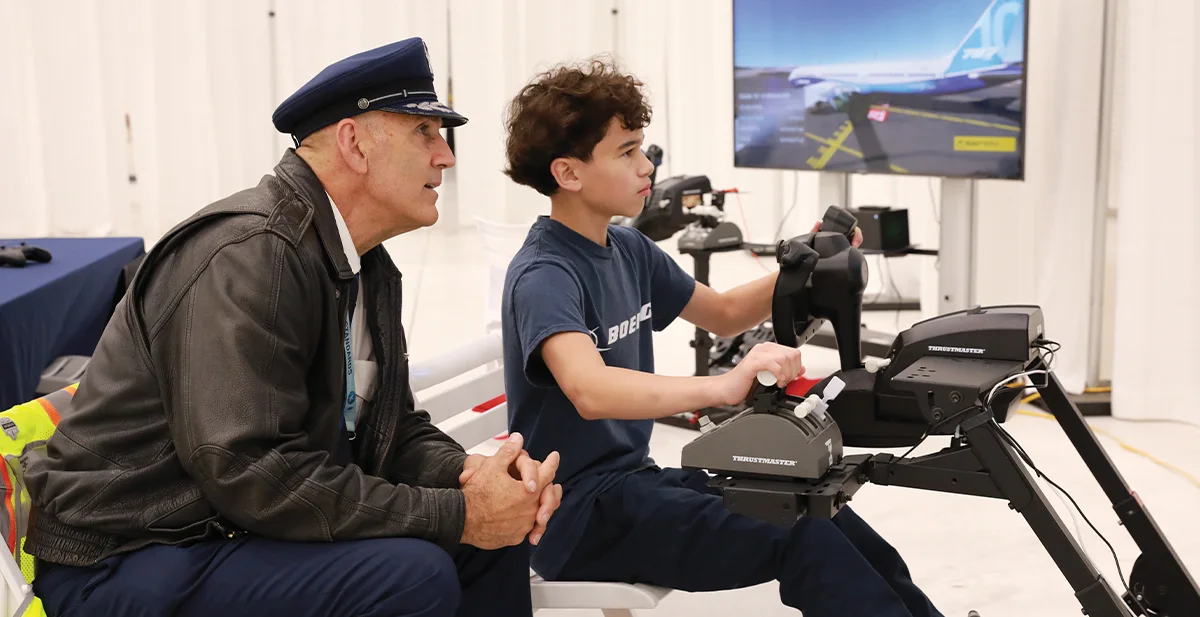
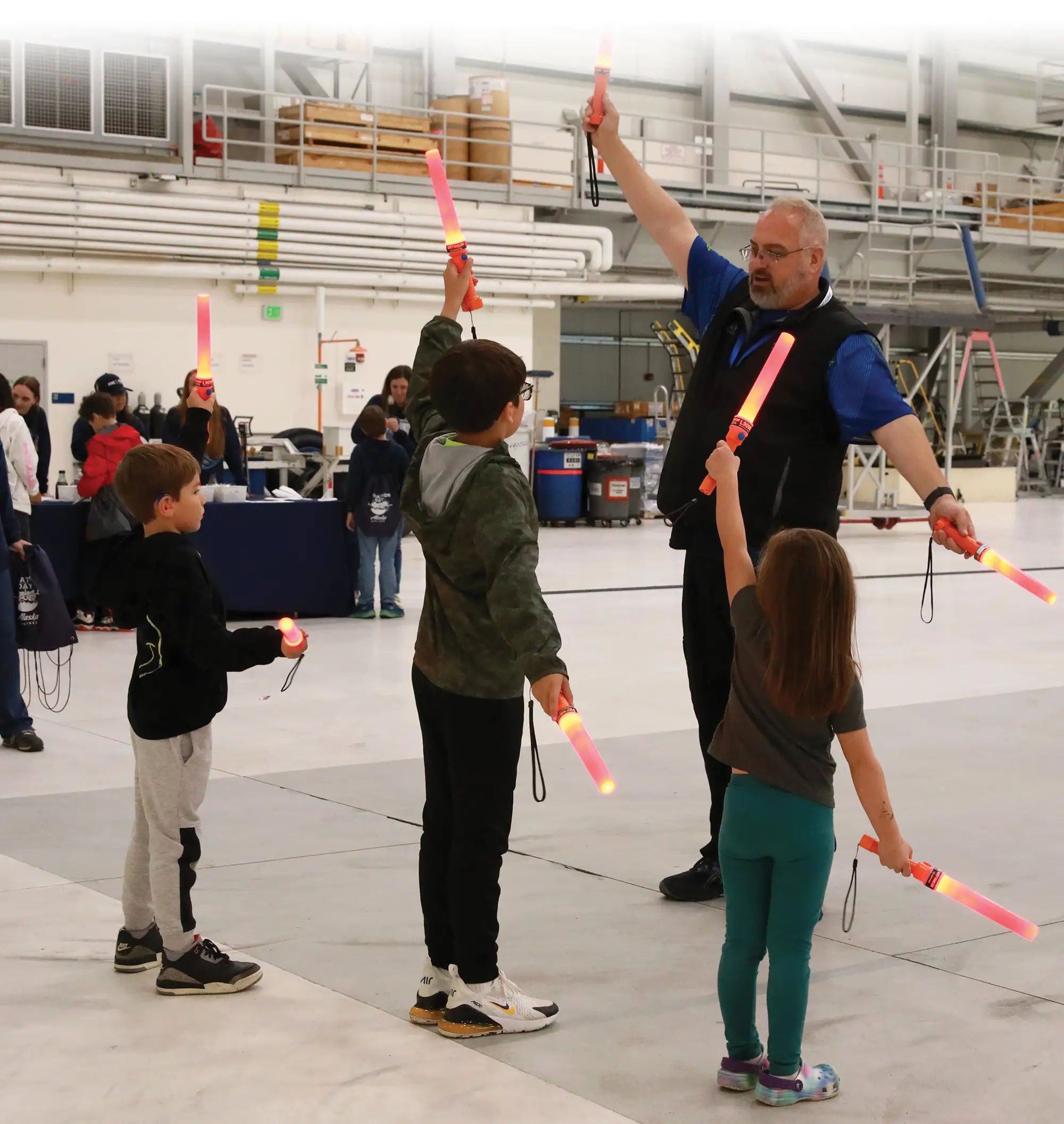
About 800 kids visited the Alaska Airlines hangar and were treated to a unique experience including simulators and VR goggles. “It really gave kids an opportunity to experience flying an airplane,” says Alessandra Frichtl, the airline’s community relations and engagement manager. “We actually gave them the opportunity to pull the life vest for the first time. Even the adults love that one.”
Also on hand was Birch Creek Aviation, a flight school at Merrill Field. Julie Thiele, Alaska Airlines base chief pilot in Anchorage, credits the company with putting more Alaskans into the cockpit. “There are a lot of flight schools, but not all of them offer what Birch Creek can offer,” she says.
Alaska Airlines also partners with a flight school in Redmond, Oregon, for its Ascend Pilot Academy. Not all applicants get in; when Thiele screens aspiring cadets, she looks for true aviators. “I don’t want to hear, ‘I just want to make a lot of money and travel,’” she says. “I want to hear, ‘I want to fly airplanes and take people from Point A to Point B and be involved in the community.’”
Aviation Day is meant to find those soaring hearts. “It means the world to me to find these young aviators,” Thiele says. “At this Aviation Day, there were a lot of those students and even some adults that were like, ‘Can I still get into aviation?’ And sure you can. It’s a passion for sure.”
Frichtl says the next Aviation Day in Anchorage is scheduled for May 2026.