

hoosing to manufacture in Alaska can seem like a fool’s mission.
“From a purely cost-performance perspective, you should probably never build stuff in Alaska,” says Nick Ferree, vice president of Equipment Source, Inc. (ESI). “But Alaska is home for us. We understand it.”
ESI isn’t alone in taking on the challenge. Hans Vogel, director of Palmer-based TriJet Manufacturing Services, is keenly conscious of the difficulties posed by the state’s large distances and small markets. By vertically integrating a workshop capable of computer numeric control (CNC) machining, welding, and powder coating, Vogel aims to bring Lower 48 prices to Alaska businesses that might otherwise shop Outside for their manufacturing needs. Plus, manufacturing workers get to stay in Alaska and enjoy living in the state.
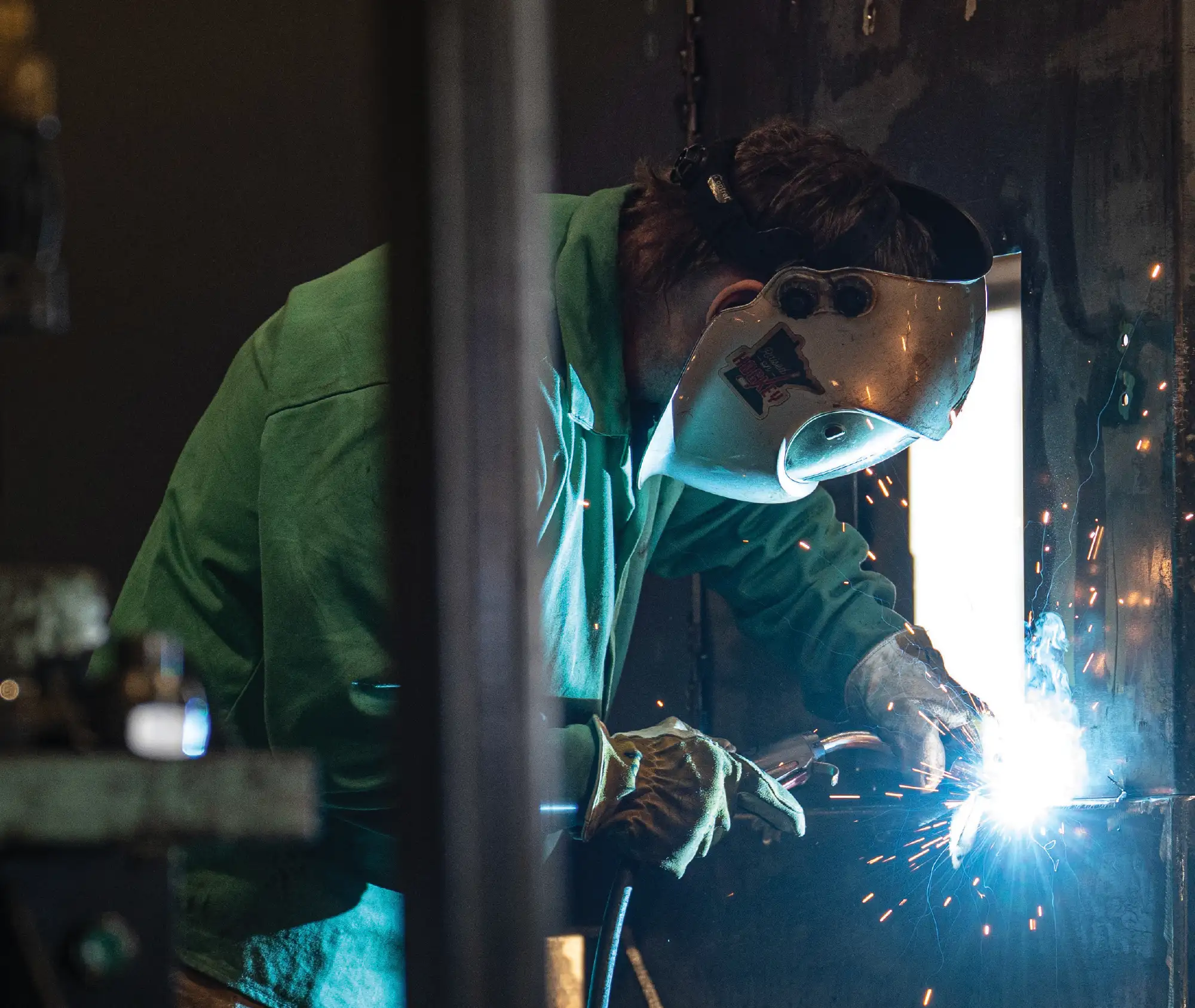
From steel fabrication to assembling all-weather equipment, these companies choose to manufacture in Alaska and offer their services to other businesses in need of an assembly line.
The latter is the domain of STEELFAB, Inc., established in 1952 along Ship Creek in Anchorage, stocking the largest steel inventory in Alaska.
“We build all kinds of jibber jabbers and whatchamacallits,” says STEELFAB, Inc. President Richard Faulkner. “We’re about the largest steel company up here.”
STEELFAB products span every Alaska industry: a monorail for the Pogo Mine, a bridge for the Alaska Railroad, and “bison boxes” to transport ungulates from the Alaska Wildlife Conservation Center to their new home in the woods around Shageluk. There’s little that STEELFAB will not, or cannot, do.
“We build sewage tankage and large floats for the gold mining industry,” Faulkner says. “Instruments, chutes, and conveyor systems for them to move product around from one place to another. We’ll work on anything.”
When Faulkner and his wife Janet purchased STEELFAB in 1988, they initiated an extensive capital improvement campaign that expanded both the original Ship Creek facility and the company’s manufacturing capabilities. The updated facility now sits on ten acres with 84,000 square feet of under-roof space, 16,000 square feet of outside under-crane storage, and a 2.5-acre erecting pad. The expansion made STEELFAB a one-stop shop to fabricate, shot blast, paint, and coat its products.
“We’re what’s called a steel service center,” Faulkner explains. “That means we sell steel angles, channels, plates, beams, pipes, stuff like that.”
STEELFAB’s equipment—it has one of the largest burn tables and press brakes in Alaska—is “generally the largest and the most sophisticated in the state,” Faulkner says, enabling the company to pierce, cut, and bend steel pieces of various sizes. As an American Institute of Steel Construction-certified bridge fabricator, the shop can fabricate bridge girders from 8 inches to 7 feet tall, and STEELFAB is one of the few beam, tube, channel, and angle fabricators in Alaska.
ESI Alaska

STEELFAB, Inc.

ESI Alaska

STEELFAB also holds the patent on jack stands created for oil fields; these stands make it easier for oil service contractors to level piping that sinks into the ground during the freeze-thaw cycle. “Instead of taking a bunch of equipment and people out to pick it up with a crane, it takes two men to go out and jack it up and be done,” Faulkner says.
Faulkner understands that Alaska-built items cost more, but he believes that clients see advantages.
“We can build it more custom for them up here,” he says. “They can generally get what they’re looking for a whole lot faster than they can buying it out of Texas. We’re not the cheapest there is, but when we build it, it’s a quality product.”
At first glance, the name Anchorage Sand & Gravel (AS&G) seems to say it all. Founded in 1938 by Arthur Waldron, the company’s Anchorage facility is flanked by towering mounds of sand and gravel, an unmistakable visual cue for passersby. While those materials are foundational (in every sense), they’re just the beginning of AS&G’s story.
“The products we produce are based on materials that contain cement and aggregate,” says Sales Manager Dave Johnson. Sand and gravel, then, are the foundation for a broad inventory of products under the AS&G name that include ready-mix concrete, precast concrete, prestressed concrete, blocks, step stones, and pavers.
The process begins at AS&G’s pit in Palmer. Railroad tracks carry the mined aggregate to South Anchorage. From there, the aggregate can be sold as pit run gravel—a compactable base material used to stabilize soil—or it can be further refined through crushing, screening, and washing to produce a variety of specialized sands.
“We make several types of sand,” Johnson says. “Concrete sand, which doubles as road sand, mason sand—used in mortar for masonry walls—and seasonal varieties like winter aggregates and septic sands.”
Not all the aggregate leaves the yard in bulk. Some is packaged into AS&G’s signature yellow bags, and some is molded into building blocks. At the company’s block plant, aggregates are mixed with cement and water to create step stones, pavers, and concrete blocks—the same blocks used to build many Anchorage schools, for example.
AS&G’s batch plant produces ready-mix concrete, which contractors use to pour sidewalks, driveways, and foundations. That same ready-mix concrete flows into Precast Concrete Company, an AS&G subsidiary acquired in 2000, which specializes in shaping concrete into custom forms, from utility vaults and planters to manhole covers and architectural panels that adorn building exteriors.
“Once the concrete has hardened, the forms can be stripped and the product is ready to be picked up,” says Precast Manager Dane Smulick.
While most consumers might never buy from AS&G themselves, the sand and gravel go into products greater than the sum of their parts, laid underfoot or stacked high by builders.
Fifteen years later, the Palmer-based company completed the design and manufacture of the Mobile Cleaning Recovery Recycle System Vehicle (MCRRS, or “McChriss”). From there, Triverus “extrapolated” the technology for the civilian market and released the Municipal Cleaning Vehicle (MCV) to clean hard outdoor surfaces. Last fall, Triverus introduced the MCVHD, a larger street-sweeper version of the MCV.
These inventions needed special parts that Vogel couldn’t simply buy off the shelf. “Back in 2003, we needed a vertically integrated technology-based manufacturing company as a vendor,” he recalls. Thus, Vogel started TriJet as a sister company.
The centerpiece of the shop, and the namesake of the company, is a 6-foot-by-12-foot waterjet table, which uses a high-pressure stream to pierce plastic or metal to very precise tolerances. The workshop also contains CNC machining tools, 3D printers, and powder coating cabinets. “We’re full right now,” says Vogel.

Anchorage Sand & Gravel

Anchorage Sand & Gravel

The need that TriJet satisfied for Triverus, it’s able to do for others. Vogel cites the examples of robot inventors, non-destructive testing consultants, and makers of aftermarket components for civil aircraft. Really, anyone who needs custom parts. “Let’s say you’re a mining company that has no capability for aftermarket component support. And we’re working with oil and gas companies to make things for machines that were designed on the Slope a long time ago, they’re still operating, and they need complex components made,” says Vogel.
TriJet specializes in low- to medium-run manufacturing. Vogel especially likes to form long-term partnerships with companies, from first prototype to a batch of fifteen or twenty, staying with the customer as the product evolves and prices go down.
“It’s customer-centric to make your prices approachable,” he says, “like a business that they’re gonna go to, to buy their stuff from Seattle or Minneapolis or wherever the other vendors are. Those are our actual real competitors, not people here.”
Partnering with companies that don’t want to manufacture on their own is a common model in the Lower 48, according to Vogel, and he’s trying to bring it to Alaska. “Ultimately, they don’t have to grow their business, if they don’t want to, in that technology-based manufacturing, that specialty side. They can be more product focused. That’s really what TriJet does: business to business for companies that need things made.”


Triverus, LLC

STEELFAB, Inc.

“Built Arctic Tough” is the motto of the company, established in Fairbanks in 2000.
“We started rebuilding competitors’ mobile industrial heaters on the North Slope,” Ferree explains. “Equipment that was built in the Lower 48 was sent up to the oil field, they’d use it up over many years, then send it to us. We’d strip it, repair it, and send it back. Through that process, we realized we could build a better heater.”
ESI’s flagship is the ES700, a mobile, diesel-fueled, indirect heater designed to produce, at the press of a button, almost 800,000 BTUs of hot air per hour.
“There are over 1,000 ES700s in operation up on the North Slope,” Ferree says, a mix of owned and rented. “Equipment yards in the summer, you see stacks and stacks and stacks of our ES700s lined up awaiting the next winter season.”
Over the next quarter century, ESI expanded its product line to include machinery designed, developed, and tested specifically to operate in Alaska’s harsh climate. Those include smaller and larger versions of the ES700, as well as ground thaw heaters, skid or trailer-mounted industrial generators, fuel tanks for sling loading beneath helicopters, industrial water pumps, arctic air compressors, and mobile bull rail trailers, among other products. All are built at ESI’s 12-acre Fairbanks campus.
While heaters marked ESI’s initial foray into manufacturing, Ferree says its largest segment now is power generators built for major utilities.
“We’re the prime generator supplier for AT&T and GCI,” he says. “If you make a cell phone call in Western Alaska, I will guarantee that your call bounces through telecommunication sites powered by ESI generators.”
Those telecom companies have technical expertise of their own, but with ESI on the case, those clients can outsource the nuts-and-bolts job. Ferree says ESI has carved out a niche as a manufacturer that can design products to meet its clients’ specific needs, particularly for use in the Arctic.
“Our manufacturing department thrives when we can design and build a specific product that will solve a customer’s problem,” he says. “We work hand in hand with customers to complete design-build projects. Our engineering team engages with the end user so we can produce a product that meets their exact needs.”
Ferree estimates that roughly 30 percent of ESI’s revenue comes from its manufactured products. The challenge is finding the right balance between which products make sense to build in Alaska.
“Alaska’s not the cheapest place to build stuff,” he says. “There are several products that we have a niche in, and it makes sense to build them here and do it cost-effectively and bring good value for our customers. Other commodity products aren’t cost-effective to make in Alaska.”
In those cases, ESI partners with outside companies to purchase components or equipment. For products ESI builds, Ferree says the company’s knowledge of what is needed to efficiently and reliably operate machinery throughout an Alaska winter outweighs the additional cost.
“Companies bring products up and say it will run at -30°F, but they’ve never tested it,” Ferree says. “We’re here. We understand the cold and the challenges it presents. When we say our stuff will run at -40°F, we know it will because we’ve tested it.”