

able TV went dark this summer for customers of GCI, Alaska’s largest telecommunications provider. The blackout was hardly a surprise; the company warned last November that it would end the service by mid-2025. In its place, GCI directed customers to video streaming—in practice, not a big change from the set-top boxes GCI had leased to customers since acquiring several cable TV companies in the ‘90s.
CEO Ron Duncan co-founded the company in 1979 as a long-distance telephone provider, using satellites to reach remote Alaska communities. Even as the company entered the local phone market, Duncan had his eye on bigger data pipelines, notes Senior Vice President of Corporate Development Billy Wailand. “Ron saw there were already wires that would support high-bandwidth data in these communities, so he began to purchase cable companies throughout the state,” Wailand says.
Cable was a means to an end, an interim step in GCI’s mission of general communications. TV entered customers’ homes via coaxial cables, thicker than the wires carrying phone calls. Wailand explains, “Engineers were able to significantly scale the speeds that you can push through coaxial cable in a way that they absolutely were not through twisted copper.”
Twisted copper, in use since the first telegraphs of the 1840s, became the earliest internet backbone. However, just as TV has outgrown coaxial cable, the telephone era of internet access ended this year when AOL discontinued dialup service, effective September 30. These relics have been displaced by broadband.
Whether that comports with writing conventions (the New York Times switched to lower-case “internet” in 2016, signaling the evolution of a proper name into a common noun), broadband is indeed the way cybercitizens connect these days. GCI’s retreat from cable TV is, in this way, a step forward into the frontier that Duncan envisioned.
Today, broadband has a strict definition. “The Federal Communications Commission defines broadband as minimum download speeds of 100 Mbps and minimum upload speeds of 20 Mbps,” explains Tony Dodge, chief network officer for Alaska Communications. Uploading 20 megabits per second is like tapping a telegraph message 400,000 times faster than Edison. Since customers download more than they upload—say, large music or video files—the inbound data is five times faster still.
And accelerating. “That definition has changed over time, and that makes sense because the needs of your average household have changed over time. Not so long ago, it was 10 megabits down by 1 up; after that, 25 megabits down by 3 megabits up,” says Wailand. The latest standard has only been in place since 2024.
Furthermore, “Several technologies are easily surpassing 100/20,” says Williams, but he figures the minimum is sufficient for typical households. “In a residential context, one must consider how many people are using the connection and what they are doing. Five people gaming concurrently will appreciate faster speeds. A small family cruising the internet will be very happy with 100/20.”
GCI
Alaska Communications

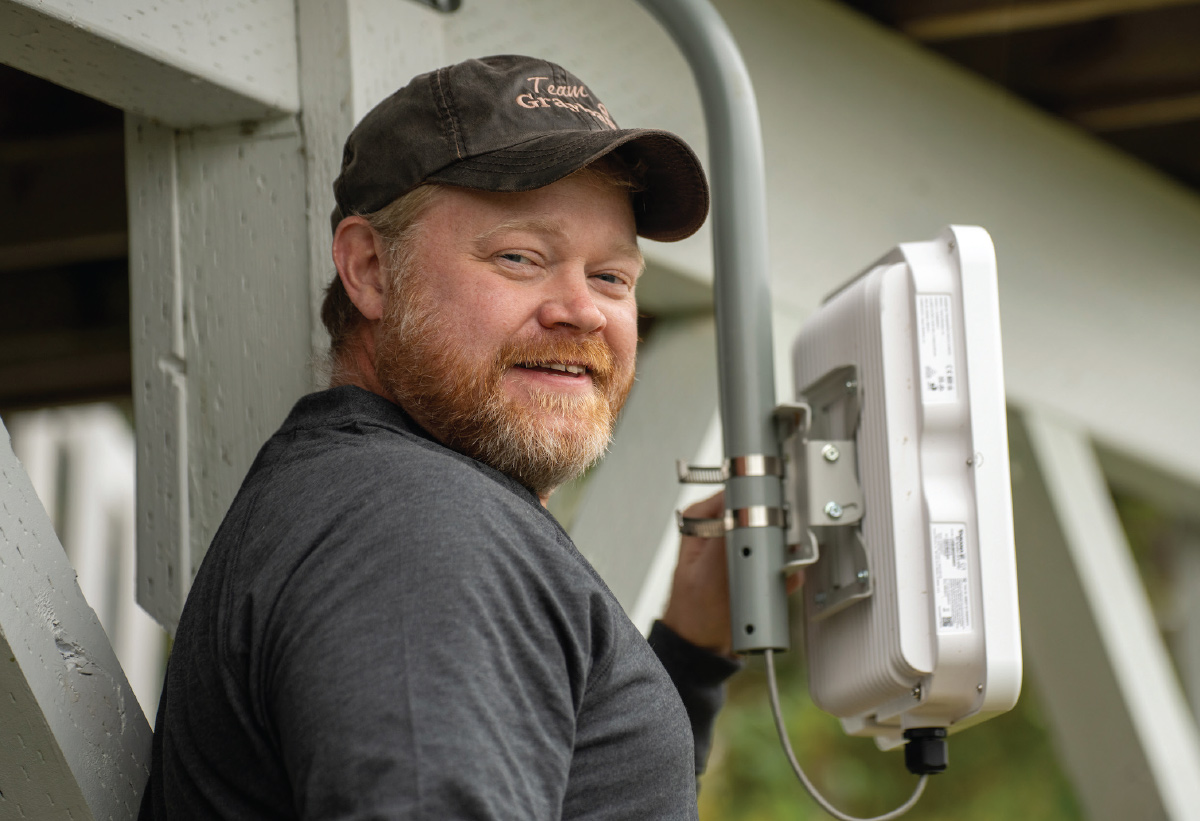
GCI and Alaska Communications are both aiming for that future standard. Dodge says, “We’re focused on deploying fiber networks capable of multi-gigabit symmetrical speeds and expanding our fiber-class fixed wireless service, which delivers up to 300 Mbps download and 100 Mbps upload. These services use fiber-fed towers to provide high-speed, low-latency connectivity to homes and businesses, which is a significant performance upgrade over satellite options.”
Dodge says, “GEO satellite has been a workhorse for rural internet connectivity, but with current needs of higher bandwidth and lower latency, we’re moving to low Earth orbit satellite solutions.”
LEO is also the key to Pacific Dataport’s Nome Gateway, a satellite-based backhaul option for enterprise customers in northwestern Alaska. When it was activated in May, the company billed it as the largest-capacity commercial satellite service installed anywhere on Earth. The array of multiple domes enable the Aurora LEO service, connected via SpaceX Starlink satellites. Williams adds that Pacific Dataport has relationships with other LEO networks, such as Eutelsat OneWeb.
Nome already had broadband service via the Quintillion subsea cable that threads through the Bering Strait, hugs the Arctic coast, and plugs into the terrestrial backbone at Prudhoe Bay. A project is on the drawing board to close the loop with fiber from Nome to Homer as well. The fragility of a single glass fiber became all too evident in 2023 when shifting ice severed the offshore cable and blacked out the broadband that Arctic communities had become accustomed to.
Williams says service like Aurora LEO was already in the works, but the outage hastened deployment. “We saw the opportunity, and we jumped on it,” he says.
The downside of fragility can’t outweigh fiber’s adaptability, however. Wailand notes that the active part of a fiber system is the equipment at either end. “If you want to upgrade it over time, you just swap out those electronics. As technology develops, you’re able to put more and more capacity onto that fiber without doing any major overhauls,” he says.
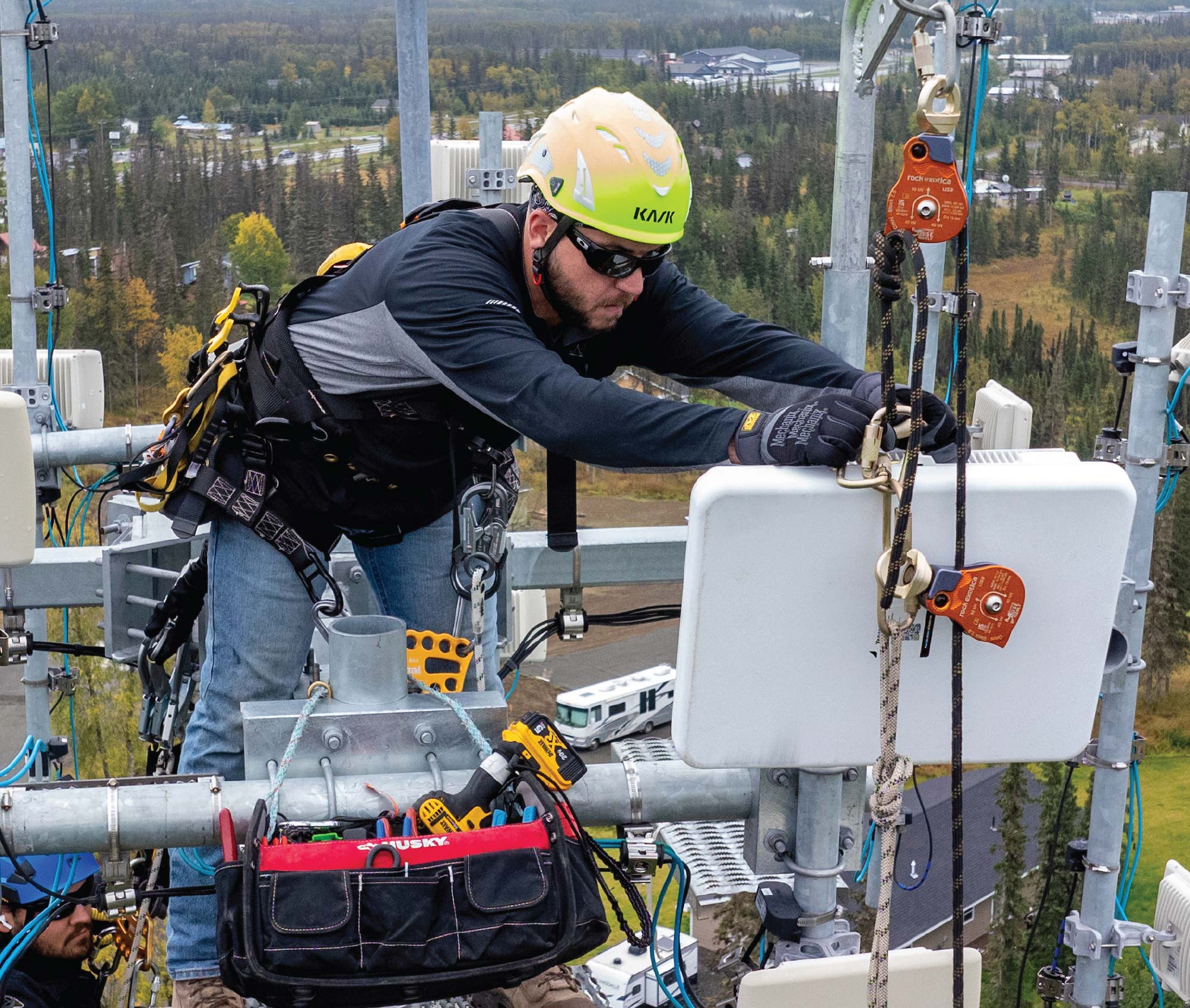
This advantage contrasts with satellites and with GCI’s other over-the-air system, the TERRA microwave relay network. “You have a smaller footprint when you only need to put in an individual tower instead of laying continuous fiber,” Wailand says. “But as the needs of these communities increase, the ability to scale microwave has not kept up.” The remote towers also need maintenance and refueling, a Herculean effort that GCI exerts because microwaves add a layer of resiliency.
Diverse backups allow for uninterrupted service, not necessarily at broadband standards. Wailand says, “If you’re using a fiber-based service with multi-gigabit speeds, any other backup service will simply not be able to deliver that. But what you want is to make sure customers still have access to critical services.”
Alaska Communications
At this moment, though, the priority is spreading a single layer of broadband statewide. Wailand says, “The federal government has recently said that the first step is to get these communities connected, and the second step, if possible, is to figure out how to bring diversity to the table.”
“Nearly $2 billion in federal broadband funding is earmarked to connect rural Alaska to the internet,” says Dodge. “Grant funding allows us to offer this service at the same rates available in urban areas. Without federal support, the cost to construct the network makes some technologies impossible to deliver for a reasonable monthly price.”
The scope of broadband installations statewide is dizzying. Projects in every region are adding communities every few weeks.
“Alaska Communications’ partners have received more than $100 million so far to build reliable, high-speed fiber broadband in fifteen communities along the Yukon and Kuskokwim Rivers,” Dodge notes.
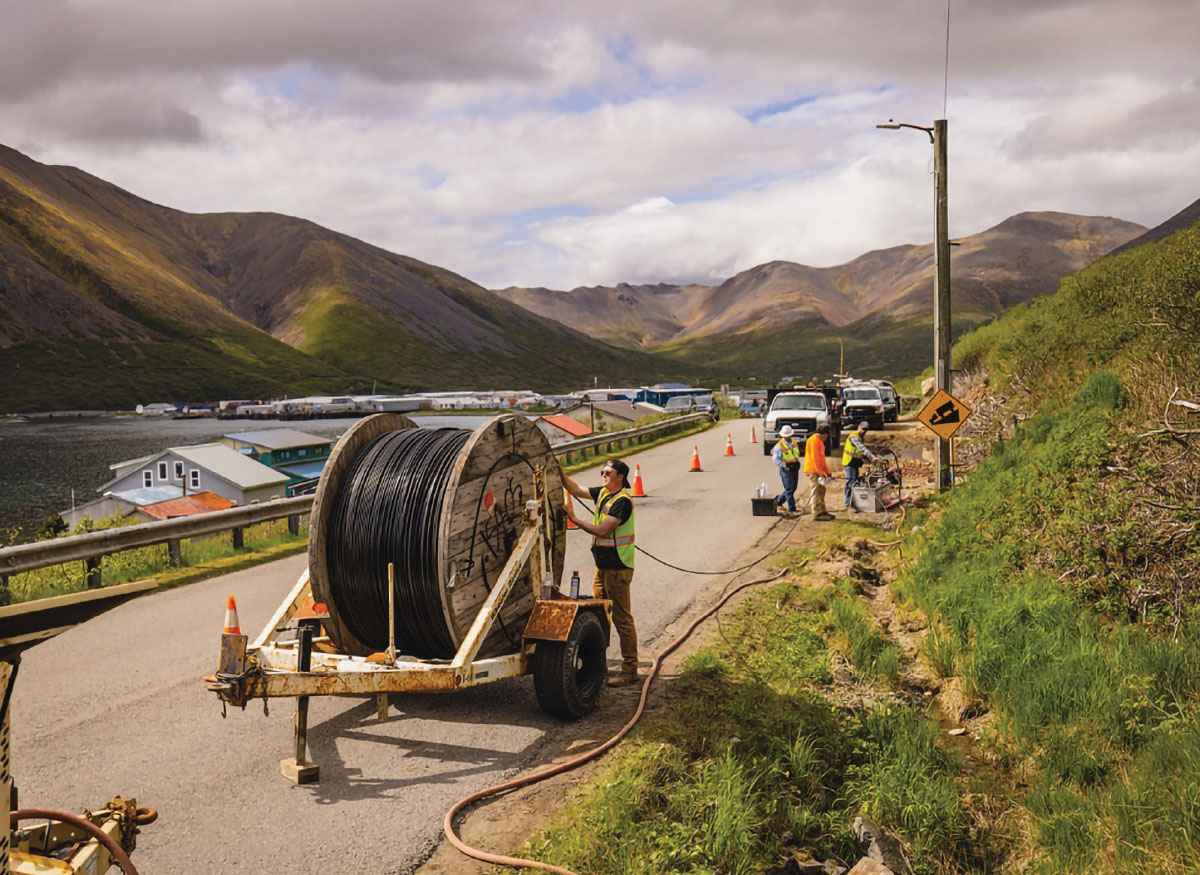
Meanwhile, GCI is laying fiber through Bristol Bay up the Kuskokwim River in partnership with Bethel Native Corporation. The Airraq Network was activated in Bethel in May. A dozen other communities are part of the “string that tells a story,” the literal meaning of “airraq” in Yup’ik.
Airraq Network is a $150 million investment, with GCI pairing more than $50 million of private capital with more than $100 million in federal grants. Concurrently, GCI is connecting another region through its AU-Aleutians project, funded by $58 million in grants to be matched by GCI’s capital investment. Branches of that 800-mile fiber brought 5G and unlimited data to King Cove and the Chignik Bay area in August.
“My hometown used to have only one landline phone, now we have some of the best connectivity, not just in Alaska, but in the nation,” says GCI Rural Affairs Senior Director Jenifer Nelson, who was born and raised in King Cove. “Access to this level of mobile and internet service is truly transformative.”
Once complete, AU-Aleutians will bring fiber-based broadband to thirteen communities on Kodiak Island, the Alaska Peninsula, and Aleutian Islands. Wailand calls it a meaningful connection, a pioneering piece of physical infrastructure where no roads or cross-country powerlines have yet penetrated.
On the other side of Bristol Bay, Nushagak Electric & Telephone Cooperative is partnering with Choggiung, Limited to install fiber inland to Levelock and Aleknagik via the village corporation’s home base in Dillingham. The National Telecommunications and Information Administration awarded a $29.5 million grant for the project last year.
In 2022, the agency awarded $68.5 million to NANA Regional Corporation to connect 1,379 households and 451 businesses in the Northwest. The Central Council of Tlingit and Haida Indian Tribes of Alaska received $49.9 million to connect 14,000 households in Southeast, plus $10.5 million for Metlakatla Power and Light to install fiber to 586 homes. Kenaitze Indian Tribe received $7 million to bring fiber to 1,055 households on the Kenai Peninsula.
The list of new installations goes on.
Dodge says, “Advances in fixed wireless technology allow for fiber-grade speeds and quick deployment. At the same time, we’re ramping up our plans to continue to build a fiber-to-the-premise network.”
At a certain point, broadband will reach every corner of Alaska (though filling in all the gaps in between may never happen). By some accounts, that point has arrived. Alaskans anywhere can, in theory, access the 100/20 minimum via Starlink, and gigabit service is scheduled by the end of this year. In the next two or three years, Amazon is activating its LEO competitor, Project Kuiper.
Some might disagree whether LEO counts as ubiquitous broadband. Dodge says it barely meets federal standards in some areas. “It’s also at risk of not being affordable. It’s a great step, but it’s not the end-state Alaskans need,” he says. “Traditional carriers are working to provide ubiquitous coverage across the state, as there are still areas that don’t have access to traditional means of broadband, like fiber.”
Fiber will remain traditional for the time being. “It’s essentially future proof due to its unlimited bandwidth, reliability, and the ability to upgrade equipment to increase capacity without replacing the entire network,” Dodge says. “However, Alaska’s uniqueness calls for a diversified end-mile portfolio.”
He expects new technologies won’t always require rebuilding infrastructure from scratch. For now, though, broadband will require new physical infrastructure, whether base stations like Nome Gateway or information superhighways like Airraq Network or AU-Aleutians.
Furthermore, “Grant funding will continue to be essential to deploying fiber in rural Alaska,” Dodge says. “We thank the National Telecommunications and Information Administration along with Alaska’s congressional delegation for their support bringing important broadband infrastructure funding to our country and state.”