

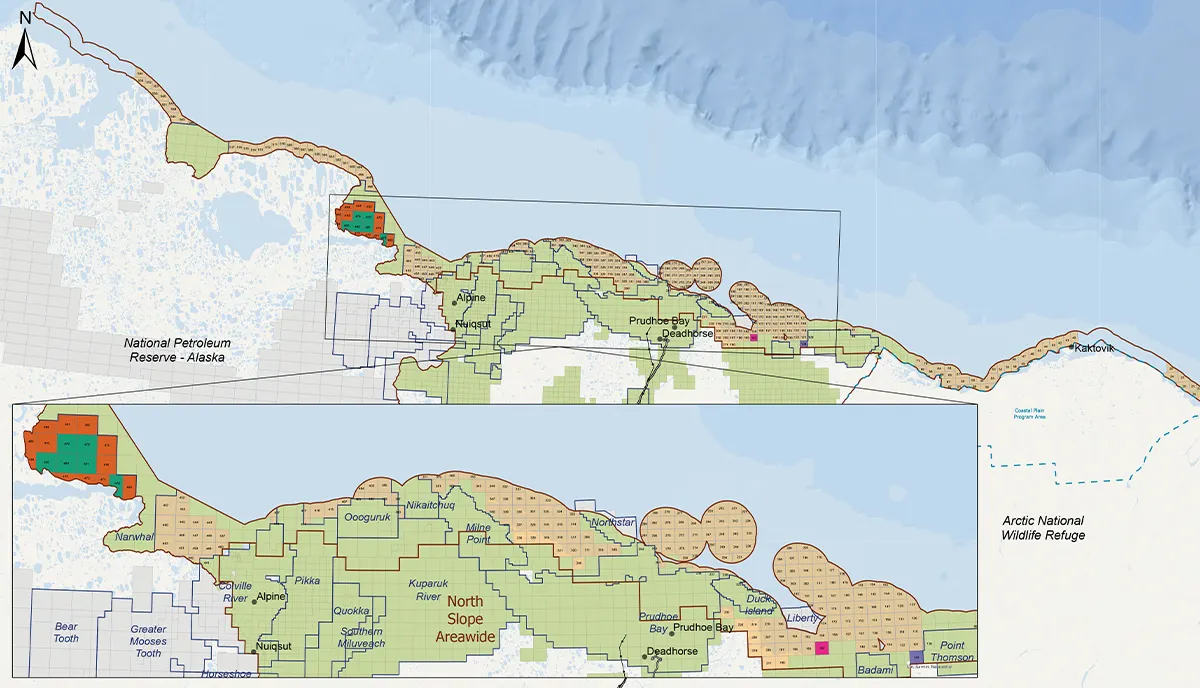
ike its tusked namesake, Narwhal is a unique beast. The affiliate of Dallas, Texas-based EE Partners Corporation is exploring for oil and gas in the Arctic Ocean, a feat that few have attempted. In 2024, the Alaska Department of Natural Resources approved the company’s request to designate its leases in West Harrison Bay, northwest of the Prudhoe Bay Unit, as its own offshore unit named Narwhal.
Part of the area had been unitized before, when Shell acquired leases to 88,000 acres. Narwhal adds 77,848 acres encircling those West Harrison Bay leases that Shell relinquished earlier in 2024.
By sinking as many as five exploration wells, Narwhal becomes the first company to drill in West Harrison Bay. The shallow inlet of the Beaufort Sea lies within state waters, which extend 12 nautical miles (about 13.8 miles) from shore.
Beyond that jurisdiction, the federal government has more ambitious plans for the Arctic Ocean.
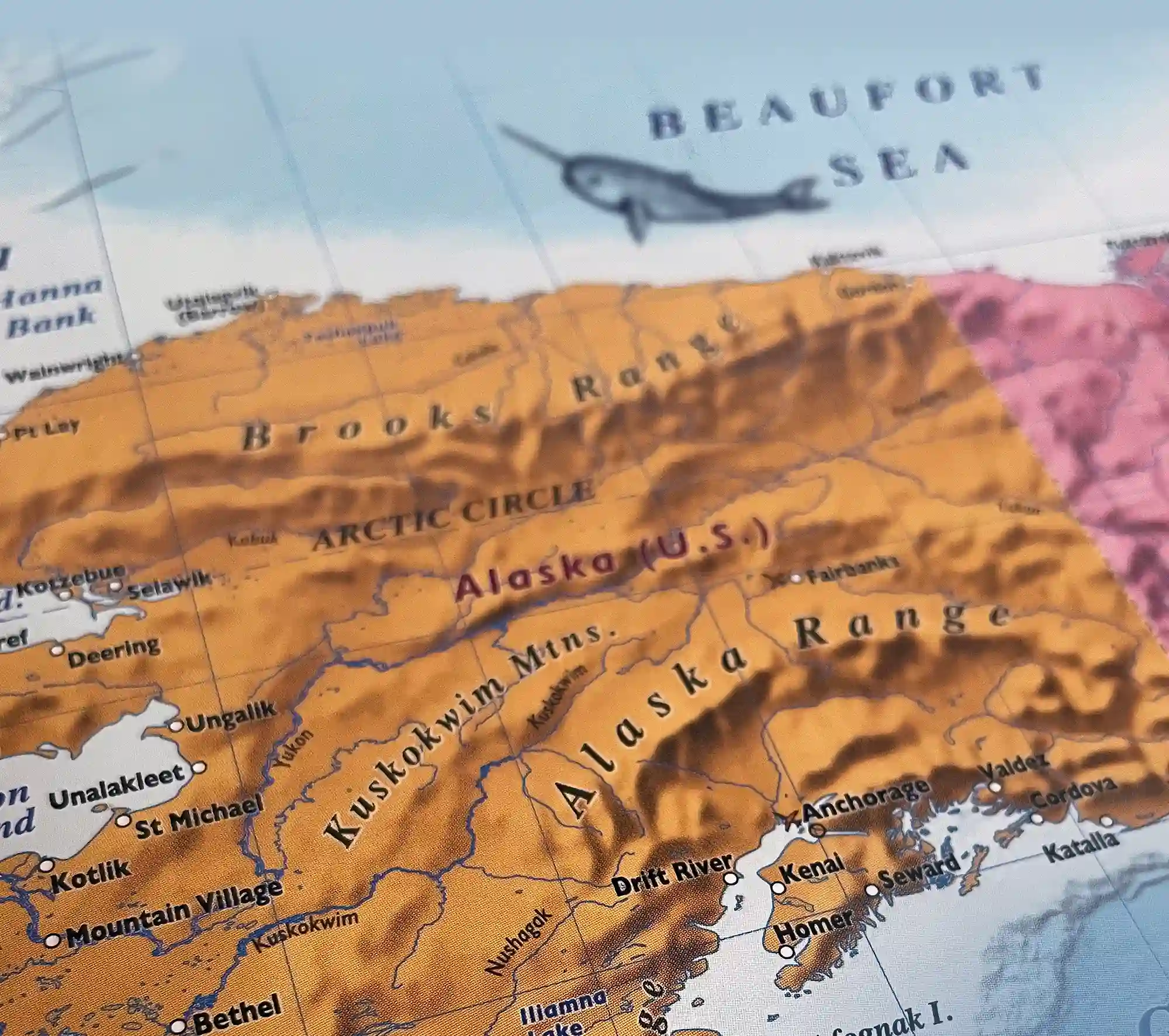
During the first Trump administration in 2018, a plan for lease sales covered just the Beaufort and Chukchi seas and Cook Inlet. The Bering Sea and Gulf of Alaska were off the table, as advocates for offshore development had requested.
This, the eleventh five-year plan, sees the first lease sale in federal waters happening this year in the Beaufort Sea, on Alaska’s northeast coast. The northwest coast of the Chukchi Sea would follow in 2028. Both areas would be offered again in 2030 along with the Hope Basin and Norton Basin on the north and south sides of the Seward Peninsula, as well as Navarin Basin and St. George Basin in the central Bering Sea. That year would also see lease sales along the entire Gulf of Alaska coast, from the tip of the Alaska Peninsula to the entire Panhandle, putting both previously out-of-bounds areas back in action.
The offerings in 2030 would also include a newly proposed lease area. The US Bureau of Ocean Energy Management reconfigured boundaries in the northernmost US territorial claims as the High Arctic planning area. The boundaries now include a wedge of the outer continental shelf which lies north of the Beaufort and Chukchi seas and points toward the north pole.
The High Arctic would be the twenty-seventh planning area in US Bureau of Ocean Energy Management’s outer continental shelf jurisdiction. The bureau manages approximately 12 million acres nationwide, with 469 leases currently producing oil and gas out of more than 2,200 tracts leased. The draft plan has two more rounds of review before final approval.
The eleventh leasing plan would replace the current tenth program, which includes just three sales through 2029, all in the Gulf of Mexico. In Alaska, a lease sale was held in 2022 for Cook Inlet, but a federal judge voided the result after finding the US Department of the Interior had not fully considered the noise impact on beluga whales.
Alaska Department of Natural Resources
Shell’s last attempt at Arctic offshore exploration ended abruptly in September 2015. By 2020, the company filed pro forma exploration plans to preserve its options before exiting West Harrison Bay—and Alaska completely by 2024 (notwithstanding its branded gas stations).
Shell bought its first Beaufort Sea leases in 2005. More followed in 2007, and then in 2008 the company spent $2.1 billion to acquire leases in the Chukchi Sea off Alaska’s northwest coast, in federal waters.
The 2012 exploration campaign was so disappointing that the Obama administration conducted a high-level review to determine what went wrong. Shell tried again in 2015 with a submersible rig 149 feet beneath the Chukchi Sea, drilling the Burger J well to a depth of 6,800 feet. Again, no payoff. Within weeks, Shell turned its back on Burger J and relinquished all other frontier leases in Alaska. The $7 billion exploration program between 2012 and 2015 was a total loss.
Compared to federal waters, however, West Harrison Bay seems a less risky proposition. A string of discoveries in the same oil play, the Nanushuk sands formation, suggest they may extend into tidewater. The same geology underlies the Willow and Pikka units being developed by ConocoPhillips and Santos, respectively. Furthermore, West Harrison Bay is much closer to onshore pipelines and other infrastructure, and the shallower water is subject to less severe ice conditions.
In 2024, EE Partners won six tracts in the middle of the bay, but it was outbid on other tracts by Juneau Oil & Gas, a Texas company managed by Brad Juneau, co-founder of mining company Contango Ore. Together, EE Partners and Juneau Oil & Gas paid $9 million for leases in the bay, including Shell’s former tracts.
In its five-year exploration plan, EE Partners commits to drilling two exploration wells in 2026. The goal is to evaluate any connection to the Nanushuk formation or, pending deeper drilling, the underlying Torok formation.
Two more exploration wells are planned in 2027, based on results from the 2026 wells, including 3D seismic data as needed. In 2028, EE Partners is scheduled to compile the results and submit an initial plan of development for the Narwhal unit.
The small company is just dipping its toe into Arctic offshore waters. Success in the next couple of years could inspire others to dive in, just as more waters are opened to development.