

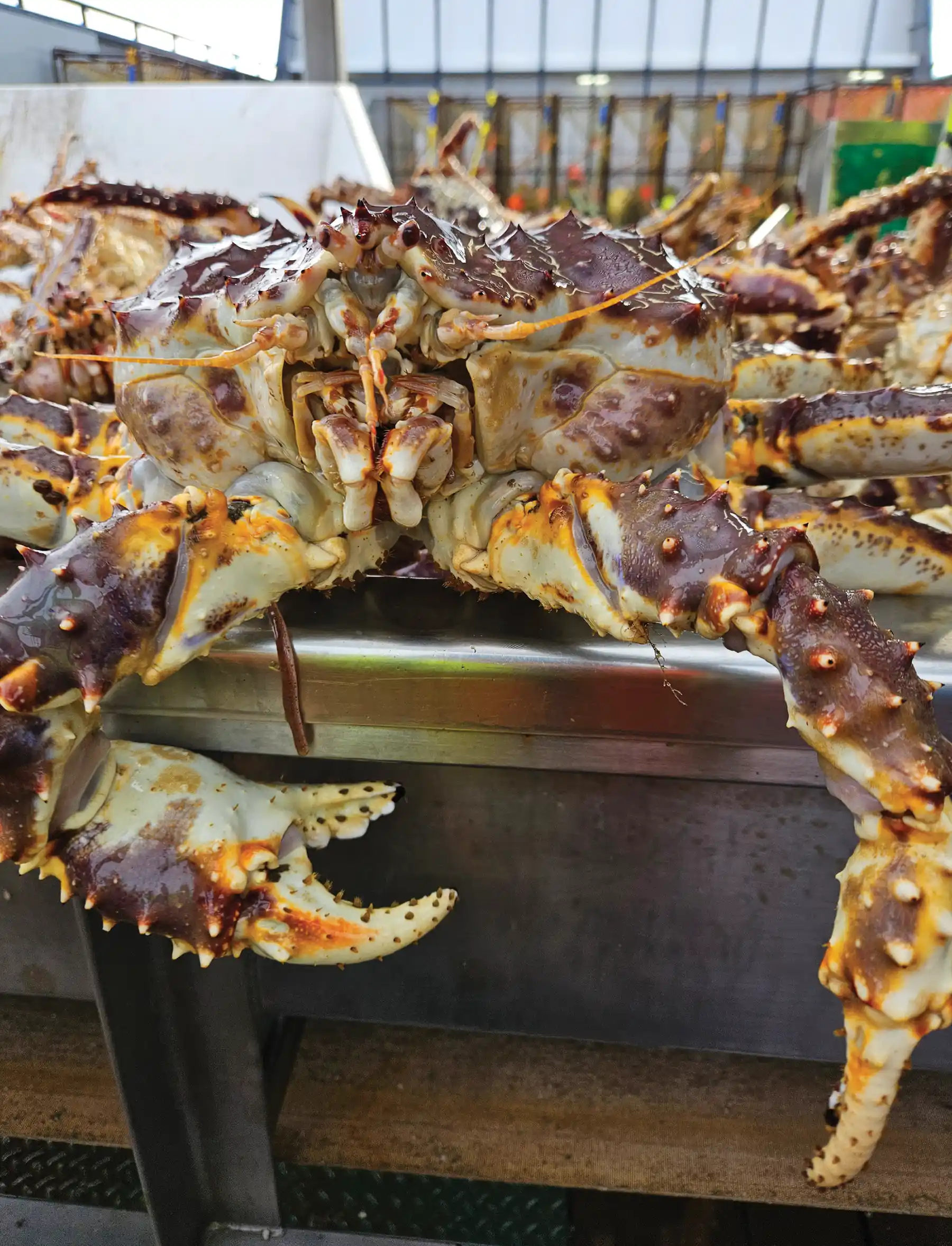
mong all the species of seafood in Alaska waters, it’s good to be king.
“King crab represents Alaska and is iconic for its size, taste, and rarity,” says Jamie Goen, executive director of Alaska Bering Sea Crabbers, a trade association for independent crab harvesters. “It’s massive compared to other popular crabs, like Dungeness, snow crab, or blue crab from the East Coast. Plus, it tastes delicious.”
In 2024, Alaska’s total commercial king crab harvest was valued at $109.1 million, or 73 percent of the value of all Alaska crab harvested, says Greg Smith, communications director for the Alaska Seafood Marketing Institute. That represented a 14 percent increase over 2023 harvest values. The king crab fishery accounted for 8 percent of Alaska’s total seafood harvest value in 2024, he adds.
Not a true crab, king crabs are Anomura: decapods with eight visible legs and a ninth and tenth hidden near the gills. Alaska boasts four species—golden, blue, scarlet, and red—but it’s the latter that most often comes to mind.
Since 1980, the red king crab fishery as a whole has struggled. Declining populations in different regions have meant limited harvests and closures to allow the fishery to stabilize; some have collapsed and never recovered. Rather than a single factor, those in the industry point to an amalgam of reasons for the decline as they actively work to find solutions to help stabilize populations and sustain the fishery.
Red king crab has historically been Alaska’s top shellfish fishery. Between 1975 and 2018, fishermen harvested nearly 854 million pounds of red king crab, valued at $2.5 billion, from Alaska waters, according to the Alaska Department of Fish and Game (ADF&G). At its peak in 1980, the Bristol Bay red king crab harvest was nearly 130 million pounds. In 1965, the Kodiak Island fishery peaked at 94 million pounds.
Jamie Goen
Jamie Goen
“The Kodiak red king crab population collapsed in the 1980s and hasn’t really recovered,” says ADF&G Fisheries Scientist Katie Palof. Southeast Alaska’s fishery “has been struggling, probably the last twenty to twenty-five years,” and opened in November 2025 for the first time since 2017.
In Norton Sound, the summer and winter fisheries were both closed in 2020 and 2021, says Janis Ivanoff, president and CEO of the Norton Sound Economic Development Corporation.
Bristol Bay’s king crab fishery, the state’s largest by volume, closed from 2021 to 2023 for the first time in more than twenty-five years, Goen says. Though it rebounded enough to reopen, its numbers remain far less than at the fishery’s peak; the total allowable catch for the 2025–2026 season was just 2.68 million pounds, a 97.9 percent decrease from 1980.
The decline leaves federal and state managers working to balance the livelihoods of fishermen with the need to keep the population sustainable. The federal government, through the National Oceanic and Atmospheric Administration and the North Pacific Fishery Management Council, and the State of Alaska jointly manage the Bristol Bay and Norton Sound fisheries. The state manages the Southeast Alaska fishery. Each has slightly different criteria for determining whether a fishery can be opened and, if so, what the annual harvest level should be.
Litzow says the federal government’s “foundation of management is the concept of maximum sustainable yield, or the largest long-term average catch that can be taken from available mature crab.”
ADF&G takes a more conservative approach and places a greater emphasis on the female population when determining harvest levels, Palof says. The differing determinations can sometimes create conflicting decisions regarding whether to open a fishery; the state cannot exceed the federal government’s recommendations, but it can set a smaller limit. Palof points to the two-year closure of Bristol Bay as an example, when the federal government said numbers supported a small fishery but the state chose to close it.
“We focus more on females; the federal government focuses on males,” Palof says. “In those two years, the female threshold fell below our state statute. At the state level, we take into account all portions of the population, and there are regulations that if the female population is depressed, it’s a warning sign that something is going on.”
The declines and fishery closures have, of course, negatively impacted those whose livelihood depends on the fishery. Ivanoff called the two-year closures in Norton Sound “devastating.”
“For fishers, this meant forgoing any income from the fishery,” she says. “Those years also meant reduced employment opportunities for seafood plant workers and reduced economic activity in area communities that are impacted by the fishery.”
“We don’t have a clear answer for the lack of recruitment, but that’s definitely the place that we’re just not seeing those crab enter the adult population,” Palof says. “There is a sufficient number of females and males during mating season. We see females with healthy eggs and fertilized, so we believe that part is sufficient.”
But because those young crabs don’t appear on surveys for five to seven years, it is difficult to know what is happening between fertilization and their eventual entry into the population. The Bristol Bay fishery, for example, hasn’t had a large group of young king crab enter the population since the early 2010s, Litzow says. It’s “almost certainly due to a combination of factors,” but data that could help provide answers is scarce.
Changes in climate and the overall ecosystem are also likely contributing factors, but again, the exact effect is unclear.
Scientists are also learning more about the effects ocean acidification has on shell formation during early stages of king crab development, which could leave the juveniles vulnerable and decrease their chance of survival to adulthood, Goen says.
Adding to the difficulty of identifying reasons for the decline is the disparate impact that various conditions can have within the population, Palof says.
“What we are kind of lacking is what would cause a crab population to go up or down, and how does that all interact with the different life stages,” Palof says. “Increasing temperatures might be bad for young crab, but okay for older crab, so it’s hard to know how they all interact. It’s not as linearly related, and I think that’s something that gets lost in the general message.”
“Thankfully, there are signs of recovery and hope for Alaska’s iconic king crab as the stock stabilizes,” Goen says. “The fishery appears to have stabilized in recent years, in part due to managers lowering the exploitation rate on how many crabs can be harvested at a given population site.”
Ex-vessel prices—the average statewide price paid at the point of landing or unloading—for red king crab have steadily increased. In 2013, the per-pound price of red king crab was $6.75, the lowest for the period 2013–2024; in 2024, it had almost tripled to $19.94 per pound.
Litzow says that “current indicators for the Bristol Bay red king crab fishery are positive, with survey estimates of abundance for mature males and mature females up 50 percent and 120 percent, respectively, over the last four years.”
But Palof cautions against relying too heavily on predictions.
“Some of the collapses we’ve seen in the past hadn’t been predicted by our projections,” she says. “We try as much as possible to stick with the most recent year, what do we know about the stock right now, because those projections are difficult.”
Research into causes of the decline also continues. Ivanoff says the Norton Sound Economic Development Corporation has financially supported crab-tagging projects to better understand the movement of Norton Sound king crab and has provided ADF&G with additional funding to support trawl survey efforts. Other activities include research aimed at understanding where crabs settle and what they need to survive, research examining the effect other commercial fisheries may have on king crab populations, and a proposed hatchery in the Pribilof Island village of St. Paul that will grow fertilized king crab eggs to about the size of a quarter before releasing them into Bristol Bay, Goen says.
Fisheries managers will continue to use “the best available science” to ensure fisheries remain sustainable long-term, Litzow says. And with so many aspects of the fishery outside their control, Palof says they’ll continue to use the leverage they have to keep the fisheries viable.
“The leverage we have when it comes to fisheries management is we can reduce the amount of crab that we take out of the water,” she says. “Or if there’s an area that we know is important for a nursery, we can go through the process of trying to protect this area from other fishing or other gear and maybe produce more crab.”
Beyond those management measures, the king crab population rules itself.