

he US Army Corps of Engineers (USACE)–Alaska District functions as one of more than forty districts worldwide, with a portfolio of projects that have significant impacts for the state and regional economies, national security, and human health and safety. USACE has a global workforce of approximately 37,000 mostly civilian personnel.
Cameron McLeod, a public affairs specialist with USACE-Alaska District, says the district’s mission areas include emergency management, military construction, environmental services, regulatory, international, and interagency services, and civil works and planning.
USACE–Alaska District provides a full range of engineering, science, technical, and construction support services in peacetime and war to strengthen national security, energize the economy, and reduce risk from disaster in the state, according to its website. Established in 1946, USACE–Alaska District has served as the nation’s leader in Arctic engineering and construction, forging an influential role in development of the “Last Frontier” vision.
Following is a handful of USACE–Alaska District’s most recent projects, starting with public works projects completed in the third or fourth quarters of 2025 and early 2026.
Location: Unalaska/Dutch Harbor, a major US fishing hub
Purpose/Scope: Deepen harbor entrance channel to -58 feet mean lower low water (MLLW) to provide safe navigation into and out of the harbor. The project involved dredging an entrance channel to that depth to create a channel approximately 600 feet long and 600 feet wide into Dutch Harbor, which has an interior controlling depth of -45 feet MLLW.
Contractor: JE McAmis, a heavy civil marine contractor with a corporate office in California and several satellite offices
Completion: August 2025
Location: Unalaska/Dutch Harbor
Purpose/Scope: Repair degraded mooring chains and connections for floating breakwater modules.
Contractor: General contractor YOY Inc. (d.b.a. Verdis) with substantial subcontracting efforts by Kenmore, Washington-based Crux Diving and Resolve Marine. Verdis bills itself as the nation’s only 8(a)-certified, woman-owned, full-service civil engineering, land use planning and construction management company.
Challenges/Innovation: Full diving inspection with underwater assessment and repairs in deep water, performed quickly as an emergency effort. Also, procurement and transport of repair materials required long lead times, which were especially challenging for domestically sourced chain and connections. Furthermore, Unalaska/Dutch Harbor is accessible only by air or water.
Completion: September 12, 2025, ahead of a required completion date of October 21, 2025
US Army Corps of Engineers–Alaska District
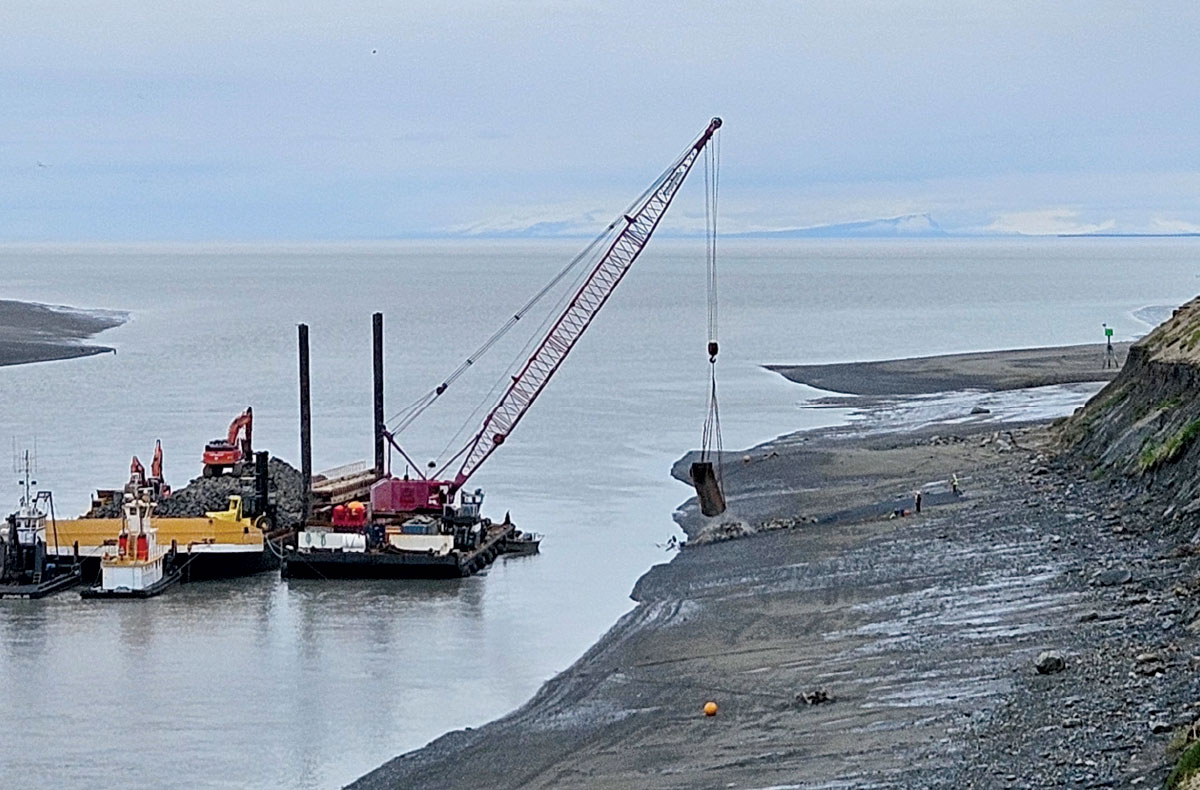
Location: City of Kenai, on the north bank of the Kenai River
Purpose/Scope: Construction consisted of approximately 5,000 linear feet of coastal rock revetment to alleviate erosion of the bluff to protect infrastructure. A revetment is a sloped, permeable layer composed of rock or riprap that dissipates wave energy, thus protecting against erosion. The recently completed revetment is designed to shield the lower portion of the bluff from storm damage and prevent erosion along the newly protected shoreline. The revetment required placing 25,325 cubic yards of armor rock, 14,425 cubic yards of core rock, and 12,380 cubic yards of bedding rock.
Contractor: Western Marine
Challenges/Innovation: Rock production, transport, and placement amidst extreme tidal fluctuations with short duration intervals and relatively small project footprint. No “in-water” work was allowed and staging areas were condensed, keying in on environmental sensitivities, such as the historic Russian Orthodox Church and cabins on the bluff in the Old Town district. Avoiding critically endangered Cook Inlet beluga whales was also a challenge. The whales frequent the Kenai River primarily for feeding.
Completion: October 10, 2025
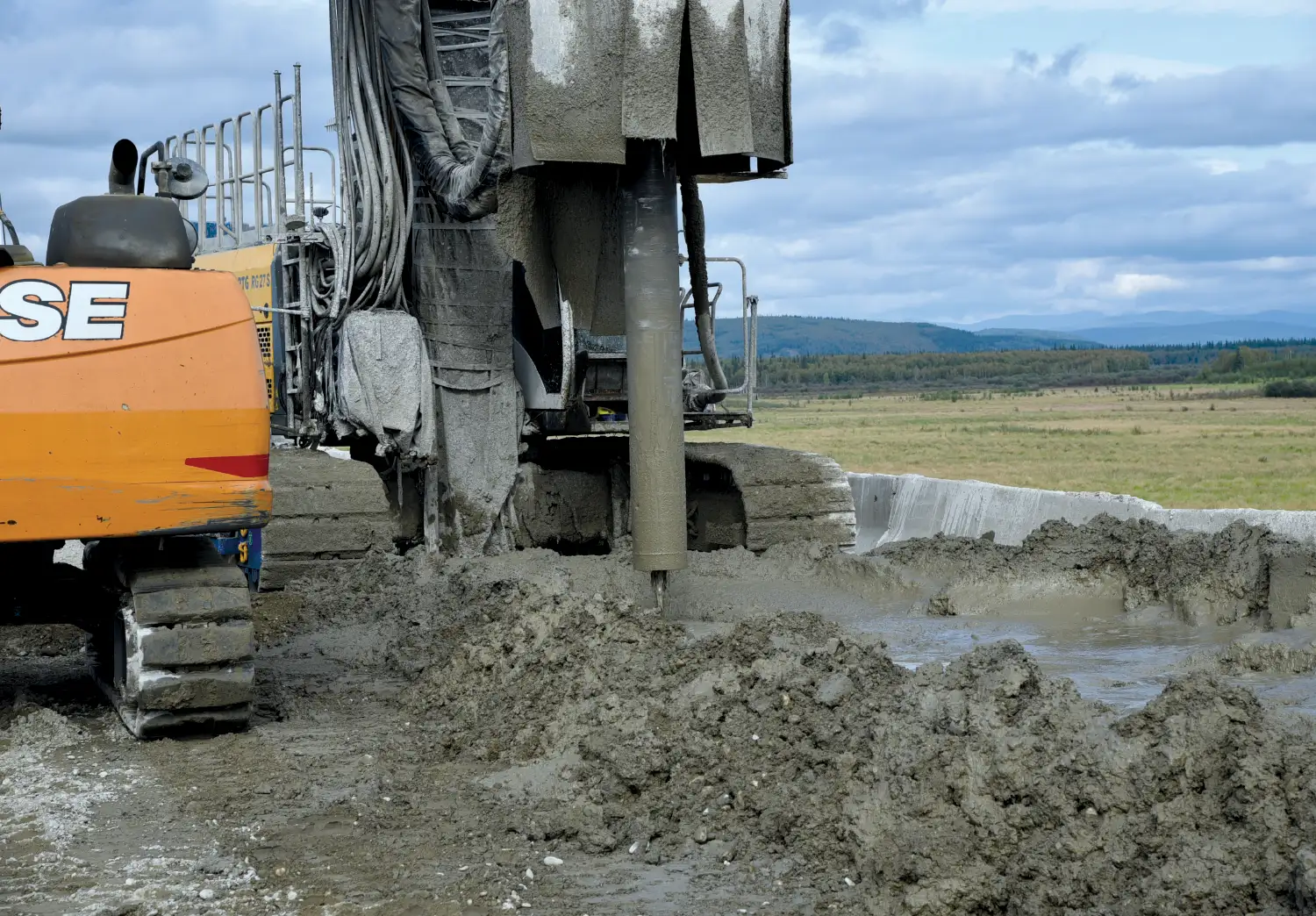
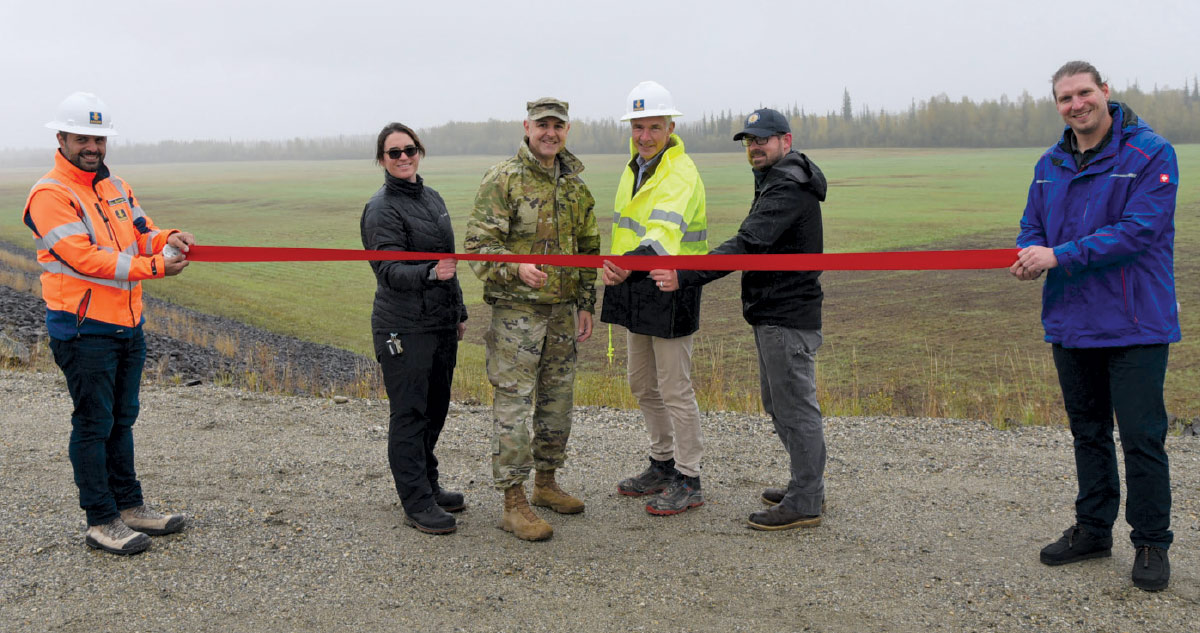
Location: Chena River, 17 miles east of Fairbanks
Purpose/Scope: Dam modification to address unacceptable risk, primarily the installation of a barrier wall to prevent seepage. The Moose Creek Dam is the main component of the Chena River Lakes Flood Control Project, a 7.5-mile-long earth fill structure that functions as a dry dam and provides flood damage reduction for North Pole, Fairbanks, and Fort Wainwright. The recently completed project installed a mix-in-place barrier wall through the centerline of the dam embankment to address the uncontrolled seepage and piping in the dam foundation.
Contractor: Florida-based BAUER Foundation Corp.
Challenges/Innovation: A novel approach of single-column mixing was utilized to produce the barrier wall. A series of refinements were made to the soil mixing technique, dramatically increasing production while maintaining good quality. This method was a first for USACE for barrier and cutoff wall construction, according to its website. The dam had been built following a disastrous 1967 flood that caused more than $80 million damage (worth nearly ten times as much in today’s dollars) and displaced about 7,000 people. USACE began work on the Chena River Lakes Flood Control Project in 1973 and completed it six years later. Today, major components include Moose Creek Dam, a floodway, and the Tanana River Levee and drainage channels. Together, these features stand as the largest federal civil works project in the state, according to the USACE website.
Completion: January 6, 2026
Cameron McLeod | US Army Corps of Engineers–Alaska District
Cameron McLeod | US Army Corps of Engineers–Alaska District
Cameron McLeod | US Army Corps of Engineers–Alaska District
Location: Skagway, on the Alaska Panhandle
Purpose/Scope: Repair the Skagway River Levee to restore its function to pre-disaster conditions from damage sustained as a result of significant flooding. The levee is located along the southeast bank of the Skagway River starting at the Klondike Highway Bridge in Skagway. The levee protects public infrastructure as well as commercial and historical properties. The aim of the project is to rebuild the levee toe and damaged side slopes.
Contractor: Hamilton Construction, a heavy civil contractor since 1939 headquartered in Portland, Oregon, and with an Alaska division office in Sutton
Challenges/Innovation: In-water work, environmental windows, remote location, coordination challenges with airport operations and onsite quarry. Skagway is home to gold-rush-era buildings preserved as part of the Klondike Gold Rush National Historical Park. A popular tourist destination, the town’s population more than doubles during summer months.
Completion: Estimated July 2027
Location: Nome, on the southern Seward Peninsula coast
Purpose/Scope: Provide an Arctic deep draft port with berthing at -40 feet and more than 2,500 feet of additional dock face. Build a new deepwater basin by extending the existing west breakwater by approximately 3,122 feet to a depth of -40 feet MLLW. Make outer basin modifications consisting of removing the existing breakwater stub (spur) from the south end of the existing west breakwater and extending the breakwater to deep water, removing the existing east breakwater and replacing it with a new 3,900-foot east breakwater that extends to approximately -25 feet MLLW. Increase the outer basin channel entrance width to approximately 670 feet and deepen the outer basin from -22 feet to -28 feet.
Contractor: Kiewit, one of North America’s largest construction and engineering companies
Challenges/Innovation: Remote logistics, short construction seasons, and large equipment that must be transported in by barge in summer. Nome has a subarctic climate with long, cold winters and short, cool summers.
Completion: Estimated 2032
Cameron McLeod | US Army Corps of Engineers–Alaska District
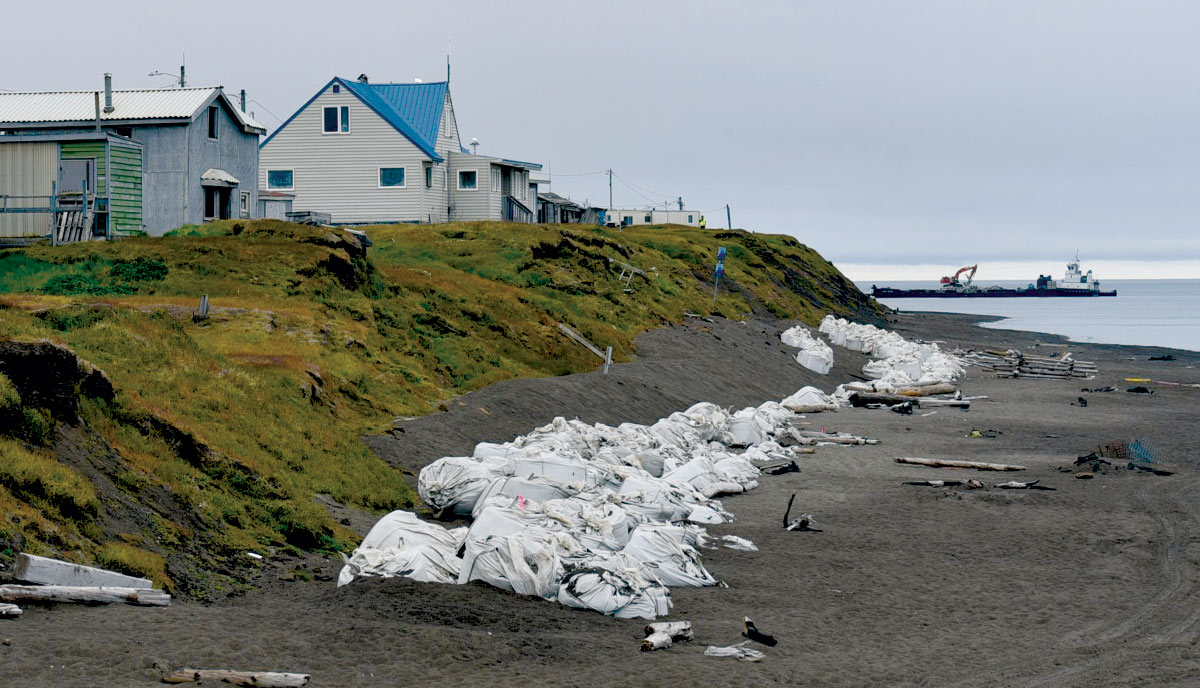
Location: Utqiaġvik, the borough seat and largest city of the North Slope Borough
Purpose/Scope: Provide approximately 5 miles of shore protection. The community experiences frequent and severe coastal storms, resulting in flooding and erosion that threatens public health and safety, the economy of the community, critical infrastructure valued at more than $1 billion, access to subsistence areas, and cultural resources. The project will reduce the risk of storm damage along the coastline by building a rock revetment at the bluff area, creating a protective berm and raising Stevenson Street.
Contractor: Brice Civil Constructors Inc., with offices in Fairbanks and Anchorage
Challenges/Innovation: Remote Arctic location and complex logistics required to transport material with limited construction season. Located 330 miles north of the Arctic Circle and bordered on three sides by the Arctic Ocean, Utqiaġvik’s climate is cold and dry. Flat tundra stretches approximately 200 miles to the south, with no wind barriers or protected valleys where dense cold air can settle.
Completion: Estimated 2033