

one are the days when merchants tallied up a client’s purchases on paper, rang it up on a cash register, and did all their bookkeeping by hand. While some Alaskans cling to certain traditional aspects of making a sale, more and more retailers and restaurateurs have point-of-sale (POS) systems that do much of the work for them.
“Everything is completely different now,” says Trish Moreland, a small business advisor at the Anchorage office of the Alaska Small Business Development Center. “Point-of-sale systems went from people using cash registers to ring things up, to barcode scanners, to POS systems that now integrate with a business’ inventory management pieces, payroll, and more.”
Customers can now safely shop online using ecommerce, pick up merchandise at the store, and find out from sellers via the POS system that their packages are on the way or what other offers are available.
“It’s not just a cash register system,” Moreland adds, noting that business owners can use POS systems to track revenue for tax reporting, manage sales tax collection, and monitor activity by state for ecommerce and other requirements. “POS has basically become an all-in-one tool for retailers.”
Greenman laughs as he remembers the early era. “There wasn’t a lot of innovation at the time; going from mechanical to electronic registers was a big deal—it was the height of technology,” he recalls. “Today’s modern POS systems are essentially computers. When I tell people what I do now, I say that I work in IT for restaurants and retail. It’s really just selling fancier cash registers.”
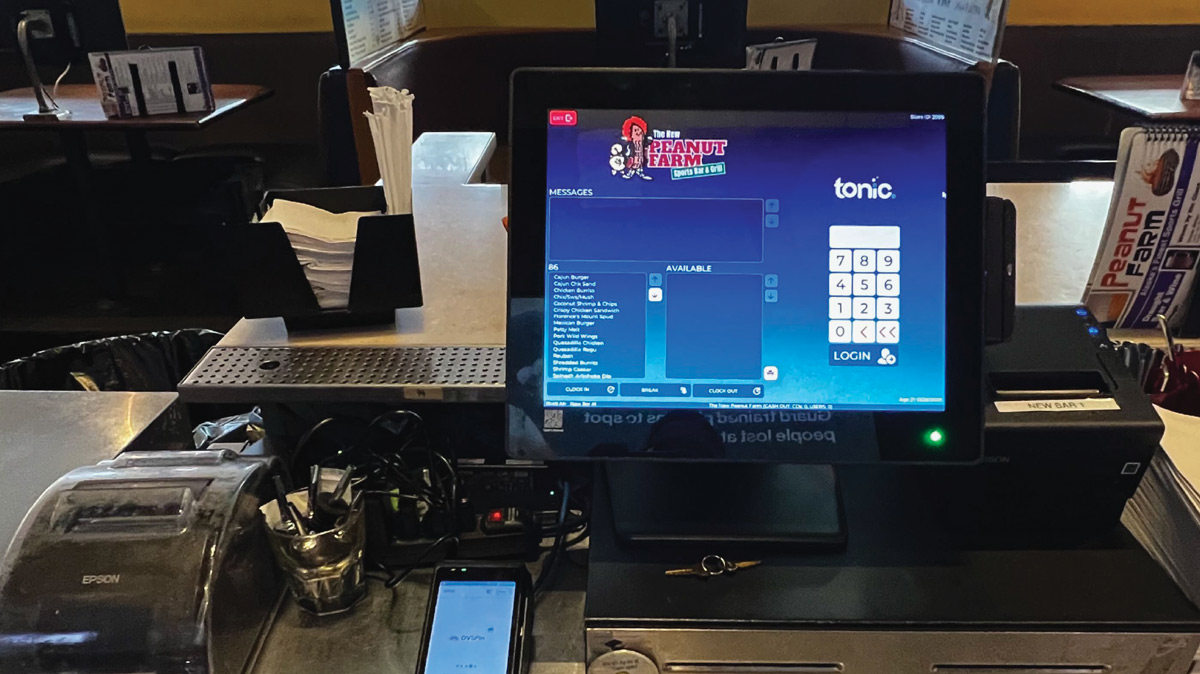
Today’s POS systems combine hardware (tablets, card readers, scanners) and software that enable businesses to process payments, record transactions, manage inventory, and track customer data.
Using modern digital tracking and analytics, these systems can scan retail items, apply discounts, and update inventory in real time; take restaurant orders tableside via handheld devices, send them to the kitchen, and split checks; and allow mobile businesses and pop-ups to use smartphones or tablets with card readers to process payments on the go.
POS systems can also be used for inventory management, automatically reducing stock levels when an item is sold, and for reporting: generating daily sales reports to analyze revenue and employee performance. Depending on the integrations chosen, POS systems can even be used to replace employee timecards and create employee schedules.
“Businesses can keep track of customers’ previous orders, loyalty points, payments, and more. In some restaurants, POS can provide a kitchen display to show orders coming in to the chefs,” says Greenman. “While previous systems kept track of how many hamburgers were sold in a given time period, today’s systems can analyze what the most popular burgers are, what modifiers (lettuce, onion) are added to burgers, and more.”
According to Moreland, if a POS system is set up properly and used correctly, it can make a dramatic impact on managing a business.
“I used to own retail pet stores, and while I could see what was being purchased, I didn’t know which items were selling slowly,” she explains. “Using reorder points in the POS system, you can see what people are buying all the time.”
“This can even help you spot things like shoplifting,” she adds. “I had a product I thought was selling really well because it was always out of stock, but the POS slow-seller reports showed it wasn’t; it was actually being stolen. Once I moved it to a more visible spot, it made a big difference in my reorder frequency—and, more importantly, my margins.”
“When Apple came out with the thin, portable, lightweight iPad, there was a lot of consumer demand, but that type of software was still half-baked for business use,” explains Greenman. “So small mom-and-pop stores came up with their own software, but it was not ready for prime time.”
Beginning in the mid-‘70s, technology innovators such as Apple began redefining themselves, focusing on what technology means to people—especially in contrast to specialized tech dominated by IBM, maker of the first computerized cash registers.
Even technologies already in existence took a while to catch on in the retail and restaurant industries. QR code technology, for example, has been around since 1995 as camera-readable labels, but it wasn’t until the COVID-19 pandemic hit that retailers began to pay attention.
“COVID forced people to get out of their boxes and to adopt new technologies,” says Greenman, noting that introducing QR codes for non-contact ordering spared Alaska businesses that would have gone under if customers hadn’t been able to connect with them.
“After COVID, some people got rid of these technologies, which is so weird to me,” he adds. “Why adopt something that clearly resonates with customers and then put it aside?”
One concern in Alaska is that many modern POS systems are cloud-based, which can be challenging in the many areas of Alaska that have low or inconsistent connectivity.
“The trends have gone from using cash registers completely offline to technologies that are all cloud-based,” explains Ben Nove, regional manager of Anchorage-based SkyTab Alaska. “Because we live in a harsh environment with power constraints and communication constraints, a lot of cloud products don’t work that well up here.”

Joni | Adobe Stock
While Alaska doesn’t yet have access to some of the products and services used in the rest of the nation, Nove says that, through Starlink satellite-based internet and other technologies, the state is moving in the right direction.
“Alaska in general is about five years behind the Lower 48,” he explains. “We don’t have a lot of national brands up here because a lot of independents don’t move into places with small populations and diverse sets of applications and phone structures. But we’re getting there.”
“Do you want to manage your inventory? Is ecommerce part of your store? How many locations do you have and do your customers shop online?” she asks. “Lay out your wish list and then request demos from your POS contacts. This is important because you don’t know what you don’t know.”
Moreland suggests that potential buyers also talk to local retailers or those in similar industries to see what is working—and not working—for them.
“Find out what they have to create workarounds for, like fractional items—dog biscuits by the pound, fabric by the yard, for example. That’s often difficult for POS to do, so it’s a good idea to put that at the top of your list,” she says.
“While some POS solutions are not as feature heavy as platforms such as Square, Toast, or Lightspeed, one of their biggest advantages is having technicians on the ground here in Alaska,” notes Moreland about considering local vendors. “This is hugely helpful if a printer goes down or a card reader fails—both of which always happen at the worst possible moment.”
Skurla’s, based in Anchorage, takes a consulting approach with its clients, working to determine what each business needs now and in the future. “You can outgrow a POS system quite quickly, depending on what you’re doing—for example, integrating DoorDash into your system,” says Greenman. “In the POS world, some systems can evolve with you so that you can stay in the same ecosystem—just like upgrading a phone.”
Nove also notes that even customers in the same industry may have very different needs depending on where they are located. “Nome has drastically different delivery issues than Anchorage does,” he says. “Barrow may only have a three-mile delivery radius, but some houses don’t have roads to them. Things have to be flown in by plane. These are oddities we have to map out and deal with.”
Vendors are able to customize for these one-off situations. “Basically, POS is implementing a computer that does business rules,” says Nove. “You tell me your rules, and we’ll try to implement it in the computer.”
Business owners may also want to purchase mobile hardware that is compatible with the POS system, especially if they sell in places like farmers’ markets or want to take restaurant orders tableside.
“All of these investments should be considered negotiable; the more volume you do and the more terminals you have, the more room you have to negotiate,” says Moreland.
Mobile terminals work best with plastic transactions, of course, but this comes at a price for the seller. Credit card fees may be taken out daily or monthly, and these can become a significant cost for small businesses. “When budgeting, typically add around 3 to 5 percent, depending on the card type, just to pay banking fees,” says Moreland, noting that this is why retailers and restaurants often offer a discount for cash transactions that don’t incur processing fees.
According to Greenman, Skurla’s saw the writing on the wall in 2010 and decided to transition to a monthly fee and offering credit card processing.
“Customers gravitated to the monthly fee because it covered everything, including credit card processing at a decent rate,” he says. “It made it easier to budget for a POS system.”
This contrasts with charging per service call. Greenman explains, “In previous years, the system could have cost you $20,000–$30,000 plus service and support, but nowadays the monthly fee covers everything, for the most part. Clients are much happier than in 2008–10, where they felt nickeled-and-dimed with every call.”
Consumers, on the other hand, are not as pleased with a system that requires merchants to pass credit card fees onto them. Not only are customers paying a fee to own the card, but they are also paying processing fees of 2.5 to 6 percent, depending on the card they use.
“On a $100 ticket, you pay $3 for the privilege of paying with a credit card; for merchants, that’s 3 to 6 percent of their business going away every month,” says Greenman of the need to pass this expense along to customers. “If a restaurant does a million a month in credit card processing, just do the math. That’s why they’re offering customers incentives to use cash; it saves them big money.”
Although fees have caused some consternation, Moreland says businesses are increasingly moving to POS systems to ease their workload.
“As more business owners reach retirement, we’re seeing a lot of customers moving to POS or upgrading their POS systems,” she says. “They are passing their businesses onto their employees, and this next generation is adopting and leaning into these new technologies.”
Nove agrees. “We are seeing a lot more adoption of POS, even from the older population,” he says. “They understand the value of having so much more insight than a general cash register can offer.”