

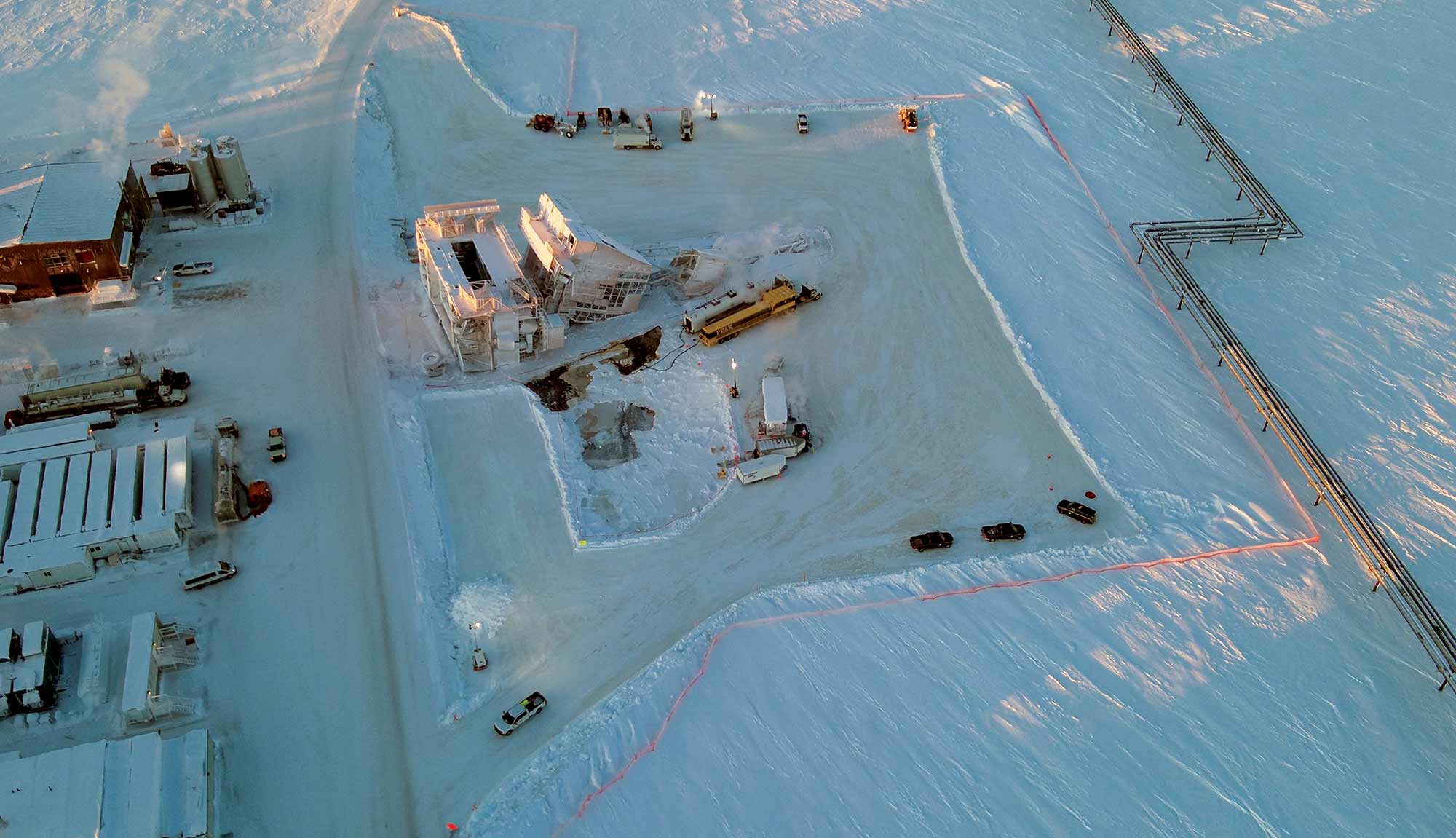
fateful night on the frozen tundra ended the career of a North Slope workhorse. The Beast was getting ready for more exploratory drilling in January when its owner and operator, Doyon Drilling, Inc. (DDI), had to scrap those plans and mobilize an emergency response when the rig toppled. The labors to lay the Doyon 26 rig to rest were worthy of its legendary reputation. Although it had many years of service left, The Beast had already contributed to the Alaska economy in ways yet to be fully measured.
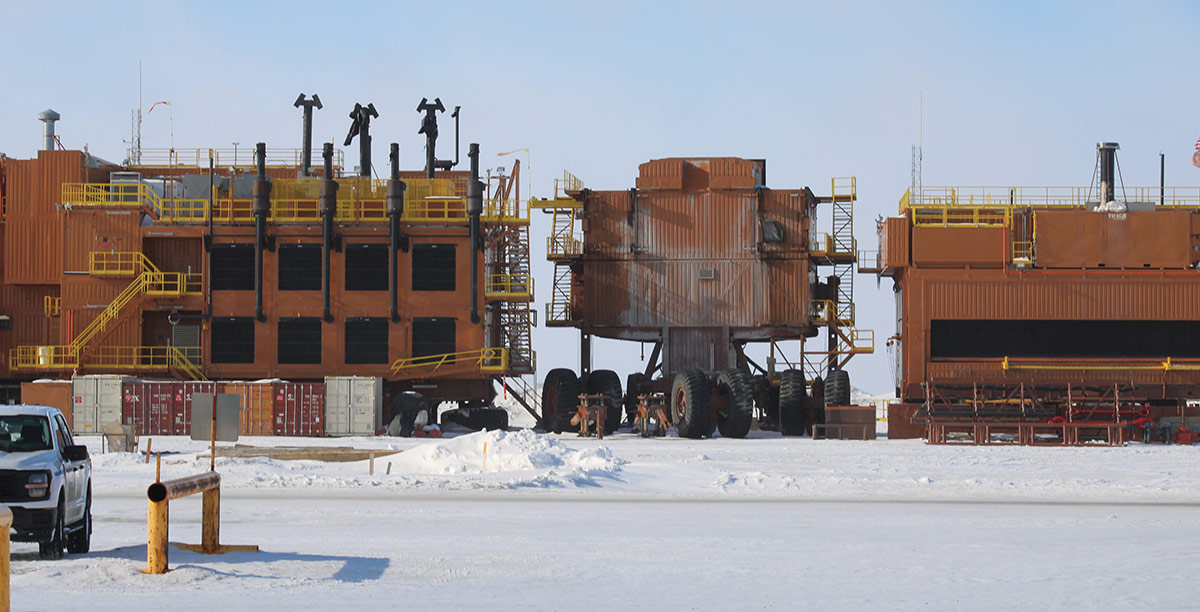
Arriving in Alaska in the tumultuous year of 2020 as Doyon 26, the machine was destined for a nickname. Designed from its inception as the world’s largest mobile land rig, The Beast was so-called because of its mammoth scale. Twelve modules worked in concert as the most efficient and advanced machine of its type, capable of feats never achieved before.
The flame that burns twice as big, burns half as long—and The Beast burned so very, very big in its short existence.
“The most accurate, up-to-date information can be found on that website,” notes Sarah Obed, senior vice president of external affairs for Doyon and public information officer for the response effort. “Unified Command is committed to ensuring effective communications and will provide updates on a monthly basis.”
The page stated the plain facts: Doyon 26 was underway on a gravel road near Nuiqsut, under the control of DDI on behalf of ConocoPhillips Alaska. It was afternoon, not yet one week after the first sunrise following the polar night.
The self-propelled module tipped over less than 50 feet away from oil and gas infrastructure. A small fire broke out, extinguished by emergency responders. Rig personnel were treated for minor injuries, but no one was seriously hurt.
The module was carrying approximately 4,000 gallons of diesel fuel and 600 gallons of hydraulic oil. Based on initial assessments, any environmental impact appeared to be contained and minimal. However, the immediate cleanup had to wait until the toppled rig fully settled.
Nearly thirty years of DDI’s collected experience went into developing Doyon 26 after ConocoPhillips Alaska commissioned the rig in 2016. Designed in collaboration with Texas-based National Oilwell Varco (NOV), the objective was to create a drill to reach farther from a single well pad.
The design was based on extended-reach drilling concepts developed by DDI’s Ron Wilson and NOV’s Ron Sorokan. Engineers had access to 3D-modeling technology to compile a “master model” of mechanical, electrical, and plumbing systems, so design decisions could be iterated quickly and fabrication diagrams produced with precision.
Doyon 26 contained several innovations, covered by seven patents. The blowout preventer module was topped by a 165-foot mast. The pipe shed module contained 15,000 feet of casing, with room left over for 2,400 square feet of offices. The engine module was equipped with eight gensets rated for more than 11,200 horsepower, or 8.4 MW, nearly the output of Copper Valley Electric Association’s diesel generators for every home and business in Valdez.
And that’s just the main drive. The rig was also self-propelled.
There’s a reason it was called The Beast. NASA’s Crawler-Transporter 2 is the heaviest self-powered vehicle in the world when it carries the Space Launch System to the pad in Florida. The total weight of 18 million pounds includes the crawler’s own 6.6-million-pound empty weight, somewhat less than the fully assembled 10-million-pound Doyon 26.
Yes, there are larger industrial behemoths in the world. The Bagger 293 excavator in Germany and its five siblings are each about three times heavier than Doyon 26. The Honghai Crane at a shipyard in China is about twice as big, but its operating power is about 1.8 MW.
That’s about on par with The Beast’s movement system, entirely separate from the main power that spun the drill. Six engines supplied more than 2,100 horsepower to the wheels. A driver could monitor four cameras around the rig and steer with a joystick. The Beast had a rack-and-pinion steering geometry that allowed the module to turn on its center, spinning like a ballerina.
Even ballerinas take a tumble, sometimes a career-ending calamity.
Alaska Business
DEC was in charge of releasing situation reports. By February 12, initial containment—the first phase of the cleanup effort—was completed, and the team developed a plan to safely remove the wreck of Doyon 26, phase two.
The phase-two plan was executed through the rest of February until the end of March. After further inspection, The Beast was disassembled, and the salvaged components carried away. Obed states, “100 percent of the rig has been fully recovered, removed, and transported from the site to be recycled.”
The third phase took place in April: final cleanup, mitigation, and remediation of the affected area, complicated by the end of winter and the softening of the frozen tundra. Spill response crews, including Alaska Clean Seas, used flush-and-recovery tactics to spray hot water onto ice and snow, forcing oil and vegetation to float on top. Vacuum trucks collected the product and took it away.
By the last weeks of April, crews recovered approximately 5,435 gallons of spilled product, which Unified Command acknowledges was higher than the preliminary estimate of fuel and oil on board. That’s not uncommon in spill response: final amounts commonly vary from initial estimates due to changes in product density through the flushing and recovery process. The response also accounted for 41 gallons of ethylene glycol coolant which remained contained in the rig.
Shore seal booms were laid in a circle around the site to prevent contaminated water from flowing out. The changing season deprived crews of ice roads to reach the site with heavy equipment, including water tankers, so teams demobilized by the end of April.
In 2022, the rig proved itself a hero for ConocoPhillips Alaska, unlocking a new section of the western North Slope oil fields with its record-setting reach.
The first wells developed at Prudhoe Bay could cover approximately 3 square miles with the directional drilling techniques of the ‘70s, using a 65-acre gravel pad. When Doyon 26 was commissioned in 2016, extended-reach drilling had advanced to cover 55 square miles from a 12-acre pad.
Doyon 26 was designed to cover 125 square miles from a single pad, drilling up to 35,000 feet horizontally, some of the longest laterals in the world.
On May 18, 2022, the rig exercised its full capability with a 6.7-mile well, setting a world record. That was also the day it produced first oil from the Fiord West reservoir northwest of the Alpine development. ConocoPhillips Alaska said the reservoir was expected to produce up to 20,000 barrels of oil per day.
The company also believed The Beast was capable of greater reach, possibly drilling up to 7.5 miles horizontally.
ConocoPhillips Alaska reserved Doyon 142 as a substitute for the work left to be done after January 23. Vice President for Commercial and Midstream Barry Romberg told the state House Resources Committee just days after the incident that the “unfortunate loss” of Doyon 26 would not have significant impact on the company’s winter exploration activity.
“Our exploration work plan for this winter is going to be on track,” Romberg said. “I don’t expect at this point any material change to our long-term production forecasts.”
By the end of April, Unified Command transitioned from weekly to monthly updates from DEC. All equipment was demobilized from the site except pieces necessary for containment, monitoring, or wildlife hazing. Wildlife agencies, along with local and tribal entities, developed wildlife response plans for the monitoring and observation phases in spring and summer.
Doyon also hired a third-party investigator to thoroughly review the incident. The exact cause of the mishap was not disclosed by the time The Beast was packed away from the site. “An investigation is ongoing,” says Obed.
Doyon had no comment on how soon a replacement rig might be brought to the North Slope. Just as new technology drove the development of Doyon 26, further innovations may inspire the creation of the next generation of majestic machines.