

he simple act of measuring land becomes an exercise in endurance, ingenuity, and precision. Surveyors work across a landscape unlike any other in North America, with unpredictable mountains, ever-changing rivers, and permafrost that can move a marker from season to season. From remote Arctic tundra to dense coastal forests, Alaska’s sheer size and unpredictability demands more than technical expertise.
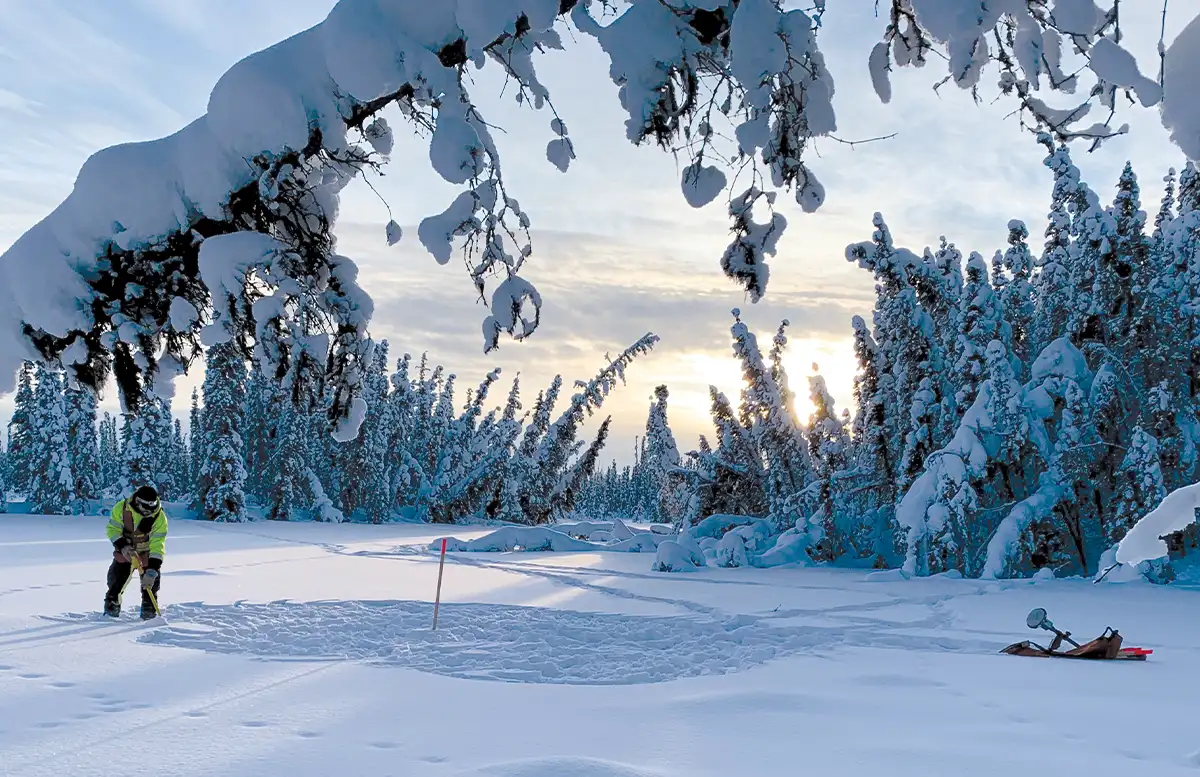
Setting primary monuments (30-inch-long pipes with caps) in permafrost is particularly cumbersome. “What that entails is digging through the ice to set the monuments,” explains Eric Gabrielson, lead land surveyor for Design Alaska. “One monument can take as much as one hour.”
Based in Fairbanks, Design Alaska has been involved in the planning, design, and construction of urban and rural facilities in Alaska for more than fifty years. One of the company’s greatest strengths is its multi-disciplinary experience in the Arctic, subarctic, and coastal regions of Alaska.
Kuna Engineering has become a trusted provider of surveying and engineering services since it was formed in 1981 in Utqiaġvik. A subsidiary of NANA regional corporation since 2005, Kuna utilizes advanced technologies to deliver a comprehensive range of capabilities.
The work of Alaska’s surveyors is foundational to nearly every major project in the state. Community infrastructure, energy facilities, housing developments, roads, and pipelines all begin with accurately drawn lines.
Founded in 1993 to support rural communities, LCG Lantech is an Anchorage-based firm offering architecture, engineering, and surveying services throughout Alaska. The team has completed more than 1,250 diverse projects, including housing, medical facilities, schools, infrastructure, and waterfront structures.
Even without storms, Alaska’s weather poses its own challenges; for example, cold weather interferes with battery-operated equipment.
Keeping survey equipment operational is key in those situations. “If our equipment’s not working, then we’re not working,” says Witt. “We do our best not to have equipment failures and always bring back-up.”
Technological advancements have significantly impacted surveying in Alaska. “The State of Alaska’s real-time GNSS [global navigation satellite system] network, ACORN, has dramatically reduced the time and cost of nearly all types of surveying across the state while also increasing accuracy. Its impact cannot be overstated,” says Gervelis.
Surveyors also benefit from advances in consumer communications. Gervelis says, “Starlink has also been transformative. It has connected remote locations to offices and data centers and is a critical enabler of ACORN in areas where traditional communications were previously impossible. Beyond technical benefits, this connectivity allows us to communicate directly with remote villages—often through village Facebook pages—to coordinate schedules, request local assistance, arrange lodging, and secure vehicle rentals such as ATVs and snowmachines.”
In addition to GNSS and Starlink, aerial and aquatic drones equipped with LiDAR, sonar, and photogrammetry have revolutionized data acquisition. These tools allow surveyors to collect data faster and more safely in environments that were once extremely difficult or dangerous to access.
Preparations vary significantly by location. “In the northern and coldest regions, surveyors don’t dress to be comfortable; we dress to stay alive,” says Gervelis. “Surveyors working on North Slope oil projects often rely on extreme cold-weather gear, including parkas that can cost $1,500 or more. Those working in coastal and Yukon River villages frequently adopt Indigenous solutions, such as seal skin hats and gloves, and qiviut yarn hats, which are about eight times warmer than wool by weight and exceptionally soft.”
Across all regions, surveyors learn the importance of staying hydrated and well-fed to maintain core body temperature. “Staying connected to updated weather forecasts is critical, as getting stranded is not unusual,” explains Gervelis. “We carry reading material, water, food, alternate heating sources, and, just as importantly, patience.”
Due to the remote worksites, surveyors rely on village residents for lodging, meals, and local transportation. “Communication is our number one focus,” says Gabrielson. “Talking before we get there lets them know the scope of our work, what we’re going to need, and how they can help.”
Respect is also a top priority. “We communicate with village leaders before, during, and after every project,” says Gervelis. “We view our work as a partnership with the village, and our success is deeply dependent on the people and leadership of each community.”
When it comes to the dangers of interactions with Alaska wildlife, stories of bear encounters top the headlines. “Bears have severely mauled several of the surveyors I’ve known, and it seems that most surveyors have a bear story of some type,” shares Gervelis. “I’ve been afraid of bears since I was a kid. My uncle’s sporting magazine had illustrations of huge bears towering over small hunters with tiny guns that looked like my BB guns! Since Alaska is the bear capital of the world, I chose to take a bear defense class.”
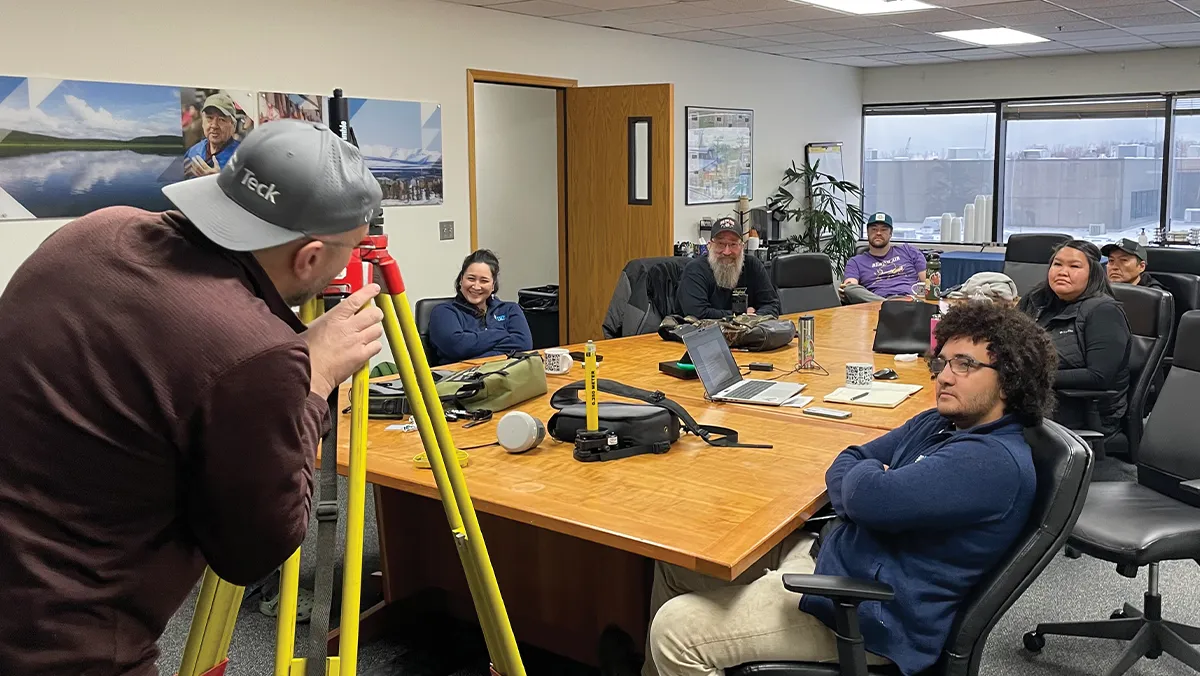
Although Witt routinely sees bears while surveying, he’s been fortunate not to have a close encounter. “You always see bears out in the distance, but they haven’t ever bothered me. But I do carry bear spray,” he shares. “The animals that have messed with my survey work the most are the curious young moose. We were working on a power alignment through the woods when a couple of young moose followed us for most of the morning. They finally became curious enough to approach our instrument, which was mounted on the tripod. They sniffed it, licked it, and then walked away.”
Gabrielson had a very unusual wildlife encounter while surveying for a gold camp in the Brooks Range. “My coworker walked up the road to get the pickup truck, and when he was driving it back to pick me up, there was a bear in the middle of the road. He honked the horn, and the bear ran down the road and around the corner directly toward me,” he recalls. “I hid under a rock, but the bear was charging down the road so fast that it jumped over the rock. From my viewpoint, I could see the entire underside of the bear!”

Design Alaska
Design Alaska
Kuna Engineering
Kuna Engineering

When Gervelis was a child growing up in Ohio, he was introduced to surveying by a neighbor who was both a farmer and a surveyor, and who was kind enough to let the neighbor kid check out his survey equipment. “In school, most of the kids hated math problems, but I loved solving those problems,” recalls Gervelis. “When I learned that surveyors get paid to walk around in the woods, solve math problems, and draw pictures, I knew that was a career invented just for me.”
Gervelis started his career in Ohio and later moved to Washington. “I met my current wife in Washington,” shares Gervelis. “She was born and raised in Alaska, and I knew if I continued dating her, I would end up moving to Alaska.” He was right. Gervelis has been in Alaska for eleven years.
Gabrielson also began his survey career early. “My father was the owner and president of a large surveying company on the East Coast,” shares Gabrielson. “I started working in the profession around 13 years old—I think my dad added me to his crews so he could avoid paying for a babysitter in the summer.” After several years of full-time surveying, Gabrielson earned an associate degree from Paul Smith’s College in upstate New York, followed by a bachelor’s degree in surveying from UAA.
Witt began his career as a civil engineer. “For my first job out of college, I went to work for a surveying firm that does civil engineering. The firm did 75 percent survey work and 25 percent civil engineering,” shares Witt. “I ended up getting enough survey experience that I qualified for a survey license in the state of Washington.”
About twelve years ago, when Witt moved to Alaska, his civil engineering license transferred, but his experience-based survey license didn’t. He says, “I went back to school to finish out a couple of quarters of specific classes.” Witt graduated from UAA with a degree in geomatics and is now one of only thirty-two individuals in Alaska to hold both a civil engineering and a survey license.
In 2000, Alaska had 389 licensed surveyors with an active license. “In 2025, we’re currently standing at 375 actively working in Alaska,” says Witt. “We’re always needing more people. But if someone does decide to be a surveyor in Alaska, I would tell them they need to really like the great outdoors.”
Gervelis suggests leaving expectations behind and approaching the work humbly. His advice: “Learn to watch and learn to listen. If you can do that, you may not only survive but truly prosper.”