

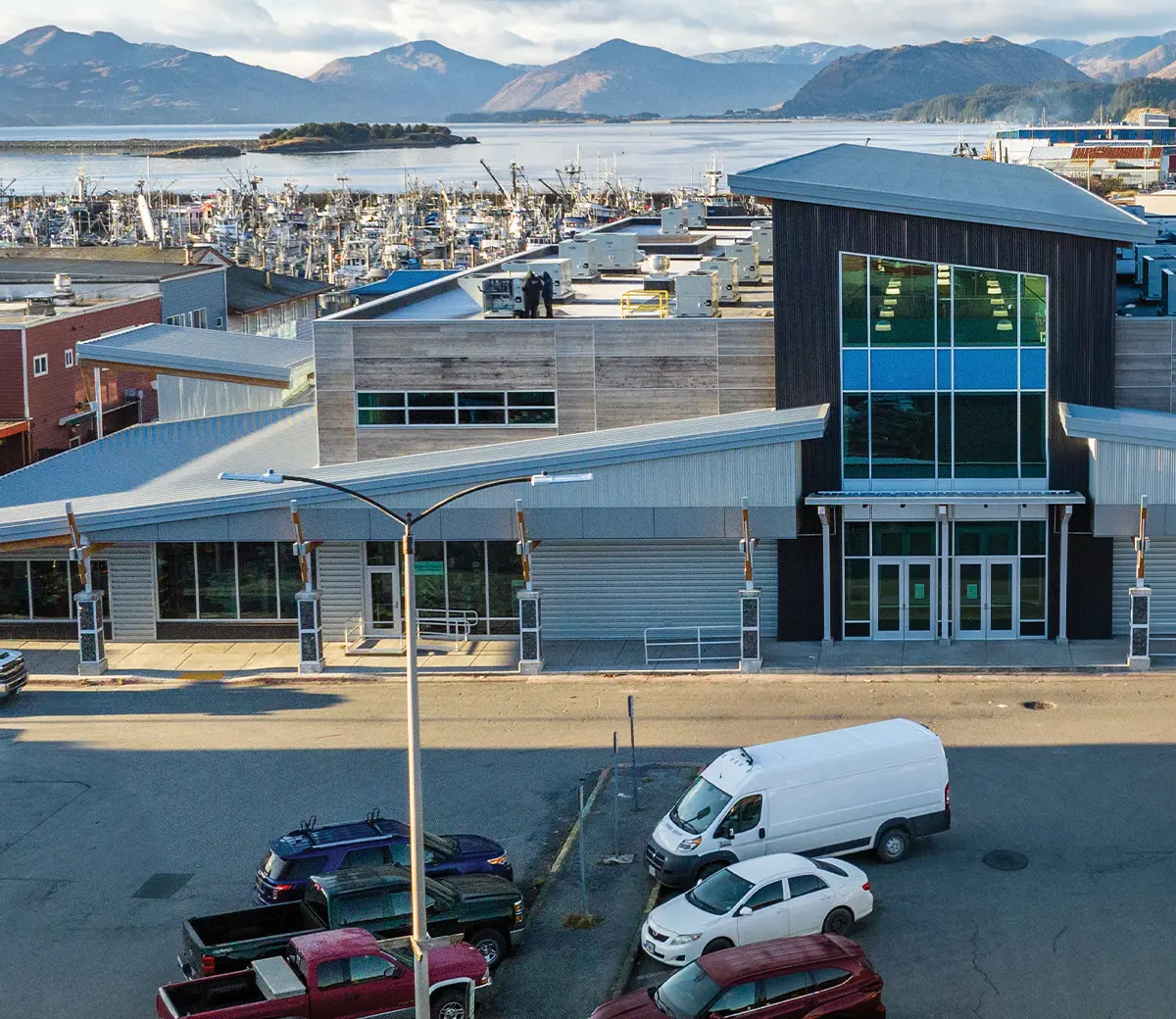
rom elementary schools and medical facilities to resorts, churches, and nonprofit centers, Nvision Architecture’s fingerprints are scattered across urban neighborhoods and remote villages alike, stretching across the entirety of Alaska.
“At Nvision, our vision is to bring people together through design to build better community,” said Paul Baril, the firm’s president and CEO. “Community-minded architecture is something we value and cherish and something we bring forth in all of our products.”
That vision has guided the firm through multiple generations of leadership and evolving design trends. Today, with a team of eleven design professionals based in Anchorage and a new satellite office in Palmer, Nvision continues to balance private and public sector work while staying grounded in a mission that has remained remarkably consistent since the firm’s earliest days.
When Porath retired in 1999, leadership passed to his close colleague Bill Tatom. The firm became Porath Tatom Architects and continued to expand its portfolio across the state.
Paul Baril joined the firm in 2000, long before he imagined leading it, but with a dream of becoming an architect.
“I came on at age 17, when I was still in high school,” Baril recalls. “I got an entry-level position doing office work.”
That early exposure set him on a path that would take him through nearly every role in an architectural office. He studied architecture, returned to the firm, and worked his way up through drafting, project design, and management. In 2007, Porath Tatom Architects merged with Krochina Architects, forming what is now known as Nvision, with Pat Krochina remaining as an owner alongside Baril.
“I am the third-generation owner,” Baril says. “I started working for the firm in the year 2000. My mentor—the person who hired me—was the second-generation owner, Bill Tatom.”
In 2017, Baril became president and CEO, carrying forward the firm’s legacy while sketching the lines that would form its future.
“People enjoy working here,” he says. “We have fun while we work. Nvision and our office is its own family.”
That sense of cohesion is not accidental. Baril has intentionally preserved a workplace culture that values collaboration, trust, and shared experience—both inside and outside the office.
“We’re a really tight-knit group,” he says. “We work hard and go out and have fun together and play hard. We’ve done an office snowmachine trip. We do a summer fishing trip or rafting trip. We get out and enjoy Alaska and each other’s company.”
That internal culture, Baril believes, directly affects the firm’s work and client relationships.
“When people are happy to work there, that shows with the clients,” he says. “When the clients are happy, the projects are better.”
Nvision’s team is made up of licensed architects and design professionals with experience across every phase of a project, from master planning and interior design to construction administration. The firm emphasizes clear documentation, cost-conscious decision-making, and stewardship of client funds—values that resonate in both public and private sector work.
“We really aim to make the planning and design process more productive and enjoyable for everyone involved,” Baril says. “Good documentation makes construction easier and more efficient, and that benefits everyone.”
“There are lots of architects and firms in the world where you can say, ‘Hey, that’s their building,’ because they all have similar designs,” Baril says. “When you look through our portfolio, you might see some similarities because we like working with certain materials, but really the architecture itself is a function of what is truly needed for that client.”
Rather than imposing a standard style or certain aesthetic, Nvision lets the program, budget, site, and stakeholder needs drive each design.
“If you look through our portfolio, we try not to ever repeat anything or have projects look alike,” Baril says. “We want each project to be unique to the client it’s serving. What that does is provide variety—from thoughtful, well-designed architecture on a low-scale budget to something more prominent when the budget allows.”
That philosophy has allowed Nvision to work across sectors without losing focus.
“We do a lot of school projects. We’re in retail, healthcare, multi-family housing—anything commercial,” Baril says. “No matter what kind of project it is, we’re focusing on it being community-minded and community-based for its stakeholder group.”
Kevin G Smith | Nvision Architecture
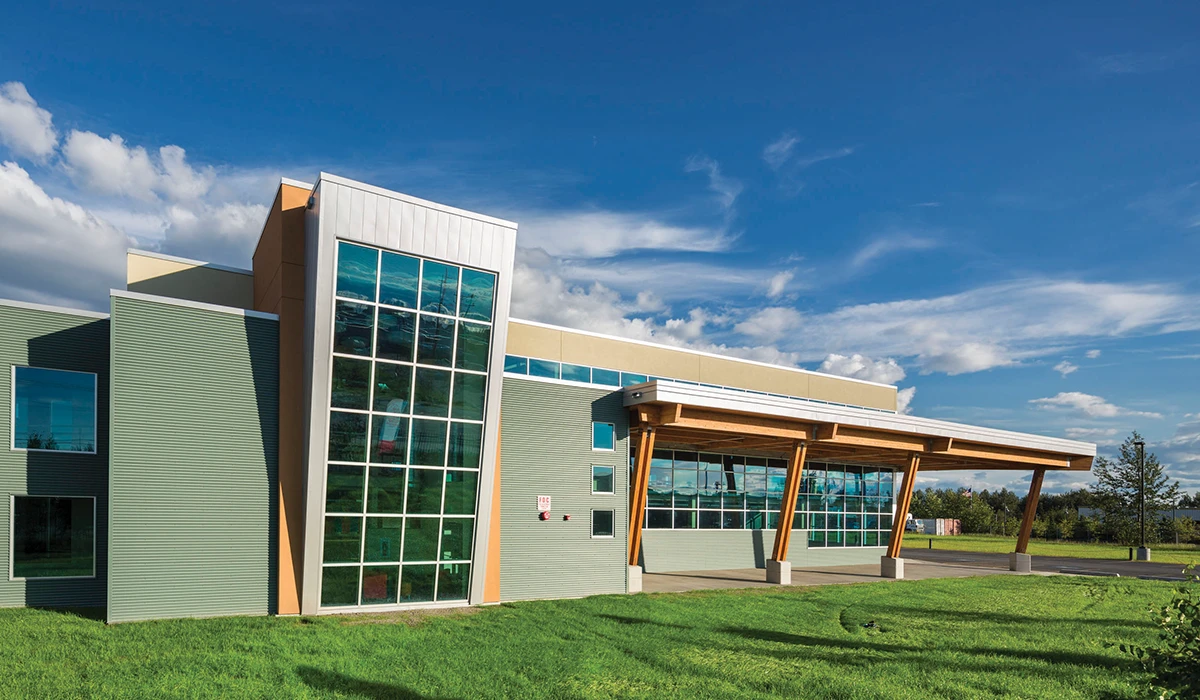
More recently, Nvision has been deeply involved in the reconstruction of Inlet View Elementary near Westchester Lagoon, currently nearing completion.
“We spent a lot of time working with what we call the building design committee,” Baril explains. “That’s a group of community stakeholders—parents, teachers, neighbors, and the principal.”
Few projects illustrate Nvision’s community-centered philosophy more clearly than Joann A. Alexie Memorial School in the Lower Kuskokwim village of Atmautluak. Built between 2018 and 2021 for the Lower Kuskokwim School District, the 34,331-square-foot school replaced the previous K-12 school and serves as an educational, cultural, and social hub. Nvision worked closely with the school district to develop an artistic design that blends modern architecture with traditional Yup’ik structural forms.
The vibrant building is raised above the tundra, echoing Yup’ik caches, while the main entrance references the facade of a traditional sod house. A large Yup’ik mask on the gym exterior is based on a student drawing. The structure is oriented to reduce snowdrifts, with angled walls that act like snow fences and improve airflow around the building.
Inside, the school is warm and welcoming, with vaulted ceilings, a large common area, and extensive use of local themes. A map of the Kuskokwim River system is embedded in the flooring, while Yup’ik art, much of it inspired by student work, is featured throughout.
A standout in Nvision’s portfolio, the school demonstrates architecture responding directly to place: climate, culture, and function all come together.
Because of Seldovia’s remote location across Kachemak Bay from Homer, the 3,362-square-foot facility had to be a one-stop medical center. Nvision worked closely with the tribe to design a two-story building that fits within the surrounding residential neighborhood while meeting commercial durability requirements.
The exterior blends familiar residential siding with more durable commercial materials that can withstand the coastal environment. Inside, Nvision used natural colors highlighted with the tribe’s brand colors to create a welcoming, culturally respectful space.
At the tip of Homer Spit, Nvision completed a major addition to the iconic Land’s End Resort between 2018 and 2019.
The 18,354-square-foot, three-story addition includes thirty-three new guest suites, each with private balconies, luxurious bathrooms, and views that celebrate the resort’s dramatic setting. The goal was to complement the existing hotel’s style and finishes while adding modern amenities and meeting current code requirements.
The project required creative problem-solving, including navigating strict height limitations, integrating fire protection systems, and maintaining guest access during construction.
Each project reflects Nvision’s commitment to architectural diversity, sustainability, and responsible project management—values that have earned the firm numerous design awards over the years.
When asked about a favorite project, Baril without hesitation cites the firm’s work redesigning the Downtown Soup Kitchen, now called the Downtown Hope Center.
When that project began, the organization was serving meals through a residential kitchen window. Nvision partnered with the nonprofit to design a new facility that could better serve Anchorage’s most vulnerable residents.
Wayde Carroll Photography | Nvision Architecture

The result was a facility that not only met immediate needs but allowed the organization to grow.
“They love the space and use it,” Baril says. “Staying connected to that project has been really meaningful to me.”
Nvision’s commitment to community extends beyond architecture. Over the years, the firm has supported more than twenty-five local charitable organizations, including AWAIC, Beans Café, Covenant House Alaska, Habitat for Humanity, Special Olympics Alaska, United Way of Anchorage, and numerous others.
“We believe in giving back in tangible ways,” Baril says. “It’s part of being a community-minded firm.”
The team is also active in professional and cultural organizations, including the Association for Learning Environments, where Baril sometimes presents to the membership. Participating on one panel, he spoke about alternative education models and the process of designing a Waldorf school in Palmer.
In 2020, Livingston Slone, an Alaska design firm with roots dating back to 1975, came under Nvision’s leadership with the establishment of Livingston Slone Studio @ Nvision, expanding the firm’s creative reach.
Most recently, Nvision opened a satellite office in Palmer. “Knowing the Mat-Su Borough is growing, we wanted to be part of that community too,” Baril says.
Even as the firm’s leader, Baril remains deeply involved in design work. “I definitely still do hands-on architecture,” he says. “I wouldn’t want it any other way. I’m an architect because I love architecture and love designing buildings.”
After more than four decades, Nvision remains focused on a simple but powerful idea: architecture as a tool for connection.
“Every building we design serves the community in some form,” Baril says. “Even a retail facility is serving the community. Every project is unique because every community is unique.”