

Paid Advertisement

Port MacKenzie

Photo Credit: Port Mackenzie
ort Mackenzie is a distinctive hub with thousands of acres of land specifically zoned for industrial and commercial development. The land includes two miles of shoreline reserved for future port infrastructure and four square miles of tide and submerged land, eliminating the need to acquire state tideland leases. With the deepest draft dock capability in the Upper Cook Inlet, the port is arguably the area’s most valuable piece of real estate for opportunity and economic activity.
“Port Mackenzie is a gateway to the world,” says Port Director David Griffin. “We have deep water and can operate year-round. And being so close to the Don Young Port of Alaska in Anchorage, we are located on a well-travelled marine highway, providing our port with regional maritime resources—including the US Coast Guard, pilots, and tug operators.”
The Port Mackenzie and Port District lands are near the maritime industry of the Port of Alaska and Joint Base Elmendorf-Richardson. If key infrastructure is compromised on the Anchorage side, Port Mackenzie could be employed to move cargo and personnel to points further north in Southcentral and the Interior. Griffin emphasizes, “The Point Mackenzie region as a whole is primed for growth due to the significant amount of developable and privately owned property, coupled with gas and electrical transmission lines, an agricultural district, planned road developments to the West Susitna region, and the completion of rail infrastructure along the Port MacKenzie Rail Extension.”
Port Mackenzie is well-equipped to handle increased demand and development in the coming years. This is primarily due to its strategic design, expansive facilities, and capabilities. Port Mackenzie’s infrastructure was designed to export various types of cargo including natural resources like wood chips, coal, ore, gravel, and fuel. Yet in many ways the port is still in its infancy. The barge dock was constructed in 2000, the deep-draft dock was completed in 2004, receiving its first ship in January of 2005.
“The port was located on a deep water channel that is naturally scoured, alleviating the need to do any maintenance dredging,” Griffin says. “The deep-draft dock is designed to be operable on a year-round basis, and the mooring dolphins and breasting dolphins are outfitted with quick-release mooring hooks and motorized capstans.” The dock is only two miles away from Cook Inlet Tug & Barge, the company that provides tug support for vessels navigating the inlet.
Port Mackenzie’s deep-draft dock stretches 1,200 feet and maintains water depths of 60 feet at low tide, capable of accommodating large bulk carrier ships like those navigating the Panama Canal. Alongside this, its 375-foot-long barge dock maintains water depths of 20 feet at low tide, and the barge bow ramp berth allows for roll-on/roll-off cargo operations at high tide.
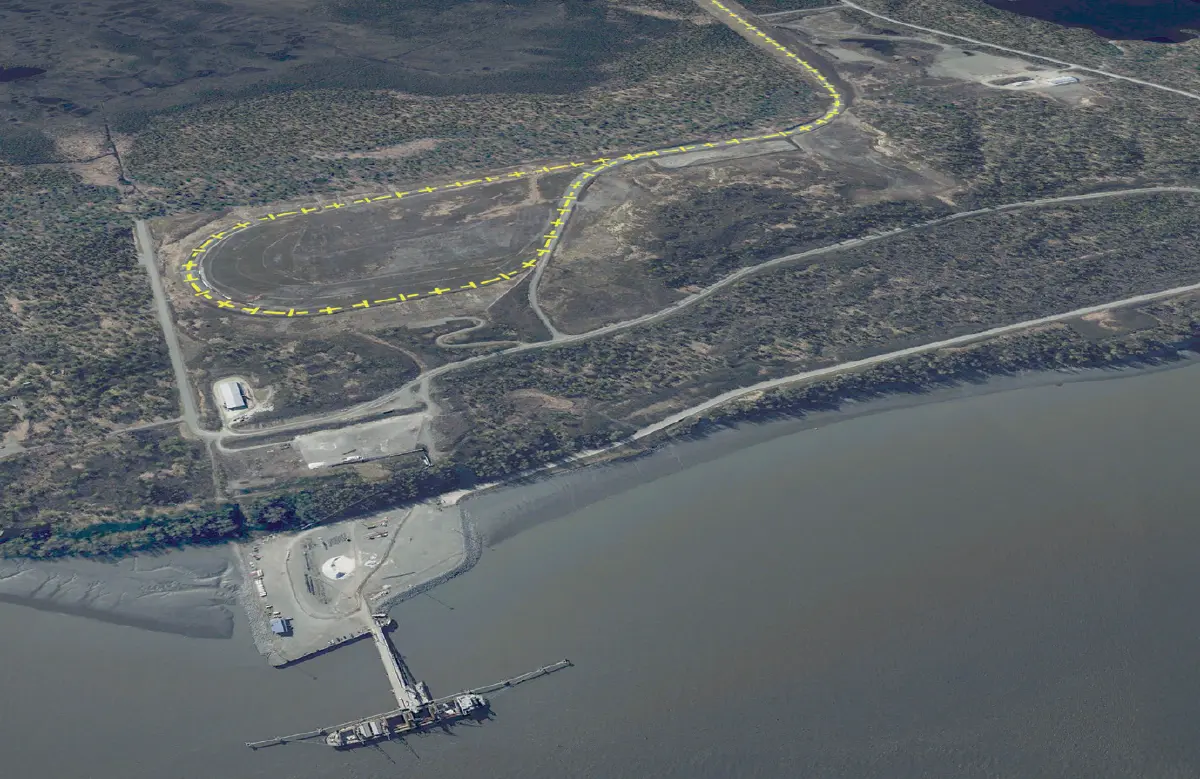
Photo Credit: Port MacKenzie

Stefan Hinman/MSB
Having a waterfront facility just two miles from Anchorage, Port Mackenzie is in a unique position. Being close to a port that handles freight and cargo twice a week year-round shows that its waterway is navigable and supports commerce. And although it’s a separate entity, Port Mackenzie is also a municipal port and public facility. This means the port can pursue grant funds from various federal sources—including the US Department of Transportation’s Maritime Administration, US Department of Defense, and Federal Emergency Management Agency—which enhances its funding opportunities.
While Port Mackenzie is relatively young, it is increasingly becoming more of a consideration for industry. And at this stage, it’s a port that makes logical sense to develop due to its location, capabilities, and ability to expand. As the state grows and develops its natural resources, Port Mackenzie is well suited for moving those commodities to market. “Our goal is to become an industrial hub that’s capable of meeting the needs of our local maritime industry while doing business with the world,” Griffin says.
With its strategic location, extensive resources, and vision for expansion, Port Mackenzie is a promising gateway to the future. Reach out today to discover how the port is poised to support Alaska’s growing industries and commercial ventures.

Port MacKenzie
David Griffin, Port Director
28000 S. Don Young Road | Wasilla, Alaska 99623
(907) 861-7799
portmackenzie.matsugov.us