



n March the Alaska Gasline Development Corporation (AGDC) and Glenfarne Group announced an agreement for Glenfarne to become the majority owner of Alaska LNG, a project intended to deliver North Slope natural gas to in-state markets and beyond.
Under the agreement, Glenfarne acquired 75 percent of AGDC subsidiary 8 Star Alaska, which is developing Alaska LNG as three subprojects: an 807-mile, 42-inch pipeline; an LNG export terminal in Nikiski; and a North Slope carbon capture plant. Glenfarne stated, “Phase 1 of the project will kick off immediately, prioritizing the development and final investment decision of the pipeline infrastructure needed to deliver North Slope gas to Alaskans as rapidly as possible.”
In May, Glenfarne selected Worley to perform additional engineering work and to prepare a final cost estimate “in sufficient detail to achieve final investment decision for the pipeline,” according to Glenfarne, which also stated at the time that it anticipates a final investment decision in 2025. The most recent cost estimate from June 2020 was $38.7 billion, a $5.5 billion decrease from a 2015 estimate when major North Slope producers were part of the venture. The economics of megaprojects have, since 2020, fluctuated massively.
Combined with other expressed international interest in Alaska LNG, the current energy surrounding Alaska LNG is thrilling: the political administration is favorable, partners are lining up, and markets seem ripe.
In the December 1985 issue of Alaska Business, Scott Hawkins, then an associate economist for Key Bancshares of Alaska and the author of “Alaska Trends,” stated: “A North Slope gas line reportedly is looking more and more feasible… the conventional wisdom that a gas line to tidewater couldn’t begin until well into the 1990s may need to be reassessed.”
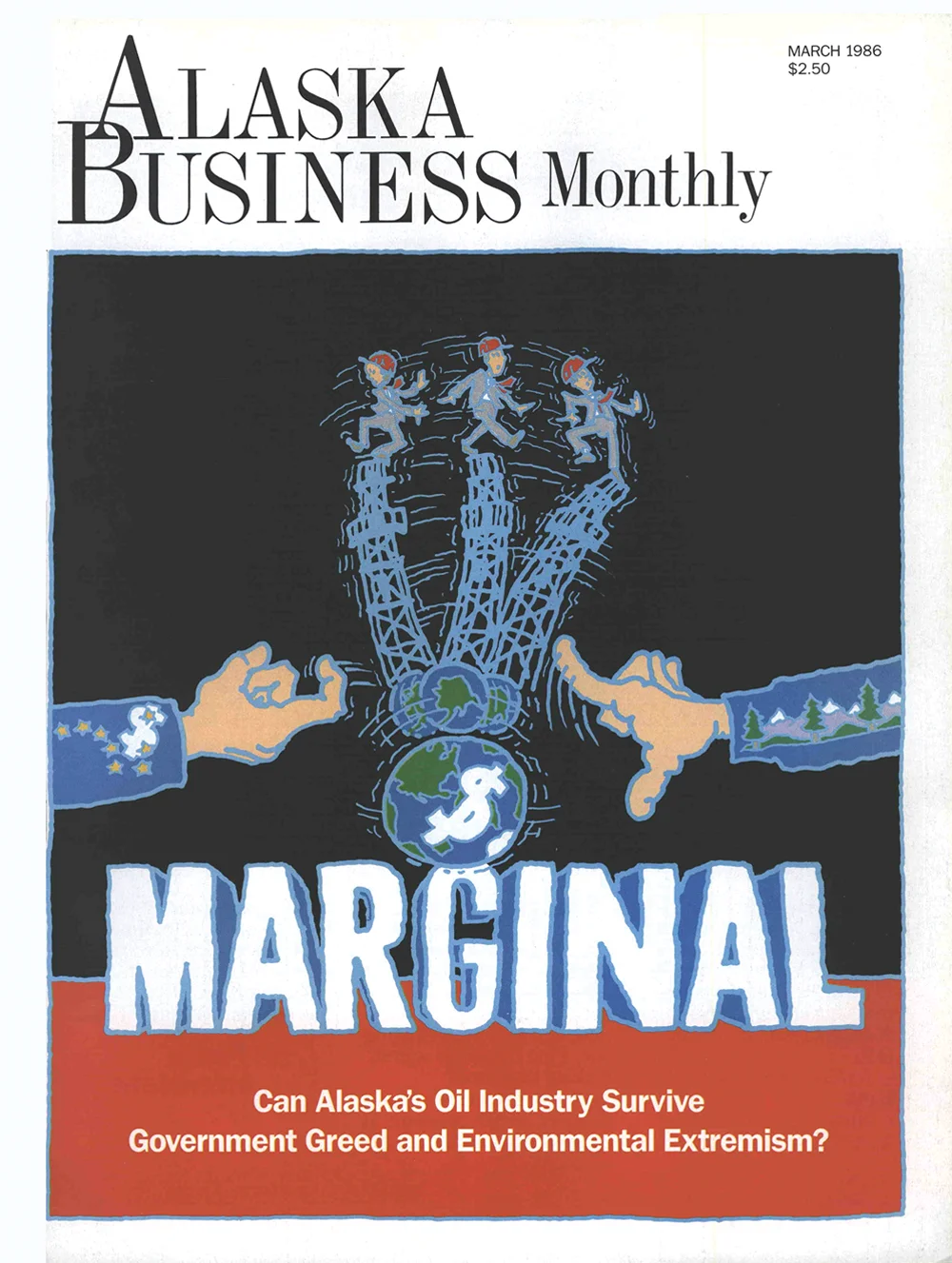
Despite the attention-grabbing subhead, this bulk of this 1986 cover story discussed technological and process advances that oil field operators were making in the mid ‘80s.
March 1986
Illustration by Dee Boyles
Despite the attention-grabbing subhead, this bulk of this 1986 cover story discussed technological and process advances that oil field operators were making in the mid ‘80s.
March 1986
Illustration by Dee Boyles
Ah, 1987. When Yukon Pacific, a subsidiary of transport conglomerate CSX, was a decade away from ending its pursuit of a 42-inch diameter gasline, called TAGS, to Valdez.
Jumping forward to May 2014, Larry Persily, who at the time was the federal coordinator for Alaska natural gas transportation projects, shared an overview of an Alaska LNG project (as it was envisioned at the time) in the Alaska Business article “Alaska LNG Project Gains Momentum.” He listed three reasons the gasline had a chance at success: Alaska’s proximity via cargo ship to Asian markets, the efficiency of liquefaction equipment in Alaska’s cold climate, and the vast known and proven gas resources on the North Slope. He wrote, “Energy analysts worldwide expect global natural gas demand to grow at a strong rate—especially in Asia—for years to come… the world could need a dozen new, large-scale liquified natural gas export projects by 2025 to supply that demand… Alaska has a shot of being one of the winners.”
He added: “Of course, any Alaska oil and gas project must overcome the reality of high costs of construction and operations in the far north.” The estimate for an Alaska LNG project, in 2012 dollars, was between $45 billion and $65 billion.
On July 1, LNG Canada announced loading and shipping its first cargo tanker of LNG to South Korea, officially becoming Canada’s first large-scale LNG export terminal, with a price tag of $29 billion (C$40 billion). LNG Canada is a multi-national joint venture comprising Shell, PETRONAS, PetroChina, Mitsubishi Corporation, and KOGAS. Its export facility is in Kitimat, British Columbia, and it’s currently operating two LNG trains with a total capacity of 14 million tonnes per annum. Two smaller facilities in Canada, Woodfibre LNG and Cedar LNG, are already under construction with anticipated completion in 2027 and 2028, respectively.
LNG Canada shares many of the attributes that Persily identified for Alaska LNG in his 2014 article: a known supply, cold climate, and proximity via ocean shipping to Asian markets.
And Canada is not Alaska’s only LNG competitor: other US states have their own plans. In December 2024, Plaquemines LNG in Louisiana shipped its first LNG cargo after starting production in mid-December. According to the Federal Energy Regulatory Commission, as of mid-2025 there are six LNG export terminals approved and under construction and another eleven, including Alaska’s at Nikiski, that are approved but have not started construction yet.
This 1987 comic ran within the article “Raising Revenue or Stimulating Growth?” It explored if a proposal to reinstitute an Alaska personal income tax or reducing state spending would better address budget deficits.
Alaska Busines Achives | April 1987

Bloomberg’s “Global LNG Market Outlook 2030: Focus on Supply Risks,” reports, “The global LNG market is on track to see more supply than demand from 2027 onwards. It is poised to become increasingly oversupplied by the end of this decade in the base case, with expected supply 63 million tons higher than demand in 2030, as new liquefaction projects are commissioned.” According to the report, a “long list” of projects lining up for a final investment decision could provide an additional 74 million tons of LNG by 2030; approximately 162 million tons of LNG supply in 2030 is estimated to come from projects already under construction, “with the majority in the United States and Qatar.”
Has Alaska LNG missed its moment yet again? That decision, for the foreseeable future, is on Glenfarne’s desk. While the company is clearly (and rationally) trying to build interest in Alaska LNG, the positive news that the company has been publishing is no guarantee that the project will move forward. In a June interview with KTUU reporter Joe Allgood, Persily, in his current role as an oil and gas analyst, said: “You need contracts to show you’ve got gas and how much it’s going to cost and when it can be delivered… You need contractors to say how much it’s going to cost to build the pipeline, the gas treatment plant, the liquefaction plant, and when they can be built… You need contracts for buyers at the other end who say, ‘At that price, at that delivery schedule, I will take X million tons, per year, for fifteen to twenty years,’ to cover a mortgage, essentially… That’s what you need, and they [Glenfarne] have none of that for this project. They have expressions of interest.”
If Alaska LNG were to move forward, there’s no doubt about the short-term positive impact in construction jobs and the economic activity associated with them. Would it be a boom like the construction of the Trans Alaska Pipeline System (TAPS)? Probably not, if only because the state’s population and economy have more than doubled in size since TAPS construction started more than half a century ago. And for those aware of the economic climate in Alaska in the mid-‘80s, it would be best if the boom wasn’t an exact echo.
In the April 1987 Alaska Business article “Raising Revenues or Stimulating Growth,” this publication documented state spending per capita in Alaska in 1985 at $3,408 compared to a national average of $723. At the time, then-Governor Steve Cowper wanted to reinstate an income tax to make up for projected budget deficits. Laird wrote: “Critics counter that a revenue shortage isn’t the issue—the level of state government spending is.” Alaska had previously collected a personal income tax but stopped in 1979 when “North Slope petro-dollars began flooding state coffers,” as Laird put it. For all the money that TAPS brought to the state, a mere six years after its completion, Alaska was in crisis.
Of course, it wasn’t just exuberant spending that landed Alaska in a recession.
After TAPS construction ended, approximately 10,000 construction jobs disappeared between 1976 and 1977. As Schultz explains, a small bust was anticipated: “It was well understood that pipeline construction jobs were temporary, and when the project was done, nearly all the job loss was in pipeline construction and support work while other parts of the economy continued to grow,” she wrote.
Unfortunately, the construction lull coincided with a crash in oil prices.
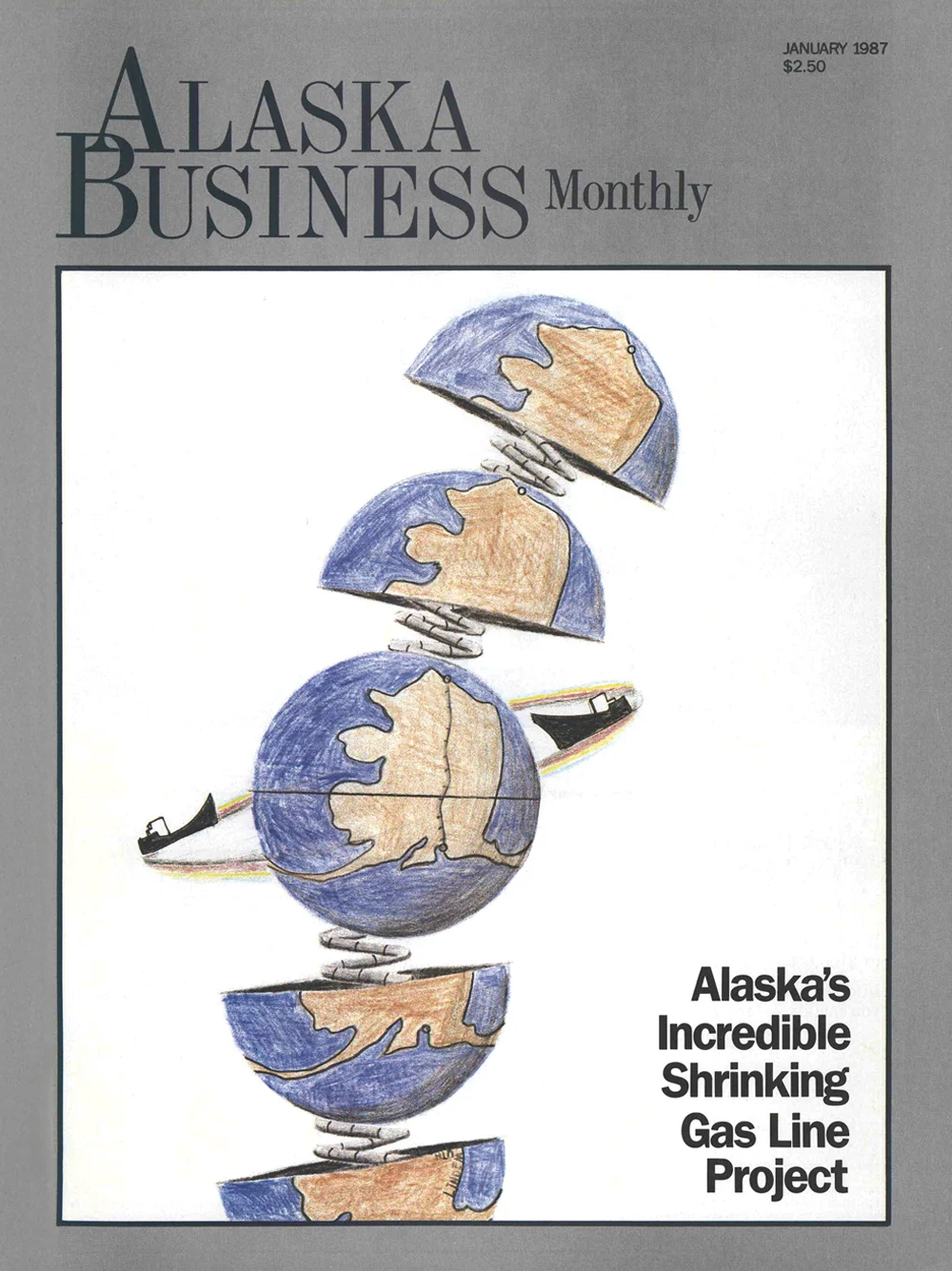
January 1987
Illustration by Charles Lindemuth
January 1987
Illustration by Charles Lindemuth
As prices continued to climb, Saudi Arabia, frustrated with the choices of other OPEC members, abandoned its role as a swing producer working to maintain price stability and instead turned to producing at full capacity. Suddenly there was a glut of oil, prices tanked, and Alaska was forced to deal with “petro-besity,” as Laird called it, “a condition of fiscal intoxication resulting from the consumption of too much oil revenue.”
Alaska’s boom was over, immediately succeeded by bottom-of-the-barrel oil prices. Of the situation, Schultz wrote, “In retrospect, it’s easy to see that the helter-skelter growth was built on a shaky foundation. The crash that followed still haunts many Alaskans.”
From 1985 to 1987, Alaska lost more than 20,000 jobs, and 40 percent of Alaska’s banks failed. During the boom, 36,000 homes were built in urban Alaska, but by the end of 1987, there were 14,000 empty homes in Anchorage; foreclosures peaked in 1988 at 6,821; and by 1989 more than 30,000 total foreclosures had been filed.
Laird, in his January 1988 letter from the editor, offered this gem on the state’s economy: “How about the difference between an Alaskan oil man in 1987 and a pigeon? The pigeon can still make a deposit on a new Mercedes.” He wrapped his comedy routine with this one: “There’s a new message on Alaska’s bumpers: God, please give us another boom—we promise not to piss this one away.”
For the previous decade, Alaska had enjoyed oil prices that soared above $100 per barrel. Remember the $1,200 “resource rebate” attached to the 2008 Permanent Fund dividend, using the state treasury’s windfall to offset higher energy bills? By 2016, the reverse happened, and the annual payouts were capped as moths flew out of the state’s pockets.
The middle of 2014 marked the start of a multi-year decline that again sent Alaska into a tailspin. In the online article “What triggered the oil price plunge of 2014–2016 and why it failed to deliver an economic impetus in eight charts,” authors Marc Stocker, John Baffes, and Dana Vorisek wrote, “The 70 percent price drop during that period was one of the three biggest declines since World War II, and the longest lasting since the supply-driven collapse of 1986,” citing booming US shale oil production as a leading cause of an oversupply of oil. Natasha von Imhof, in her September 2015 Alaska Business article “Alaska’s Budget Crisis: Myth or Reality?” reported that Rex Tillerson, then-chairman and CEO of ExxonMobil, attributed the price decline to three main factors: weakening demand in Europe, an overestimation of demand in China, and (again) a significant supply influx from North American shale oil.

As is ConocoPhillips Alaska’s Nuna project, which at the time of the article was a potential project held by Pioneer Natural Resources. It sold its North Slope assets to Caelus Energy in late 2013, and ConocoPhillips Alaska acquired Nuna from Caelus in 2019.
Bradner’s article expressed that the investment into these and other projects vindicated the passage of SB21, for which many in the oil industry advocated; SB21 remains the governing regulation for state oil taxes today.
August 2013
Digital Composition by David Geiger
As is ConocoPhillips Alaska’s Nuna project, which at the time of the article was a potential project held by Pioneer Natural Resources. It sold its North Slope assets to Caelus Energy in late 2013, and ConocoPhillips Alaska acquired Nuna from Caelus in 2019.
Bradner’s article expressed that the investment into these and other projects vindicated the passage of SB21, for which many in the oil industry advocated; SB21 remains the governing regulation for state oil taxes today.
August 2013
Digital Composition by David Geiger
Even without the boom of a massive project, Alaska had nonetheless again acclimated to high oil prices in the early ‘10s and the joy of spending. Von Imhof wrote, “In the last decade, Alaska State general fund spending grew from $2.1 billion in FY2004 to $4.4 billion in FY2014, a 109 percent increase. To put it in perspective, inflation increased only 30 percent during that same time, and population increased just 11 percent.”
In her analysis in Alaska Economic Trends, Schultz explained that Alaska in the mid-‘80s and circa 2014 shared essential similarities—state revenue depended on the value of oil, and Alaska relied heavily on federal spending—but Alaska had also seen considerable changes, such as an older population, larger state savings accounts, a more stable housing market, steady population and job growth in the preceding years, and more services in the industry mix.
In her conclusion, Schultz stated: “Nearly thirty years after the big bust, Alaska has accrued large budget reserves… The state didn’t have that kind of breathing room in the 1980s, and it slashed budgets almost immediately… policymakers have more time now to address the problem.”
Which (judging by current events) they didn’t do.

December 1987
Illustration by Jerrett Holderby
December 1987
Illustration by Jerrett Holderby
Per capita spending remains high compared to the national average. In 2022, Alaska spent approximately $20,000 per person, while the national average was in the range of $13,000.
How has this situation sustained since the post-pipeline boom? Well, the budget reserves that Schultz credited with cushioning the shock in 2014 have been spent, leaving the state’s ultimate rainy-day piggy bank: the Permanent Fund. State leaders abandoned the previous statutory formula—a calculation based on half of the statutory net income averaged over the five most recent fiscal years—and now legislators and the governor haggle over how much to split between the operating budget and dividend payouts. With the piggy bank cracked open, Alaska needs an answer for what will happen on the next rainy day in ten or twenty years.
Except there is an answer! Same as the old answer: build a new, massive project, rake in more oil and gas revenues tied even more tightly to commodities markets that Alaskans don’t control, and hope that periods of prosperity outnumber low prices.
The boom and bust of the mid-‘80s apparently cemented an Alaska mindset that all problems are solved with oil money, and if prices aren’t good, get more oil—and if there isn’t enough oil, try natural gas. With this history in mind, the déjà vu optimism for another 800-mile pipeline is stunning. This is not a repeating cycle from hundreds of years ago; many of the Alaskans in positions of influence today remember the crash of the ‘80s, and an even larger portion were around during the crisis in 2014.
In forty years of coverage, Alaska Business has printed article after article, expert after expert, leader after leader, advocating for Alaska’s financial future to be controlled by Alaskans—not by Saudi Arabia, Washington, DC, or shale producers in North Dakota. If Alaska LNG moves forward, the resulting revenue would be more wisely directed toward stability in Alaska’s economic future, not just a burst of spending followed by another cycle of head-hanging regret that, once again, we had the money—and changed nothing.