

he word “landfill” conjures up unglamorous images: garbage pits, trash heaps. In the North Slope Borough, though, landfills rely on engineering approaches found almost nowhere else in the United States, making use of the region’s natural environment.
Two major landfills—the Oxbow Landfill near Deadhorse and the Barrow Landfill near Utqiaġvik—are undergoing expansion and upgrades as part of a long-term strategy to keep pace with both community and industrial waste streams. Both projects reflect how Arctic conditions shape infrastructure decisions—and how permafrost itself becomes a design feature rather than an obstacle.
The Barrow Landfill, operated by the North Slope Borough, is largely dedicated to municipal solid waste from Utqiaġvik and surrounding areas, with limited construction debris allowed by permit. Each of the landfill’s cells has a finite lifespan, so the borough periodically expands the site to ensure continued service for residents and local businesses.
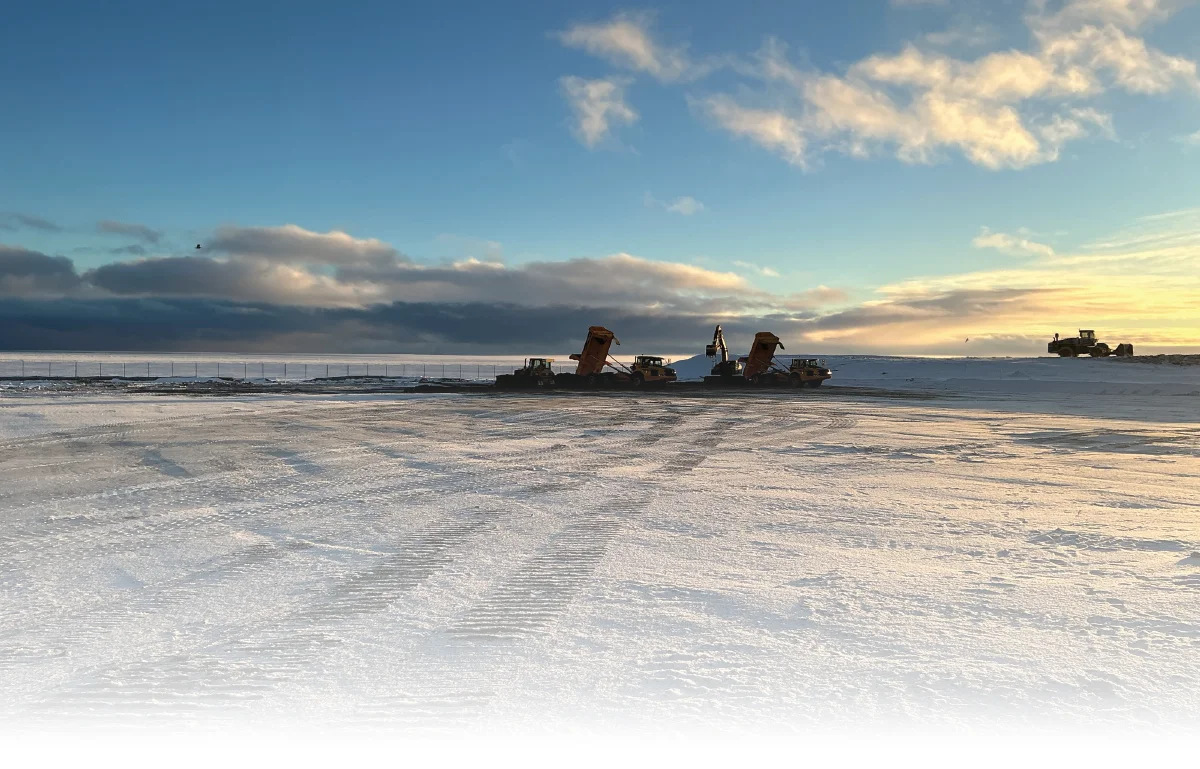
Phase 5 of the Barrow expansion, now underway, adds a new working pad and upgrades older cells to keep pace with the needs of the North Slope’s largest town.
Work on the Barrow Landfill expansion began last fall and will finish before the next freeze-up. UMIAQ Design, a subsidiary of locally owned Ukpeaġvik Iñupiat Corporation (UIC), performed the engineering. Gravel is sourced from nearby pits owned by UIC Arctic Operations and Development and placed through a joint effort of ASRC Construction and UIC Construction, with support from the North Slope Borough.
For oil companies operating far from population centers, Oxbow is not optional; it is a logistical necessity.
As one contractor notes, in a place with no road system connecting communities and industrial sites to the rest of Alaska, you can’t just truck waste in and out. Every module change-out at a drill site, every camp renovation, every pipeline maintenance job generates waste that must go somewhere.
In recent years, disposal cells at Oxbow steadily approached capacity. In response, the North Slope Borough pursued permit modifications and a fourth expansion to add a new waste cell and accommodate the volume of waste arriving from industrial and municipal sources. The borough applied to the Alaska Department of Environmental Conservation for a lateral expansion of the Oxbow facility, effectively increasing its permitted footprint and extending its usable life as the primary disposal site for Prudhoe Bay area waste. ASRC Construction is leading the Oxbow expansion with its subsidiary, ASRC Builders.
Traditional landfills in temperate climates are designed as sites where trash is buried; groundwater is protected and waste is safely isolated using clay or synthetic liners, leachate ponds, and methane collection wells.
On the North Slope, nature provides the liner.
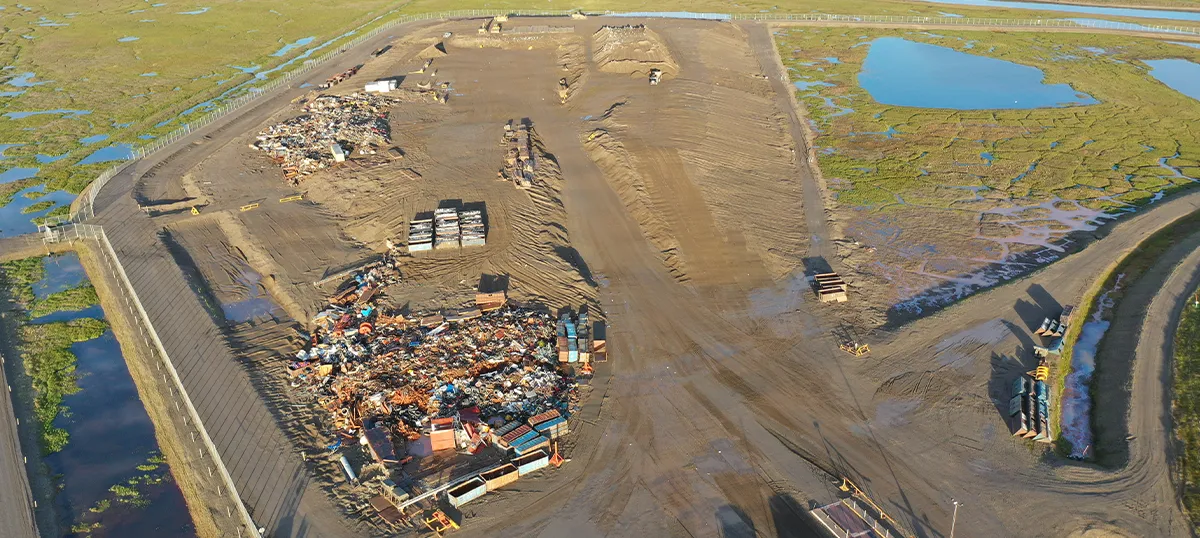
Freezeback landfills like the Oxbow and Barrow sites depend on subzero ground to immobilize liquids and prevent draining. Instead of digging a hole for waste, trash at facilities like the Oxbow Landfill sits on the frozen ground, gradually forming a mound as it accumulates. Monitoring wells allow for close observation of the ground temperature to ensure no leachate leaks into the surface. Landfill scientists use thermistors to keep tabs on the permafrost to guard against ground contamination.
As part of the expansion at the Barrow Landfill, contractors completed initial dirt work in November 2025 and then allowed the ground to settle. They will return in April to drill piles for the monitoring wells. A survey will tell UIC Construction crews whether more gravel—sourced from UIC Arctic Operations and Development—is needed.
“That’s what we’re worried the most about. [Ground settling] just requires more gravel, which is additional cost for the contractor,” Lynn says.
Later, when a landfill cell enters the end of its service life, contractors return to cap the cell with gravel, then revegetate it.
“Essentially, we put mounds of trash up, then cover it,” Lynn describes. “The last one was finished in about […] 2022, and we’re just getting the grass to grow, which is obviously very difficult in Barrow.
When you get done, it’s just a small, revegetated mound, and all the debris is frozen inside of it.”
Solid waste infrastructure on the North Slope doesn’t operate in a vacuum. For projects like this one, regulators require detailed monitoring and permits. The Barrow Landfill Phase VI project, for example, was authorized by the US Army Corps of Engineers for placement of more than 26,000 cubic yards of fill into wetlands to construct Cell 5, with a completion deadline of 2029. Oxbow’s expansion underwent a similar state review to ensure protection of the Putuligayuk River corridor.

UMIAQ Design
“The storms are becoming more severe, and the sea ice isn’t freezing back as fast, and it’s not staying frozen as long,” Lynn says. “As we witnessed this year in Kotzebue—it flooded again, and it was a record flood. And then last year there was [also] a record flood. We have the same issue up in Barrow. The ground is not staying frozen for as long, so it’s thawing out earlier in the spring and not freezing up until later in the summer, which is causing settling for all of these civil projects.”
Even small climate shifts have measurable effects on infrastructure. “We’re getting more settling now than we’ve ever gotten in the past, just due to the half a degree warmup that we’ve seen and how fragile the permafrost really is,” says Lynn.
To deal with these conditions, UIC Construction builds thick gravel berms—more like dikes than walls—to contain snowmelt and storm water as the climate becomes wetter.
Standing water was one of the barriers to starting work on the Barrow Landfill in the first place. UIC Construction had to pump out as much as possible before initiating work on the site; what couldn’t be pumped was left to freeze, then the ice was scraped off the ground where the new cell would go.
“We don’t really think of polar bears being that far inland,” Lynn admits. “[The landfill] is a mile from the ocean, but they smell the residential waste. They’re running out of sea ice to hunt off of, so they get hungry and look for food. And the landfill is easy picking for them when we’re not running equipment.”
Some of UIC Construction’s crew found themselves “stuck” in their truck for an afternoon, he says, when one polar bear refused to leave the landfill. Bear guards had to be summoned to deter the bears so the contractors could get back to work.
While no one has had a face-to-face encounter with polar bears yet, the presence of the bears is another marker of the North Slope’s changing climate. As conditions continue to evolve, it will be crucial for maintenance crews on landfills like Oxbow and Barrow to continue monitoring the durability of the permafrost to guard against the effects of an ever-warming Arctic.