

The Safety Corner
orestry work is inherently dangerous on many levels. In Alaska, arborists working in the tree care industry encounter hazards such as falls from heights, electrical exposures, struck-by falling objects, elevated noise, and logging equipment such as chainsaws and chippers. This important work must be done to protect people and property, as well as for preventative maintenance such as powerline easement cutting and trimming for utility operations.
This work is sometimes conducted during and after natural events like windstorms, wildfires, and ice storms, adding additional exposures to an already risk-filled endeavor. According to studies, climber falls were the leading incident for severe nonfatal injuries for this occupation. Other major causes of severe, nonfatal injury included ground workers being struck by a falling branch, chainsaw incidents, and falls from aerial equipment.
The industry is growing, especially in Alaska, creating a greater demand for safe workers. According to TCI Magazine, the magazine of the tree care industry, “63,700 workers employed in tree-pruning and removal operations is probably a significant underestimate.” The US Bureau of Labor Statistics used these numbers to calculate a preliminary rate estimate and reported a fatality rate of 110 per 100,000 tree trimmers and pruners. This rate is about 30 times higher than the all-industry average.
However, this work can be performed safely when the correct approach to reducing risk is implemented. This involves a formalized safety program, effective oversight at the jobsite, and a supportive management team with front-line workers in complete safety alignment to maintain a positive safety climate.
The “5-15-90” rule should be included and reviewed whenever possible. This critical safety guideline in tree felling states that 90 percent of accidents happen within 15 seconds of the tree starting to fall, and within 5 feet of the trunk—emphasizing the need for a clear, pre-planned escape route (a 45° angle away from the fall direction) that is used immediately.
This plan should be reviewed with the employee prior to working in the field and should have a way and means of evaluating whether the employee does or does not understand every part of the plan. In addition, an annual safety plan review should occur company-wide to review operational exposures and controls. This is an opportunity to ensure the safety culture continues and improves by reviewing changes in operational safety programs, assessing areas of improvement, and discussing near-misses and incidents to better understand where shortcomings in the safety program may exist.
Of high importance to protect workers is the fall protection and prevention program. Working from heights as a tree climber often requires ascending the tree to limb and top it and then descending for felling. Most climber falls relate to either tie-in-point/anchor failure, disconnecting from the climbing system, or severing the climbing line with a saw. One additional failure point is the use of the bowline knot to create a loop at the end of a rope. The use of that knot for rope systems is common within the tree care industry. However, studies have proven that the bowline knot can fail when dynamically loading. Most companies have moved to a Yosemite bowline, a variation that decreases the risk by wrapping the working end of the rope through the loop to help prevent the knot from loosening when loaded.
Safe practices when using all ropes, knots, devices, and related equipment should be covered in the fall protection and prevention program, with practical, hands-on training and verification of proper use in the field.
In addition to those standards, there are regulations that are incorporated into OSHA’s general industry standards by reference, meaning that the standard becomes a legally binding part of the federal rules—making it mandatory for employers to follow. Arborists, especially those working near power lines or in wildfire zones, follow National Fire Protection Association guidelines, often along with American National Standards Institute A300 (pruning/care) standards in addition to all OSHA requirements.
In the field, every job site should have a pre-work safety meeting that includes the previously discussed pre-task plan. A pre-task plan is a brief, proactive safety assessment done before starting any specific job. It includes a formal discussion on communications, controlled access zones, outlining tasks by worker, potential hazards, required safety gear, control measures, and team roles to ensure work is done safely and efficiently, reducing accidents and improving focus. Specific exposures such as equipment, overhead powerlines, and tree-felling logistics are examples of additional discussion points during this meeting. This will help to reduce risks by “planning the work and working the plan.”
All workers should be paying attention to the work being conducted around them at all times. Whenever a risk emerges that was not discussed during the safety meeting, all employees should be able to stop work to discuss the exposures and controls. This empowers workers to be able to speak up if they observe a hazard that is not effectively mitigated, potentially preventing injuries or worse. Once adequate safety measures are put in place, then the work can continue.
Sarah Pulcino
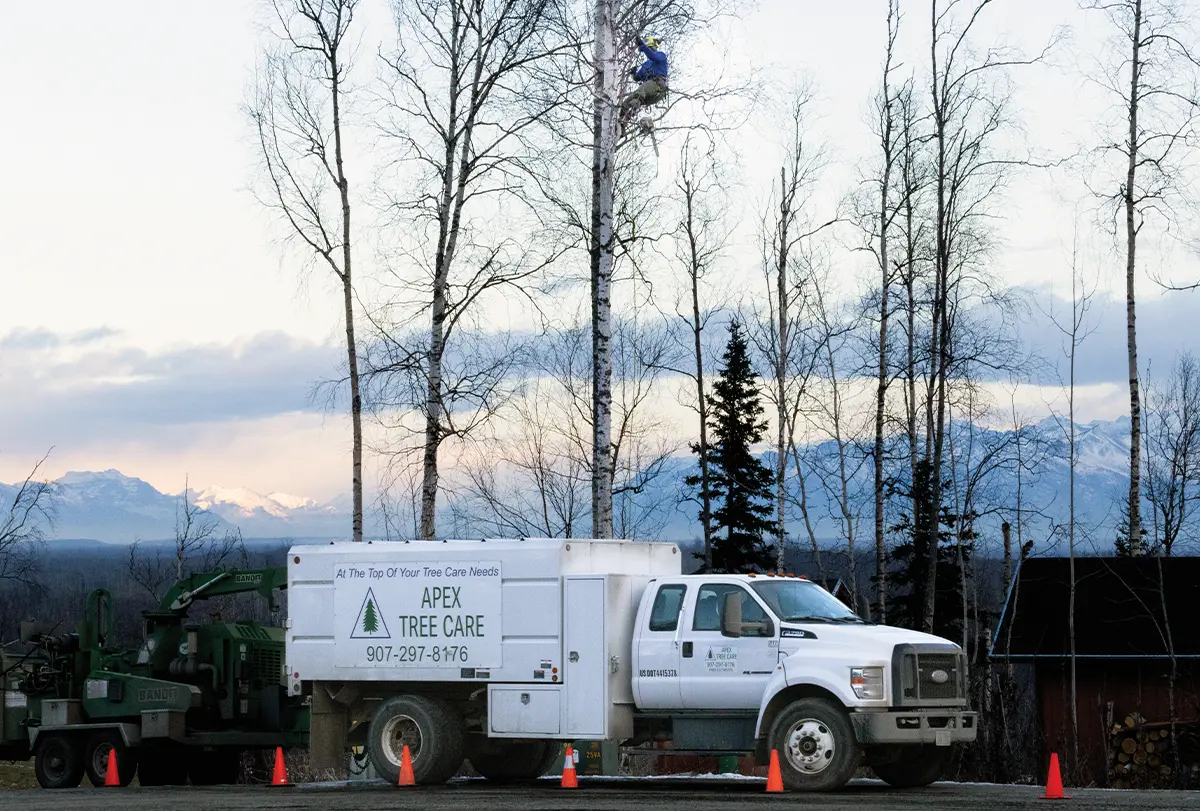
Employees using this equipment should have formal training on each unit, understand the capabilities and limitations, and be familiar with the operations manual (which should be located on the equipment).
Ben Pulcino, owner of Apex Tree Care, has a staff with more than fifty years of combined tree care experience. He states, “We have strived to keep new equipment, and that it is serviced daily before use. This is not just to prevent breakdown but to ensure all safety components are functioning properly. From our woodchipper to chainsaws, ropes, climbing gear, and vehicles, all are maintained—and discontinued when safety may be an issue.”
This professional, proactive approach illustrates a company’s commitment to safety for the workers, limits exposure and liability on the jobsite, and reduces operational costs.
Arborists face high risks from falls, machinery, and falling debris, making it a dangerous job, but safety is significantly improved through strict protocols like working in teams, advanced training in tree physics, using modern rigging and personal protective equipment, and staying updated on best practices. All of these measures ensure that risks are managed through knowledge and technology rather than just accepting the inherent danger.