

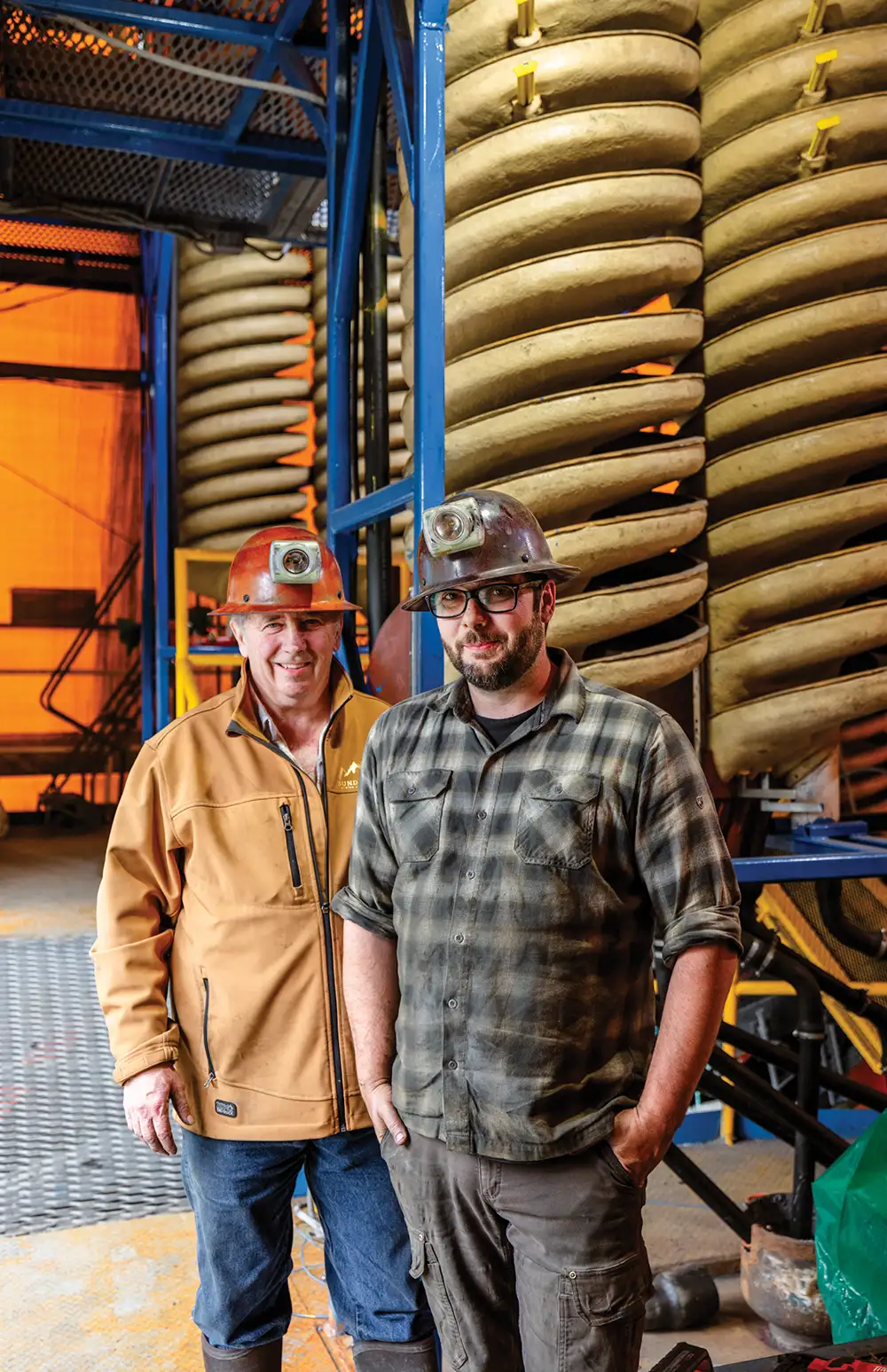
obert Fithian, co-founder and manager of Sundance Mining Group, eagerly highlights certain details of Dawson Mine, an underground gold and silver producer that’s been operating quietly for eight years near Hollis on Prince of Wales Island. It’s the only mine permitted for year-round mining and milling since Kensington mine began production in 2010, he points out. Its mill uses no chemicals, relying instead on a gravity-only recovery circuit. It’s financially solvent, has no lost-time accidents, and is Prince of Wales Island’s leading private employer.
Fithian doesn’t immediately focus on how much gold and quartz Dawson Mine has yielded or the ins and outs of daily operation. He’s proudest, it seems, of how the mine has gained and maintained the support of the local community.
“If you want to do business in rural Alaska, you need to have respect for the people, their way of life, and the natural resources you’re going to impact,” he says.
Fast forward about eighty years to 2014, when Fithian joined Sundance Mining Group and began shopping for properties to mine. He considered more than thirty options across Alaska. He settled on the Dawson property, not only because of a report that indicated a potential resource of 44,000 ounces of gold but because of the advantages of the mine’s location. For starters, Prince of Wales Island had a history of resource extraction. Unique in the Panhandle archipelago, the fourth-largest island in the United States is crisscrossed by nearly 300 miles of roads, so Dawson Mine can be accessed by a paved highway. The site further benefits from temperatures and conditions that allow for year-round work.
He adds that the permitting process for Dawson Mine was notably easier because the primary property is on State of Alaska lands managed by the Alaska Department of Natural Resources (DNR), not the federal government, despite the Tongass National Forest covering most of the island. Federal permitting likely would have taken up to three years, Fithian estimates, but reviving Dawson Mine was permitted in a little over a year.
He attributes at least some of the speed to DNR’s desire to create economic opportunities while maintaining its lands. “We have a state DNR that wants to see economic development done, and they care, and they want to make sure that we’re doing it safely and correctly and environmentally soundly,” Fithian says.
In “engineered” mines, once miners find a quartz vein containing gold, they can follow those veins to access large, consistent zones to mine; as they extract the ore, the miners can fill the space left with other rocks and move on.
Dawson Mine, though, is a “geologic” mine; Fithian describes its vein system as “nuggety.” Hot fluid once traveled through cracks and fissures, depositing minerals throughout the rock, making Dawson Mine’s gold deposits less predictable.

Caitlin Blaisdel
Miners make holes in rock faces with 135-pound handheld pneumatic rock drills called jacklegs. Explosives placed in the holes blast the rock to provide access to the mine’s vein system. It’s “old school” mining, and it’s labor intensive.
It’s also a deliberate process that results in less waste.
“Maybe the larger mines are going to take a larger amount of tonnage daily. They can use much larger modern equipment to do that. And they typically end up taking more waste rock than they want to get the tonnage up,” Fithian says. “We are very selective, so we’re just mining the vein system without the waste.”
Finding the veins that carry the grade of gold that will make Dawson Mine successful is a tricky endeavor because of its geologic nature. Not every vein will carry the value in silver and gold that Dawson Mine needs to be a viable project.
“It’s a chunk of gold here, a chunk there,” describes Dawson Mine’s senior geologist Kris Alvarez. She says mining Dawson Mine can feel more like gambling.
Technology helps the gamble pay off. Alvarez uses Maptek Vulcan software, common throughout the industry, to create a three-dimensional computer image of the mine and its veins. The image helps her visualize where the gold is, how it’s trending, and how deep those trends go into the mountain. Based on those images, she can make recommendations to Fithian about where and how to mine the gold most efficiently.
Mapping the mine’s gold zones also gives Fithian a glimpse into the future. Over time, he says, better understanding how the veins are trending will help the Dawson Mine geologists map out the mine’s potential.
“It’s pretty exciting because we just signed a lease that[…] connected our vein system with historic drilling that was done in 2007. We have been able to explore those old mines we’re headed toward, and we’re absolutely certain that the vein system that we’re mining on is the same vein system those old mines were developed on,” Fithian describes. “It enlarged our mine life by literally forty to fifty years.”
Caitlin Blaisdel

The Dawson Mine provides jobs for more than fifty year-round employees, most of whom live on Prince of Wales Island. While Fithian knows he could increase the tonnage taken each day by hiring more employees and speeding up production, that’s not his focus. He values the “generational potential” of Dawson Mine over its ability to produce more and faster.
“I don’t like the ‘get it all quick and get out of here’ mentality because you end up with one or two generations that had jobs and economy from [the mine],” he reflects. “We could [provide jobs for] four or five more generations. And I think that’s more important than getting rich quick and getting out of here.”
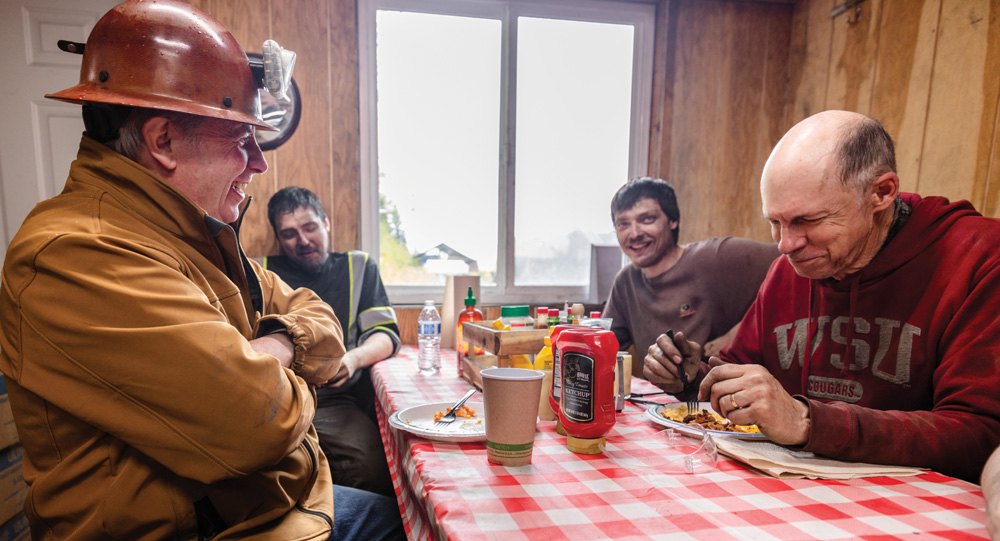
The advantage of being a small operation, he adds, is that he can maintain a high caliber of employee. He believes that the people who work at the mine do so because it lacks the more corporate structure of larger mines where the culture is “produce, produce, produce.”
“The type of work we do demands a pretty strong mentally and physically capable human being,” he explains. “If [the operation] was three or four times bigger, it would change, where the employees would start to be more ink on paper instead of the special people we view them as.”
Caitlin Blaisdel
A century ago, gold would have been separated from ore using flotation extraction. That process works by finely grinding ore, mixing it with water, and then injecting chemicals—in this case, xanthate and pine oil—which gets agitated when air bubbles are pumped in. The chemicals cause water to repel the gold and quartz, which rise and create foam. Finally, the foam is collected, while the waste—or tailings—sink to the bottom of the mixture and are disposed of.

Caitlin Blaisdel
Caitlin Blaisdel
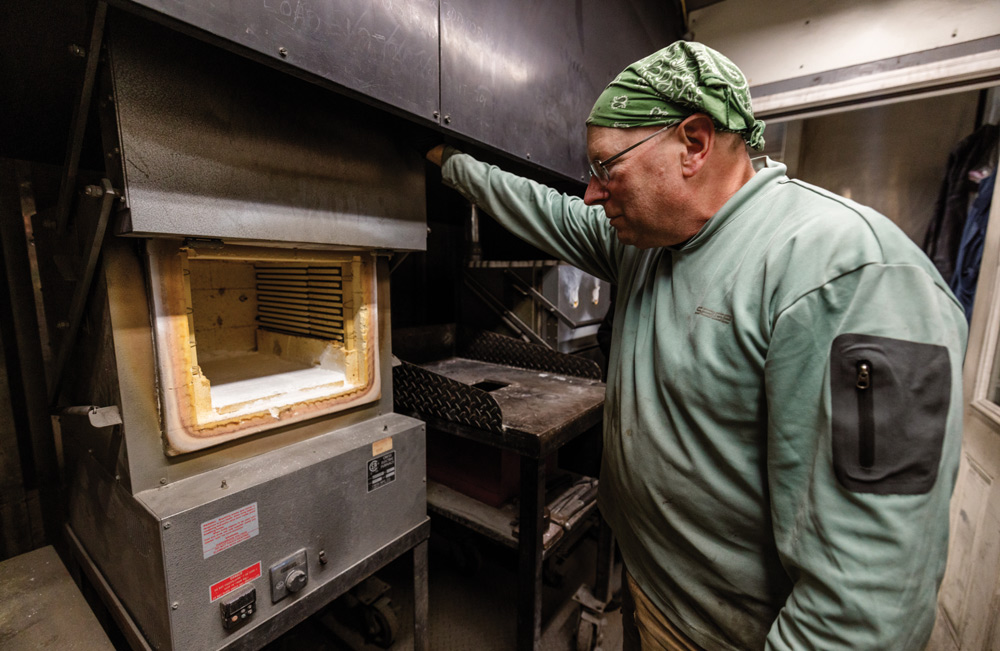
Fithian has worked to enhance this gravity technique so that Dawson Mine’s mill achieves about 86 percent recovery of gold. He acknowledges that flotation extraction would raise that recovery to 90-plus percent. But the cost, for him, is too high.
“There was no way that I could have ever permitted the mine—or would have even tried—using a chemical that can be poisonous,” Fithian says, “right here in the heart of a community, with some pretty special aquatic resource lands.” Therefore, Dawson Mine has no tailings with toxic chemicals added.
Caitlin Blaisdel
Caitlin Blaisdel
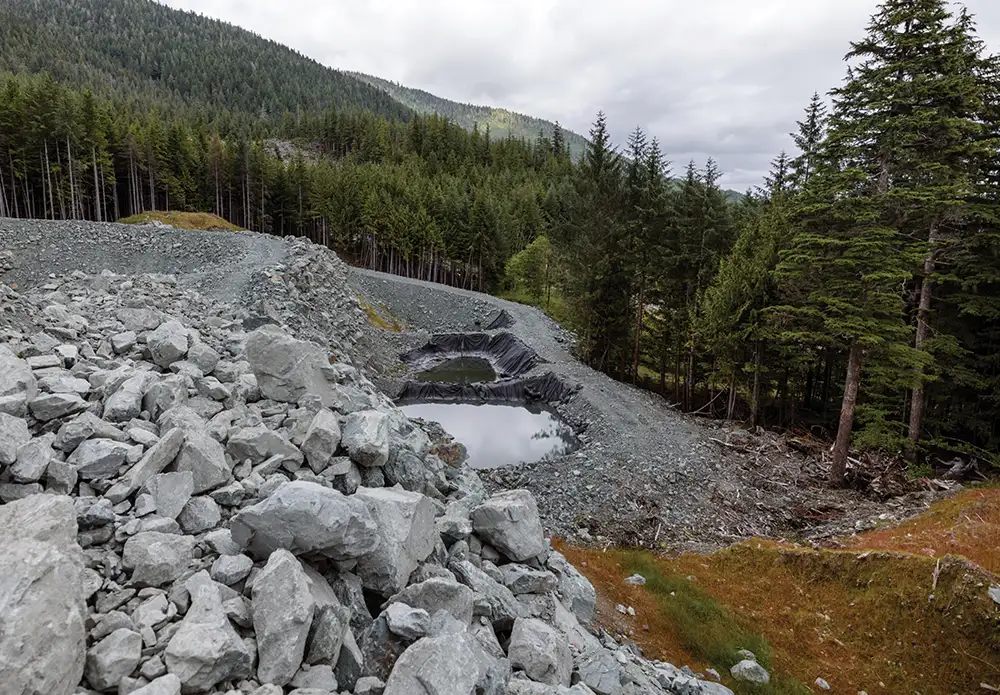
Thanks to the gravity extraction process, Dawson Mine’s tailings ponds don’t have to be lined to keep waste from seeping into the groundwater. In the early years of the mine’s revival, Fithian did monthly testing to prove the absence of waste harmful to the environment; today, the mine is only required to do quarterly testing, thanks to the care taken with its tailings and to the gravity-only extraction process.
This low-impact approach is also a cost-saver: Dawson Mine doesn’t have to maintain a full-time water treatment plant.
More importantly, it also demonstrates what Fithian calls “social license”: respect for the land, its people, and their way of life. His philosophy plays out not just in the measures he’s taken to preserve the river near the mine but in other projects and efforts to maintain or improve the land.
The tailings site is just entering its third phase. As Dawson Mine begins the tailings site reclamation process, Fithian has plans to cover and level out phase one and build a baseball diamond over it for the people of Hollis.

Caitlin Blaisdel
“We just shut the mine down and went and cleaned up the estuary, used our big, heavy equipment and hauled the stuff to a scrap pile,” Fithian says. “Every year, we try to do something. Every couple years, we clean up a stream that the local people get their drinking water from.”
When Prince of Wales Island experiences ice storms each winter, Fithian’s son, Jared, who serves as the mine’s superintendent, heads up an effort to plow and sand Hollis roads, while the Alaska Department of Transportation and Public Facilities is busy with the rest of the island.
“We don’t even discuss it. I typically find out later, ‘Oh, by the way, Dad, I went and sanded all the subdivisions today,’” Fithian says.
It’s a small but impactful gesture that reflects the way he wants Dawson Mine to be perceived. “Those things just pay dividends,” he adds. “It’s showing that we’re a good neighbor in this community.”