


eadlines that ask yes-or-no questions can always be answered “no.” British tech journalist Ian Betteridge codified this law in 2009, but headlines have ended with question marks for as long as newspapers have existed. A compilation of Murphy’s Law variants published in 1991 called it “Davis’ Law” (for unclear reasons). Whether known by that name or as Betteridge’s Law, this wisdom is honored more often in the breach than in the observance.
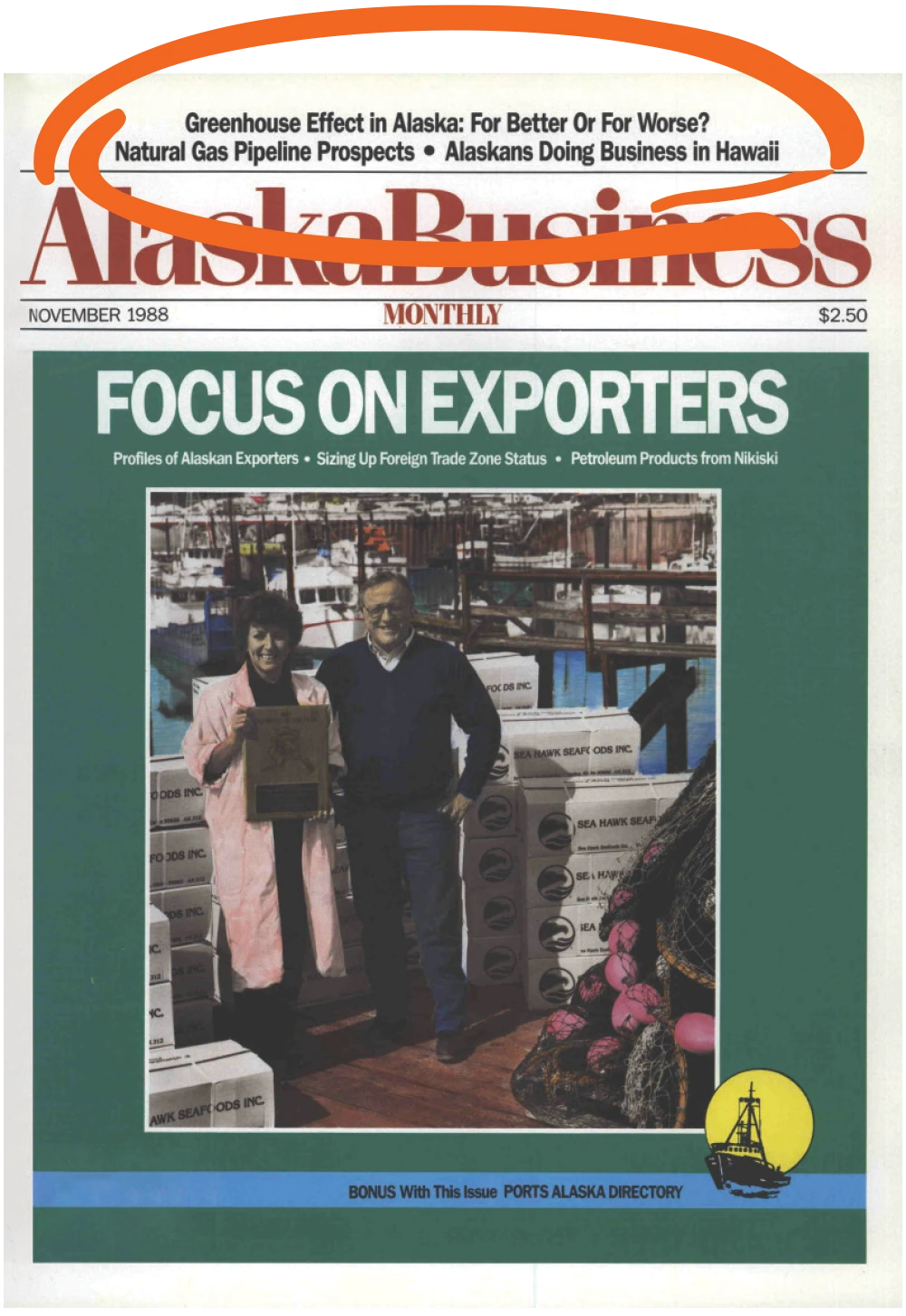
Or not often at all. This magazine employed question marks on its cover seven times in its first sixty issues, including the first one ever printed. Does “no” automatically apply?
Home construction doubled in 1983, with 920 units built in Juneau. However, a cold storage facility closed, diminishing the local seafood industry. Then-Mayor Fran Ulmer suggested developing docks for seafood processing.
The local population, meanwhile, is shrinking. The 2020 census counted 32,255 Juneauites, and from that peak the capital city has shed about 3.1 percent of its population, or about 700 people—more than the city gained between the 2010 and 2020 censuses. Still, Juneau has more people now than the 20,000-odd in 1985.


Kleeschulte, previously a spokesman for Governor Jay Hammond and then an aide to US Senators Frank and Lisa Murkowski, now says, “I wouldn’t want to write a follow-up story on my adopted hometown’s economic outlook any time soon.”
By March 1985, “Even a decade hasn’t been long enough to untangle the dozens of conflicting threads” of all those variables, Kleeschulte wrote. He quoted his former boss Jay Hammond criticizing perverse incentives: “The system produced unnecessary pressure on the fish, just so people can hold on to valuable permits.” The average permit price of $50,442 is worth about $152,500 today, yet some permits have outpaced inflation.


A while later, effects are still mixed. “The Limited Entry Act had a number of goals, and some have proven out more than others,” says Glenn Haight, a member of the Alaska Commercial Fisheries Entry Commission who has worked in seafood industry development since the ‘90s.
Limited entry succeeded, he says, in defining the maximum amount of gear allowed in the water, and state fisheries have been maintained as an owner-operator industry. On the other hand, participation in traditional fisheries has steadily declined while year-round commercial fisheries employ a class of professional fishermen.
An idea floated in 1985 was a permit buyback. Haight says, “There is a prevailing belief among many permit holders that too many permits were originally issued. That has yet to be analyzed in a large-scale manner which could lead to a paring down on the number of permits.”
By 2008, for example, the Southeast salmon purse seine fishery retired 35 of 419 permits by a reverse auction financed with federal grants and loans. Permit holders also paid a special assessment for subsequent buybacks. However, a retrospective analysis found that, under certain assumptions, the cost of buybacks exceeded the net benefit.
While the question remains unanswered, Haight says, “It’s our job to continue work with Alaska’s fishing industry, our communities, and the legislature to see what can be done to help in areas that are falling short.”
In 1989, soon after the Exxon Valdez oil spill, the legislature revised the Economic Limit Factor, which had eliminated taxes on low-producing wells, and production has never repeated the 2-million-barrel-per-day peak from the previous year.
“Alaska’s oil and gas industry did survive the last forty years regardless of all the efforts to derail them, but not without pain,” says Rebecca Logan, CEO of the Alaska Support Industry Alliance. “Over the last four decades, there have been years when Alaska lost out on oil and gas revenue and the jobs associated with them, due to the political winds in Juneau and [Washington,] DC.”
Laird defined “survival” as continued aggressive exploration and development by 1996 and not retreating to legacy production. Even without hoped-for game-changers like lifting the oil export ban (not until 2015), opening the Arctic National Wildlife Refuge (not until 2017), and marketing North Slope natural gas (still pending), Exxon discovered the Point McIntyre satellite of Prudhoe Bay in 1988 and began production in 1993; Conoco discovered Badami in 1990; and ARCO Alaska discovered the Alpine field in 1994.
However, rather than contrast “survival” versus retreat, Logan contrasts bare-minimum survival against robust thriving. She says, “Alaska’s resource development activity will continue to thrive when the business climate is favorable and survive when it is not.”
By the way, the 1986 article doesn’t mention environmental extremism, except possibly the example of a 121-page book of federal regulations for disposing of crankcase oil.
A working group for reshaping the Alaska Marine Highway System (AMHS) issued findings in 2021. The group stated, “Operations are hindered by frequent turnover in politically appointed positions, short-term planning horizons, cumbersome procurement processes, indirect labor negotiations, and political influence over operational decisions.” Thus, Southeast Conference and the AMHS Reform Committee recommended transitioning AMHS to a state-owned corporation, not unlike the Alaska Railroad.


His privatization idea seemed unlikely at the time; AMHS officials told legislators that private operators would likely keep the system’s only profitable route, the mainline run from Seattle to Skagway, and jettison the other routes. Marrou suggested that off-season fishing boats could pick up the slack.
A 2020 report commissioned by Governor Mike Dunleavy likewise concluded that privatization would be impractical. It echoed a 1986 observation by economic researcher Eric McDowell: “It’s difficult to view public services and conveyances like roads, airports, and the marine highway in the context of private enterprise.” Laird’s article counters with examples of privatized parks, prisons, and street sweeping, and Laird says the state might still subsidize service, but “the check may be smaller than it is today.” Not according to the long-term plan.
In his article, Kleeschulte noted Japanese ownership of Alyeska Resort (now owned by a Canadian company) and Alaska Pulp Co. in Sitka (now defunct) and Canadian investment in Red Dog Mine and, through Yukon-Pacific Corp., attempts to market North Slope natural gas. “Japanese, Korean, and Taiwanese firms may buy into the project as part of any agreement to buy the gas,” Kleeschulte predicted, anticipating occurrences in early 2025.
According to the Global Business Alliance, international investment in Alaska supports 15,200 jobs, or about 6.2 percent of the state’s current workforce. That’s down from more than 7 percent in 2017 but higher than the US average of 6 percent. Of the 117 international employers operating in Alaska, the biggest foreign investors are from Canada, Japan, and the United Kingdom, and manufacturing (read: seafood processing) is the largest sector.
In the ‘70s, the US Department of Justice was so concerned about Japanese ownership of seafood processors that it launched a special investigation. It found no significant problems, other than a dependence on foreign capital to modernize equipment and develop new products. However, a surge of Japanese investment in Alaska seafood processing had already declined by 1986, and Japan’s roaring economy in the late ’80s deflated by 1992.
Seafood conglomerate Maruha Nichiro Corporation exited Alaska in 2020, selling Peter Pan Seafood Company to American investors. Peter Pan has been going through tough times, but what remains is still under domestic ownership.
Canadian companies still have major stakes in Alaska, with Teck operating Red Dog Mine and Novagold pursuing the Donlin gold project. Western Australia-based Northern Star Resources acquired the Pogo gold mine in 2019, and other Aussie mineral companies are exploring Alaska. Australian investment arrived on the North Slope in 2021 when Santos acquired Pikka developer Oil Search, a company based in Papua New Guinea.
Lack of infrastructure and skilled labor were two factors limiting the fabrication of larger sealift modules. However, then-Veco President Pete Leathard said that Trans Alaska Pipeline System construction had left Alaska with a skilled workforce.
Nearly forty years later, Leathard still sees local laborers as the core of a module industry. “Alaska has a good solid base of good tradesmen, and the additional workforce will come,” he says. “Construction tradesmen travel across the country and to Alaska when long-duration work at reasonable pay is available. A company just needs to know how to source these people.”
Leathard acknowledges that Alaska’s capabilities are suited to smaller, truckable modules. However, he sees this as an advantage over sealift modules built at Gulf Coast shipyards. “It is an extra five-week journey by barge to the North Slope versus Anchorage. Five weeks can mean a lot when it comes to minimizing costly extra work and meeting the startup schedule,” he says.
One-off jobs are great, but Leathard still sees potential for sustained module making. He says, “I have been involved with many major projects in many countries throughout the world. I have been involved with major projects on the West Coast and the Gulf Coast and Canada. Alaska is equal and better than most in quality and productivity.”
Broad predictions about permafrost melting, coastal flooding, and major displacements of fish populations have come to pass, more or less, if not to the degree anticipated: “Southeast’s average temperature is likely to rise by 11°F by 2030—when the equivalent of carbon dioxide in the atmosphere doubles,” for instance, is on track to miss the mark.
Last year, the Alaska Center for Climate Assessment and Policy at UAF published Alaska’s Changing Environment 2.0, updating the inaugural 2019 report. It states that average temperatures increased in Alaska by more than 3°F in less than fifty years; prior to the ‘70s, annual averages had changed very little. Six of the top ten warmest years in Alaska have been recorded since 2010.
Atmospheric carbon dioxide, measured at Mauna Loa Observatory, was about 350 parts per million in 1989, and now it stands at 428. An adjusted forecast by the Intergovernmental Panel on Climate Change anticipates the doubling to 700 by 2075.
The 1985 article predicted longer growing seasons in Alaska, extending by ten days for each 1.8°F rise. In fact, Alaska’s Changing Environment 2.0 notes a nearly thirty-day extension, two weeks earlier in the spring and two weeks later in the fall, compared to a century ago.
“I wish in 1988 I had had the foresight to write more about permafrost melt and its economic impacts on Alaska’s infrastructure and the expense of village relocation,” says Kleeschulte, who now maintains a ten-acre farm in Virginia near the Blue Ridge Parkway. “That 1988 article on greenhouse gases did impact my thinking on the need for renewable energy and how it could play a big role in Alaska’s future economy.”
Since retiring in 2018, Kleeschulte says he spends his time volunteering at a local food pantry while not “inflicting my political views on anyone.”
In Betteridge’s formulation, question headlines indicate that an article lacks firm factual support. That is, if a publisher could confidently answer “yes,” then the headline would be a declarative sentence.
For example, “Alaska’s Oil Industry Can Survive Government Greed and Environmental Extremism.”
Or this one: “Foreign Investment: A Safe Long-Term Prescription.”
If the answer is “no,” then declarative headlines signal boring or depressing stories: “Juneau Will Not Bust.” “Not Time to Get Politics Out of Alaska’s Ferry System.” “Alaska Can’t Measure Up in Module Manufacturing.”
These three headlines abide by Betteridge’s Law, but two of these seven flout it, and two have no definitive answers: “Limited Entry Is Working (with Mixed Results).” “Greenhouse Effect: Bad for Alaska (But Not as Bad as Predicted).”
Therefore, this article’s own headline refutes itself. Questions in headlines are not always answered “no.” Which could’ve been the headline all along.